
Was Jesus in the Grave Three Days and Three Nights? Here’s How It Adds Up

In Matthew 12:38-41, we read about how some of the scribes and Pharisees asked Jesus for a sign that he really was who he said he was: the Messiah. Jesus responded that only one sign would be given to them: the “sign of the prophet Jonah.”

For just as Jonah was three days and three nights in the belly of the great fish, so will the Son of Man be three days and three nights in the heart of the Earth.

Here’s the problem: If Jesus died on Good Friday and rose on Easter Sunday, that doesn’t add up to 3 days and 3 nights. At most it adds up to 2.5 days and 2 nights.

So… does that mean that Jesus didn’t stay in the grave long enough to fulfill his own prophecy?

Nope. Jesus really was in the grave three days and three nights, which is why the early Christians also taught that he was raised on the third day (Acts 10:40, 1 Corinthians 15:4). Let me explain how it adds up, but be prepared: it’s going to change the way you think about “Good Friday.”

Some Basics to Start With

  1. The Jewish calendar is lunar (based on the cycles of the moon), whereas the Roman calendar (which we use) is solar (based on the rotation of the Earth around the Sun). As a result, they don’t always correspond, hence the reason why the date of Easter changes every year. Today in Western Christianity, Easter is celebrated on the Sunday following the Paschal Full Moon. For more on why the date of Easter changes each year, click here.
  2. We tend to think of the new day beginning when we wake up, but in the Jewish mindset, the new day begins at sunset. So, when the sun sets on Monday, it is not considered Monday evening, it is considered the beginning of Tuesday.
  3. We know that Jesus resurrected on a Sunday, “the first day of the week” (Matthew 28:1; Mark 16:2,9; Luke 24:1)

What is a “Sabbath”?

The word sabbath means “rest,” and it refers to a holy day when no work is to be done.

Every Saturday is a sabbath, but there are other sabbaths as well – also known as “special Sabbaths.” Some of these “special Sabbaths” are celebrated on a specific calendar date, no matter what day of the week that date falls on – kind of like how we in the USA celebrate Independence Day on the 4th of July, and we observe that holiday no matter what day of the week it falls on.

In John 19:31, we read this about the day when Jesus was crucified:

Now it was the day of Preparation, and the next day was to be a special Sabbath. Because the Jewish leaders did not want the bodies left on the crosses during the Sabbath, they asked Pilate to have the legs broken and the bodies taken down.

The special Sabbath referred to here was the Feast of Unleavened Bread, a holiday which is always observed on the 15th day of Nisan according to the Jewish calendar.

According to Leviticus 24:4-14, there are three special holidays in the month of Nisan: Passover (the 14th of Nisan), the Feast of Unleavened Bread (15-22 of Nisan) and the Feast of First Fruits which was held on the Sunday following the Passover.

Let’s Sum This Up

Jesus actually died on a Thursday. Friday and Saturday were both sabbaths: Friday was the first day of the Feast of Unleavened Bread, and Saturday was the weekly sabbath.
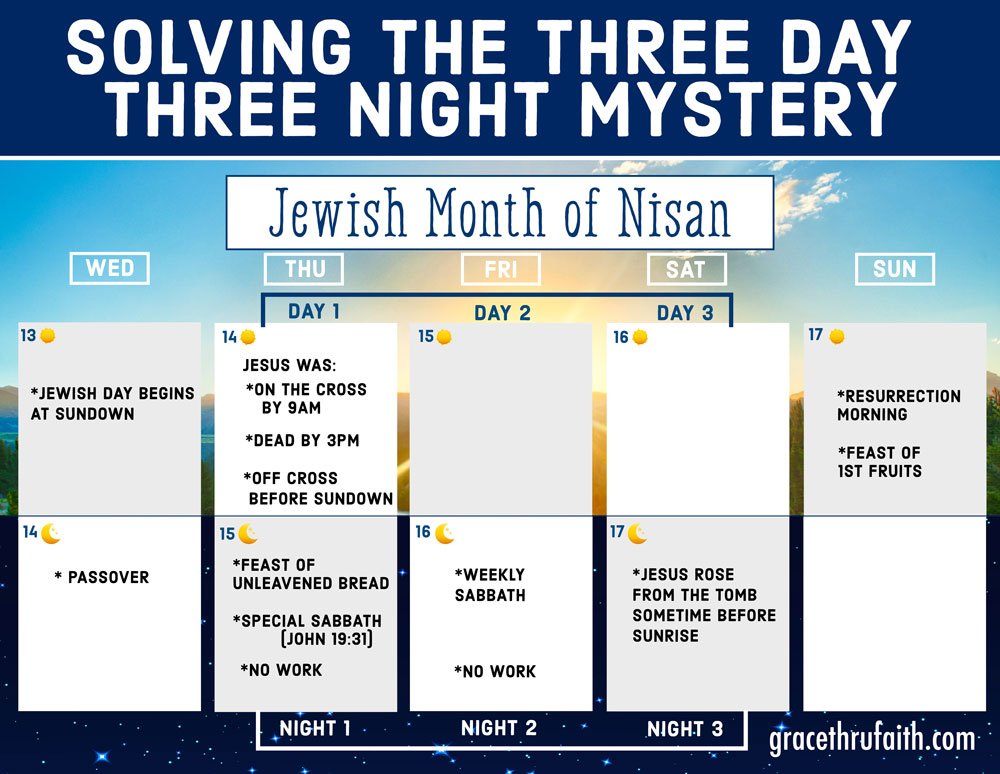
Jewish Month of Nisan

How can we be sure that this is what happened?

Several decades ago, the London Royal Observatory took on the challenge that since they could theoretically identify the position of the planets and start on any date in history, to figure out if around the time of Jesus there was such a time when Passover fell on a Thursday. Since the Jewish calendar is lunar, there is always a full moon on Passover, so this is pretty easy to figure out. Not surprisingly, there were several years around the time of Jesus when this took place. It’s really not that uncommon – just like how Christmas falls on a Tuesday every few years.

Even More Interesting…”Coincidences”?

According to Exodus 12:1-13, God told the Israelites that they were to select the Passover Lamb on the 10th day of Nisan. They were to examine it from the 11th to the 13th to make sure it was without blemish, and they were to sacrifice it on the 14th.

If the 14th was Thursday – and Jesus was crucified on “the day of Preparation” (Matthew 27:62, Mark 15:42, Luke 23:54, John 19:31) which was the day when Passover began and the celebration began with the eating of the Passover meal (Jesus and his disciples then would have eaten the last supper Passover meal on Wednesday evening). Then what this means is that when Jesus entered Jerusalem on Palm Sunday, that was on the 10th of Nisan – the day when the Passover lambs were to be selected!

Furthermore, remember that the Sunday after Passover was the Feast of First Fruits (Leviticus 23:9-11) – which means that Jesus resurrected on the Feast of First Fruits. This is what Paul the Apostle is making direct reference to in 1 Corinthians 15:20-23, where he says:

But in fact Christ has been raised from the dead, the firstfruits of those who have fallen asleep. For as by a man came death, by a man has come also the resurrection of the dead. For as in Adam all die, so also in Christ shall all be made alive. But each in his own order: Christ the firstfruits, then at his coming those who belong to Christ.

So there you have it:

Jesus was indeed in the grave for three days and three nights. It really wasn’t that much of an anomaly, but it resulted in two sabbaths back to back – something which regularly happens every few years.

So “Good Friday” was actually on Thursday, “Maundy Thursday” was actually on Wednesday, and “Holy Saturday” was actually two days long.

However, it is incredible to see how God orchestrated and prepared for this to happen as it did for thousands of years before it happened. In reality, the Bible tells us that God had planned this whole thing out from eternity past (see Revelation 13:8) – and all of it so that you may have life in His name by believing! (John 20:31)

Note: this post draws largely from the work of Jack Kelley, “Solving the Three Day Three Night Mystery” 
The Less Famous Days of Holy Week

holyweek

Good Friday and Easter Sunday get all the press, but there are other important days of Holy Week.

Maundy Thursday

What is a “maundy” anyway? It comes from the Middle English and Old French word Mandé, which comes from the Latin Mandatum – which means Mandate.

Maundy Thursday refers to the mandate that Jesus gave the night before his crucifixion, when he shared his last supper with his disciples. After Jesus had washed his disciples’ feet in an act of love and service, he then told them:

A new commandment (Latin: mandatum) I give to you, that you love one another: just as I have loved you, you also are to love one another. By this all people will know that you are my disciples, if you have love for one another. (John 13:34-35)

On Maundy Thursday we remember the events of the last supper, the institution of the sacrament of communion, the betrayal of Jesus by one of his closest friends, and the all night prayer vigil that Jesus had in the Garden of Gethsemane, where he sweat blood from the stress and anxiety he was experiencing as he looked forward to the physical and spiritual suffering that awaited him.

It was on this night that Jesus prayed three times: “My Father, if it be possible, let this cup pass from me; nevertheless, not as I will, but as you will.” (Matthew 26:39-44)

The fact that the Father did not remove this “cup” of suffering from Jesus reminds us that there was no other way for us to be saved, then for Jesus to go forward with taking our place in death and judgment so that we might be able to receive forgiveness and eternal life.

Holy Saturday

The day between Good Friday and Resurrection Sunday is known as Holy Saturday. For the disciples of Jesus this would have been a day a great darkness and uncertainty, when the effects of Jesus’ crucifixion were not yet understood by all, and even though it wasn’t the case – it seemed like all hope was lost. Little did they realize that Sunday was coming…

Max Lucado wrote an excellent post on “The Silence of Saturday” a few years ago:

Jesus is silent on Saturday.  The women have anointed his body and placed it in Joseph’s tomb.  The cadaver of Christ is as mute as the stone which guards it.  He spoke much on Friday. He will liberate the slaves of death on Sunday.  But on Saturday, Jesus is silent.

So is God.  He made himself heard on Friday.  He tore the curtains of the temple, opened the graves of the dead, rocked the earth, blocked the sun of the sky, and sacrificed the Son of Heaven.  Earth heard much of God on Friday.

Nothing on Saturday.  Jesus is silent.  God is silent.  Saturday is silent.

Easter weekend discussions tend to skip Saturday.  Friday and Sunday get the press.  The crucifixion and resurrection command our thoughts.  But don’t ignore Saturday.  You have them, too.

Silent Saturdays.  The day between the struggle and the solution; the question and the answer; the offered prayer and the answer thereof.

Saturday’s silence torments us.  Is God angry?  Did I disappoint him? God knows Jesus is in the tomb, why doesn’t He do something?  Or, in your case God knows your career is in the tank, your finances are in the pit, your marriage is in a mess. Why doesn’t He act?  What are you supposed to do until He does?

You do what Jesus did.  Lie still.  Stay silent.  Trust God.  Jesus died with this conviction: “You will not abandon me to the grave, nor will you let your Holy One see decay” (Acts 2:27 NIV).

Jesus knew God would not leave him alone in the grave.  You need to know, God will not leave you alone with your struggles.  His silence is not his absence, inactivity is never apathy.  Saturdays have their purpose. They let us feel the full force of God’s strength. Had God raised Jesus fifteen minutes after the death of His son, would we have appreciated the act? Were He to solve your problems the second they appear, would you appreciate His strength?

For His reasons, God inserts a Saturday between our Fridays and Sundays.  If today is one for you, be patient.  As one who endured the silent Saturday wrote:  “Be patient, brethren, until the coming of the Lord” (James 5:7 NKJV).

Christians Who Don’t Believe – Part 2

In case you missed Part 1 of this post, you can read it here.

There was a BBC article published this past Sunday about the beliefs of people in England regarding the resurrection of Jesus and life after death.

According to their survey:

  • 25% of people who call themselves Christians in Great Britain do not believe that Jesus resurrected from the dead.
  • Only 17% of the general public in Britain believe word-for-word the account of Jesus’ resurrection.
  • 10% of non-religious people in Britain believe that the Easter story contains some truth, but only 1% believe it is literally true.
  • 21% of non-religious people believe in life after death.
    • Of these, 65% said they believe that their soul would go to heaven or hell, and 32% believe they will be reincarnated.

And here’s the one I find most shocking:

  • 31% of British Christians surveyed said they do not believe in life after death.

While someone like me looks at this and sees an incredibly dire situation, the article says that Church of England officials were actually quite encouraged by it! Here’s why:

  1. Because it showed that “many British people, despite not being regular churchgoers, hold core Christian beliefs.”
  2. It showed more regular church attendance amongst younger Christians than older ones.

Maybe it’s me, but in light of the survey it seems like a bit of stretch to say “many” and to say “core Christian beliefs”. Is literally believing in the resurrection of Jesus from the dead not considered by them to be a “core Christian belief”?

What’s interesting about this is that the Bible directly addresses those who call themselves Christians and yet do not believe that Jesus actually rose from the dead.

In 1 Corinthians chapter 15, Paul speaks first to those who call themselves Christians and do not believe in life after death, and then he speaks to those who deny that Jesus literally rose from the dead. It’s almost like this chapter could have been written for 31% and 25% of British Christians respectively.

The first point Paul makes is that the literal resurrection of Jesus from the dead is and has always been a central tenant of the gospel: the core of Christian belief, and it is only by believing this gospel that we are saved. (1 Corinthians 15:1-4)

The second point Paul makes is that not only was the death of Jesus foretold by the Scriptures, but so was his resurrection. (1 Corinthians 15:3-4)

The third point Paul makes is that there were hundreds of eye witnesses still alive at that time who could attest to having seen Jesus alive after his crucifixion. (1 Corinthians 15:5-8)

Then Paul goes on to say (Vs 12-15) that if there is no life after death, then all of the apostles and Christians were liars, because they told people that Jesus had risen from the dead and that they had seen him.
If they had lied about this, they either did it knowingly or unknowingly. If they did it knowingly, then they are intentionally conning people and they should therefore not be trusted. If they lied unknowingly, that means that they are delusional and should not be followed, because they are, to put it crassly: deranged.

Next, Paul says that if there is no life after death, then Christian faith is pointless, and they have just been wasting their time and believing in a fairy tale (Vs 17-18) – and ultimately there is no hope, and no good news. And if this is the case, that Christianity is just another form of moralism and empty rituals, then Christians are the greatest fools in the world. (Vs 19, 30-34)

If in Christ we have hope in this life only, we are of all people most to be pitied. (1 Corinthians 15:19)

But… if Christ is truly and literally risen from the dead, then that means that God has broken a hole in the pitiless walls of this broken world, and made a way for us to be saved! And Jesus is the first fruits of those who will be resurrected from death to everlasting life.
And the day is coming when the perishable puts on the imperishable, and the mortal puts on immortality, then shall come to pass the saying that is written:

“Death is swallowed up in victory.”
“O death, where is your victory?
O death, where is your sting?” (1 Corinthians 15:54-55)

And because that day is coming, we can have the confidence in whatever circumstances we may face in this life to be steadfast, immovable, always abounding in the work of the Lord, knowing that in the Lord your labor is not in vain. (1 Corinthians 15:58)

The story of Jesus’ resurrection is an integral and indispensable part of the good news of the gospel: the core message of Christianity. The hope that we have as Christians is based on it. To deny it is to deny Christian belief and to try to change Christianity into a form of moralism full of empty rituals which encourages condescension towards God and towards other people of faith, but which leaves you as a person worthy to be most pitied because you are without hope in anything greater than yourself.

If however, you believe in God, then let me ask you the question Paul the Apostle asked the crowd at his own trial: Why is it thought incredible by any of you that God raises the dead? (Acts 26:8)

It would be incredible if you or I raised someone from the dead, but if God is God — the creator and sustainer of life — then such a thing is neither impossible nor even difficult for him.

May you be filled with true belief this Easter season, so that you may believe, and in believing have life! (John 20:31)

Christians Who Don’t Believe – Part 1

20120507-incredulity_of_saint_thomas_by_caravaggio

What does it mean to be a Christian? Most people would say that it means that you are a follower of Jesus or that you believe a certain set of doctrines.

The BBC published an article this past Sunday about the beliefs of people in England regarding the resurrection of Jesus and life after death. The report corresponded with some comments I made this past Sunday about how there is a correlation between rising standards of living and a decrease in religious adherence in many societies of the world, and what some of the reasons for this are. You can listen to the audio of that message here.

Here are some of the statistics listed in the article:

  • 25% of people who call themselves Christians in Great Britain do not believe that Jesus resurrected from the dead.
  • Only 17% of the general public in Britain believe word-for-word the account of Jesus’ resurrection.
  • 10% of non-religious people in Britain believe that the Easter story is true.
  • 21% of non-religious people believe in life after death.
    • Of these, 65% said they believe that their soul would go to heaven or hell, and 32% believe they will be reincarnated.

And here’s the one that I find most shocking:

  • 31% of British Christians surveyed said they do not believe in life after death.

This brings up a very important question: What do you actually have to believe in order to be a Christian?

Or to put it another way: Are there any things which, if you don’t believe them, you can no longer legitimately call yourself a Christian?

When I was 16 years old, one of my Christian friends from school told me I wasn’t a Christian. I was offended – because, you see: I grew up going to Lutheran school. I was catechized and confirmed in the Lutheran church, and I sincerely believed in God’s existence. In fact, I believed that Jesus was God the Son and the Son of God and that he literally died and rose from the dead just as the Bible describes.

So how dare she say that I was not a Christian, right?

But she was right. I wasn’t a Christian.
And I knew it.

Here’s the text she turned me to if you’re interested: Matthew 7:21-23

But here’s why, in spite of believing the biblical doctrines were true, I was not a Christian: because that is not the kind of belief by which a person is saved and becomes a child of God.

But to all who received him, who believed in his name, he gave the right to become children of God, (John 1:12)

Because here’s the thing: the Bible says that the devil also believes all of those things about God: in God’s existence, in the fact that Jesus was God and that he lives, died and resurrected on the third day. (James 2:19)

The word “to believe” in Greek is the word πιστεύω (pisteuo).
It doesn’t mean less than believing in something’s existence or acknowledging that something happened, but it does mean more than that. It means: to trust in, to cling to, to rely on, to adhere to, to commit to.

This is the kind of belief that the Bible is talking about when it says:

  • But to all who received him, who believed in his name, he gave the right to become children of God, (John 1:12)
  • these are written so that you may believe that Jesus is the Christ, the Son of God, and that by believing you may have life in his name. (John 20:31)
  • Jesus answered them, “This is the work of God, that you believe in him whom he has sent.” (John 6:29)
  • For God so loved the world, that he gave his only Son, that whoever believes in him should not perish but have eternal life. (John 3:16)

I have a few more thoughts to share about this, but I’ll save them for tomorrow.
Stay tuned for Part 2.

This Life and the One to Come

I’ve been preaching a lot on the topic of hope recently. It is a theme which I consider amongst the most beautiful in the world.

This past Sunday was Easter, and I taught a message titled: ‘A Living Hope’ (listen to it here).

In the sermon I spoke about Viktor Frankl and his book Man’s Search for Meaning, in which he says that life only has meaning if you have a hope which suffering and death cannot take away from you.

Interestingly – and perhaps tragically, however, it is not clear to me that Frankl ever discovered a hope worthy of that description.

This is the living hope which we have in Jesus, which Peter talked about in 1 Peter 1:3-9, speaking to people who were in fact suffering. It is a hope which is imperishable, unfading and kept in heaven for us – that’s how secure it is.

It is only that kind of hope which can enable us to live now and face any difficult which life might throw at us.

I recently came across a quote from CS Lewis: at the end of The Last Battle, the final book in the Chronicles of Narnia series, he says that for those of us who have received the gift of eternal life, when we get to the end of our lives here on Earth, we will realize that they were merely the title and the cover page, and then at last we will begin Chapter One of the Great Story which no one on Earth has ever read: which goes on forever, in which every chapter is better than the one before.

I don’t know about you, but that gives me goosebumps. I long for that day, and I desire to live with that perspective.

“And as He spoke, He no longer looked to them like a lion; but the things that began to happen after that were so great and beautiful that I cannot write them. And for us this the end of all the stories, and we can most truly say that they all lived happily ever after. But for them it was only the beginning of the real story. All their life in this world and all their adventures in Narnia had only been the cover and the title page: now at last they were beginning Chapter One of the Great Story which no one on earth has read: which goes on for ever: in which every chapter is better than the one before.”

CS Lewis, The Last Battle


Easter Egg Hunt Recap

In some places the saying goes: “April showers bring May flowers.”

I’m pretty sure in Colorado the saying should be: “February sunshine brings March blizzards.”

March is the snowiest month of the year in Colorado, and this past Wednesday we had a big storm.

Reports varied between 17 inches and 25 inches of snow accumulation. The roadsides looked like car graveyards and large parts of the Front Range were without power for extended periods.

One of the issues for us was that every year our church hosts a big Easter event in Roosevelt Park in downtown Longmont, adjacent to the building we meet in, the St Vrain Memorial Building.

This year, with that much snow on the ground and more snow in the forecast for Friday (last) night, we knew we wouldn’t be able to have the event in the park.

Thankfully we were able to move the event indoors to the Memorial Building.

It’s a big building, and I’ve always said you could easily fit 1000 people in there. Well, today we put that to the test…

Whereas in past years we’ve had up to 1200 people at this event in the park, we figured that with the snow and the move indoors we would see maybe 500 people attend. We were wrong. We know from raffle tickets that we had over 1000 people in attendance.

12916284_976369809077834_4917685554026729778_o
Photo cred.: Devan Siefford


The event went well, especially considering the limitations on space. We had a great team of volunteers to serve our community and hopefully next year we can be back outside. Each year is a learning experience, and we look forward to an event better event next year.

One of the highlights of the event each year is the puppet show, which is one of several ways in which we share the true message and meaning of Easter with those who attend.

WhiteFieldsEasterEggSnaps-20
Families enjoying the puppet show. Photo cred.: Charles Jones

Tomorrow is Easter Service at White Fields! He is risen indeed!

Blessed be the God and Father of our Lord Jesus Christ! According to his great mercy, he has caused us to be born again to a living hope through the resurrection of Jesus Christ from the dead, to an inheritance that is imperishable, undefiled, and unfading, kept in heaven for you. (1 Peter 1:3-4)


Approaching Easter

Yesterday we had a blizzard hit the Front Range. Some places got as much as 25″ of wet, heavy snow. I was in Boulder yesterday and there were broken tree limbs littering Broadway.

I don’t mind this snow actually, I am only praying about what it means for our big Easter Outreach this Saturday in Roosevelt Park…

As we approach Easter, here are 2 things I wanted to share: a quote and a link to an article.

Our Lord has written the promise of resurrection not in books alone, but in every leaf of springtime.
– Martin Luther

Steve Brown on 6 Proofs of Christ’s Resurrection


The History of Lent & the Lost Celebration

ash-wednesday-cropped

I grew up going to a Lutheran school until 8th grade, and one of the highlights of the year was Ash Wednesday, the first day of the season of Lent:  the 40 days leading up to Easter, which is a time of fasting and self-denial in preparation for Easter. On Ash Wednesday we would have chapel service and would get to walk to the front of the church and have ash put on our foreheads in the shape of a cross. Today as I was out around town, I noticed people with these ash crosses on their heads.

Lent is a tradition which predates all Christian denominations, but today is practiced mainly by Roman Catholic, Anglican/Episcopalian, and Orthodox Christians. However, Lent is more and more popular among evangelical Protestants, some of whom long for connection to the rich history of Christian tradition. I ran across a plethora of articles today from sources like Relevant and Christianity Today recommending that evangelicals would benefit from the practice of Lent. I tend to be inclined this way myself: to appreciate and want to be connected to Christianity’s rich traditions and to embrace the meaningful symbolism.

However, I have changed my thinking in recent years about Lent in particular. In seminary I took a course about the history and development of Christian worship. Here’s what I discovered about the development of Lent:

In the earliest days of Christianity, the time recorded in the Book of Acts, it is clear that new converts to Christianity first came to faith and then were baptized. As time went on, Christians began to feel that it was important that not only faith precede baptism, but instruction also. So they began to require believers to go through a period of instruction in Christian doctrines (catechism) before they could be baptized.

Several early Christian writings indicate that new believers would be baptized on Easter, which from the earliest days of Christianity was the chief Christian celebration. One of these writings that mentions baptisms of new believers being practiced only on Easter is from Tertullian, who argues that baptism need not only be practiced on Easter.

The number 40 held special significance for the early Christians because of the significance of the number 40 in the Hebrew scriptures, and so the 40 days leading up to Easter were the days of preparation, instruction and consecration for those who were getting ready to be baptized on Easter.

Easter itself, for the first 400 years of the church, was a feast that did not last only one day, but which began on Easter Sunday and lasted for 40 days. During that 40 days, people were forbidden from fasting, as well as from kneeling when they prayed, as kneeling is a posture of contrition, and these 40 days were set aside for the express purpose of celebrating the new life, the forgiveness and the redemption that we have because Jesus rose from the grave. It was a 40 day season of joy.

But here’s what changed: in the 4th Century, paedobaptism (child or infant baptism) became the norm. Paedobaptism was already a practice of some churches before that; Tertullian, in his On Baptism (circa 200), mentions that some churches practiced it and others did not, but that it was becoming increasingly popular in his time.

The reasons for the rise of paedobaptism were:

  1. Questions about how those who were born into and raised in Christianity should be initiated into the faith, and how this relates to the Old Testament model of a people in covenant with God.
  2. The emergence of Christendom as Christianity had become the official and dominant religion of the Roman Empire, so to be a citizen of the Empire was equated with being “Christian” and it was presumed that everyone who was a citizen of the empire was a Christian.  This view prevailed throughout the medieval period in Europe and was perpetuated by the magisterial Reformers.
    (I have written more on the subject of Christendom here)
  3. The formulation of the doctrine of ‘original sin’ by Augustine of Hippo, which gave many people a rationale for baptizing infants. The reasoning was that since the Nicene Creed declares that there is ‘one baptism for the forgiveness of sins’, that infant baptism remitted original sin (something Augustine did not teach, but which led to parents wanting to have their babies baptized as soon after birth as possible). Thomas Aquinas also taught that baptism removed the guilt of original sin; however, this teaching was rejected by Luther and other Reformers and is not held by all modern adherents of paedobaptism.

But here’s the issue that paedobaptism brought up in the church: If you baptize babies, then you can’t instruct them before you baptize them, because they’re infants… So what do you do with the 40 day period of consecration and preparation leading up to Easter? Hmm…
Here’s what they did: they decided to make this a time of all believers consecrating themselves to God in preparation for Easter, and catechism was moved to adolescence and paired with a confirmation of one’s faith/baptism.

So, here’s what you had at that point:  40 days of consecration to God before Easter – EASTER – 40 days of celebration of salvation and new life after Easter.

But then, guess what happened with time: We kept one 40 day observance and dropped the other. And which one did we choose? Not the celebration, but the consecration… and over time that consecration became more and more dour and focused on self-denial, penance and contrition.

James White writes:

It is perplexing why Christians have forsaken the season of rejoicing in exchange for the season of penance.

Particularly during the medieval period (and vestiges of this remain in our day in some places and to some degree) some Christians became more obsessed with the process of Jesus’ death – his “passion” – than with the purpose of his death.

Taking this into consideration, I am less inclined to celebrate Lent. I believe that I should consecrate myself to God every day. Romans 12:1 says – I appeal to you therefore, brothers, by the mercies of God, to present your bodies as a living sacrifice, holy and acceptable to God, which is your spiritual worship. 

However, I do believe that the discipline of self-denial is healthy and very much needed for some people, and that setting apart a dedicated time of consecration is both biblical and good.

In the end it gets down to WHY you are practicing Lent. If it is a spiritual discipline through which you draw nearer to God by purposefully setting aside something in order to consecrate yourself in an amplified way for a particular time – then I think that is wonderful and would recommend that you do it.

No matter what – whether you practice it or not – please remember the history, and along with your 40 days of consecration, I encourage you to practice 40 days of dedicated rejoicing in the salvation and new life that Jesus made available to you.

Celebrating what He did for you should take precedence over focusing on what you do for Him.


Making the News

The past 2 Sundays White Fields Church and yours truly have been mentioned in the local newspapers in Boulder and Longmont.

Last Sunday I was honored to be featured in the Times-Call's annual 100 People of the St. Vrain Valley, in which I got to share about mission work in Hungary as well as what I enjoy about being a local pastor here in Longmont. You can find that article online here.

This past Sunday, White Fields' annual Easter Outreach in Roosevelt Park was reported on by both the Boulder Daily Camera and the Longmont Times-Call. Check that article out here.

Sometimes you can't be sure how what you say to reporters will actually get reported, but I was very pleased with how the Camera and Times-Call reported what I said.