In this episode of the Theology for the People Podcast, I speak with Shane Angland to explore a question that I have thought about for a long time: Did the early church fathers view Scripture the way Protestants do today—or is the Protestant view of the Bible a Reformation novelty?
Shane and I walk through patristic theology and discuss how figures like Irenaeus, Athanasius, Chrysostom, Jerome, and Augustine spoke about the inspiration, authority, sufficiency, and clarity of Scripture. We also examine the “rule of faith” and whether it functioned like a controlling magisterium—or more like a summary of Scripture’s core teaching that guided interpretation.
Along the way, we discuss:
What “patristics” are, and where the patristic era generally begins and ends
Whether the fathers believed Scripture could contain errors
How early Christians handled difficult passages (textual issues, translation, and humility)
The unity of Scripture and the Christ-centered reading of the whole Bible
The Reformation’s claims about Sola Scriptura and the perspicuity (clarity) of Scripture
Augustine’s On Christian Doctrine and why it’s really about how to interpret the Bible
Whether the church creates Scripture’s authority or recognizes it
How medieval developments changed the relationship between Scripture and tradition
If you’ve ever wondered whether the Reformation recovered an earlier Christian approach to the Bible—or introduced something new—this conversation is for you.
The Bible in Patristic Thought: Authority, Clarity, and the Rule of Faith – with Shane Angland –
Theology for the People
In this episode of Theology for the People, Nick Cady is joined by recurring guest Shane Angland to explore the question: Did the early church fathers view Scripture the way Protestants do today—or is the Protestant view of the Bible a Reformation novelty?Nick and Shane walk through patristic theology and discuss how figures like Irenaeus, Athanasius, Chrysostom, Jerome, and Augustine spoke about the inspiration, authority, sufficiency, and clarity of Scripture. They also examine the “rule of faith” and whether it functioned like a controlling magisterium—or more like a summary of Scripture’s core teaching that guided interpretation.Along the way, they discuss:What “patristics” are, and where the patristic era generally begins and endsWhether the fathers believed Scripture could contain errorsHow early Christians handled difficult passages (textual issues, translation, and humility)The unity of Scripture and the Christ-centered reading of the whole BibleThe Reformation’s claims about sola Scriptura and the perspicuity (clarity) of ScriptureAugustine’s On Christian Doctrine and why it’s really about how to interpret the BibleWhether the church creates Scripture’s authority or recognizes itHow medieval developments changed the relationship between Scripture and traditionIf you’ve ever wondered whether the Reformation recovered an earlier Christian approach to the Bible—or introduced something new—this conversation is for you.
I have recently started posting more on the Theology for the People YouTube channel. You can watch this interview on video here:
What is the enduring legacy of the early church councils, and what role should they play in the lives of Bible-believing Christians today?
In this episode of the Theology for the People Podcast, I am joined once again by Matt Pursely, Executive Pastor at Park Hill Church in San Diego, California and graduate of Westminster Theological Seminary with a focus on Historical Theology, to discuss what happened after the Council of Chalcedon (451 AD), and why it matters for believers today.
We also discuss the views of William Lane Craig, who holds to a Neo-Apolinarian Christology which many see as being in conflict with Chalcedon. We explain his view, and how other early councils, such as Constantinople III, speak to it.
We also explain the importance of the debate over monothylitism and dyathelitism and the question of impeccability vs. peccability and whether Jesus was truly tempted internally or if his temptations were merely external.
Click here to listen to the episode, or listen in the embedded player below.
After Chalcedon: The Role of the Early Church Councils for Evangelicals Today – with Matt Pursely –
Theology for the People
What is the enduring legacy of the early church councils, and what role should they play in the lives of Bible-believing Christians today?In this episode, host Nick Cady is joined again by Matt Pursely, Executive Pastor at Park Hill Church in San Diego, California and graduate of Westminster Theological Seminary with a focus on Historical Theology, to discuss what happened after Chalcedon, and why it matters for believers today.We also discuss the views of William Lane Craig, who holds to a Neo-Apolinarian Christology which some see as being in conflict with Chalcedon. We explain what this view is, and how other early councils, such as Constantinople III speak to it. We also explain the importance of the debate over monothylitism and dyathelitism and the question of impeccability vs. peccability and whether Jesus was truly tempted internally or if his temptations were merely external. Subscribe to the Theology for the People YouTube Channel here.Visit the Theology for the People website here.
I have also started posting more on the Theology for the People YouTube channel. You can watch this interview on video here:
In this episode of the Theology for the People Podcast, I sit down with returning guest Shane to explore the Council of Chalcedon (AD 451), the fourth ecumenical council of the early church.
Recorded live in Colorado during an Expositors Collective training weekend, this conversation traces the events leading up to Chalcedon, its theological breakthroughs, and its messy aftermath.
From the fallout of the Council of Ephesus, to the clash between the Alexandrian and Antiochian schools of Christology, and the mess of Ephesus II, Shane breaks down the stakes: how do we understand the two natures of Christ—human and divine—in one person?
The episode also tackles the political power plays, the deposition of bishops, and the schisms that followed, including the rise of the Oriental Orthodox churches. Plus, hear why Shane sees Chalcedon as both a triumph and a tragedy—and what it still teaches us today.
Resources Mentioned:
The Definition of Chalcedon (available online for further reading).
In this episode, Nick sits down in person with returning guest Shane to explore the Council of Chalcedon (AD 451), the fourth ecumenical council of the early church. Recorded live in Colorado during an Expositors Collective training weekend, this conversation traces the events leading up to Chalcedon, its theological breakthroughs, and its messy aftermath. From the fallout of the Council of Ephesus to the clash between the Alexandrian and Antiochian schools of Christology, Shane breaks down the stakes: how do we understand the two natures of Christ—human and divine—in one person? The episode also tackles the political power plays, the deposition of bishops, and the schisms that followed, including the rise of the Oriental Orthodox churches. Plus, hear why Shane sees Chalcedon as both a triumph and a tragedy—and what it still teaches us today.Resources Mentioned:The Definition of Chalcedon (available online for further reading).Bruce Shelley’s Church History in Plain Language (Fifth Edition).Augustine’s The Unity of the Church on the role and limits of councils.Visit TheologyforthePeople.com
In this episode of the Theology for the People Podcast, we continue our series on the first four ecumenical councils of the early church, diving into the Council of Ephesus (431 AD).
Matthew Pursely, Executive Pastor at Park Hill Church in San Diego, CA, joins us again to explore the theological debates surrounding Nestorius, the nature of Christ, and the implications of the hypostatic union—Jesus being fully God and fully man.
We discuss how this council addressed Nestorianism, affirmed Mary as the “Theotokos” (God-bearer), and shaped Christian understanding of communion and humanity’s connection to Christ.
The Council of Ephesus (431 AD): Hypostatic Union, Nestorianism, & Theotokos – with Matt Pursely –
Theology for the People
In this episode, we continue our series on the first four ecumenical councils of the early church, diving into the Council of Ephesus (431 AD). Matthew Pursely joins us again to explore the theological debates surrounding Nestorius, the nature of Christ, and the implications of the hypostatic union—Jesus being fully God and fully man. We discuss how this council addressed Nestorianism, affirmed Mary as the "Theotokos" (God-bearer), and shaped Christian understanding of communion and humanity’s connection to Christ.Recommended ResourcesFor those wanting to dive deeper into the councils and related theology:Edward Siecienski – The Filioque: History of a Doctrinal ControversyAdonis Vidu – Exploring the Doctrine of Divine InseparabilityJohn Behr – The Nicene Faith (2 volumes) and John the Theologian and the Mystery of ChristKallistos Anatolios – Retrieving NicaeaJohn Henry Newman – Arians of the Fourth CenturyWilliam Bright – Notes on the Canons of the First Four General CouncilsTodd Miles – Superheroes Can’t Save You: Epic Examples of Historic Heresies (compares heresies to superhero archetypes—highly recommended entry-level read).Connect with Us:Subscribe to the Theology for the People podcastVisit the Theology for the People website at theologyforthepeople.com
How did the early church come to a clear understanding of who Jesus is and how the Holy Spirit relates to the Father and the Son? And why did it take more than one council to settle these questions?
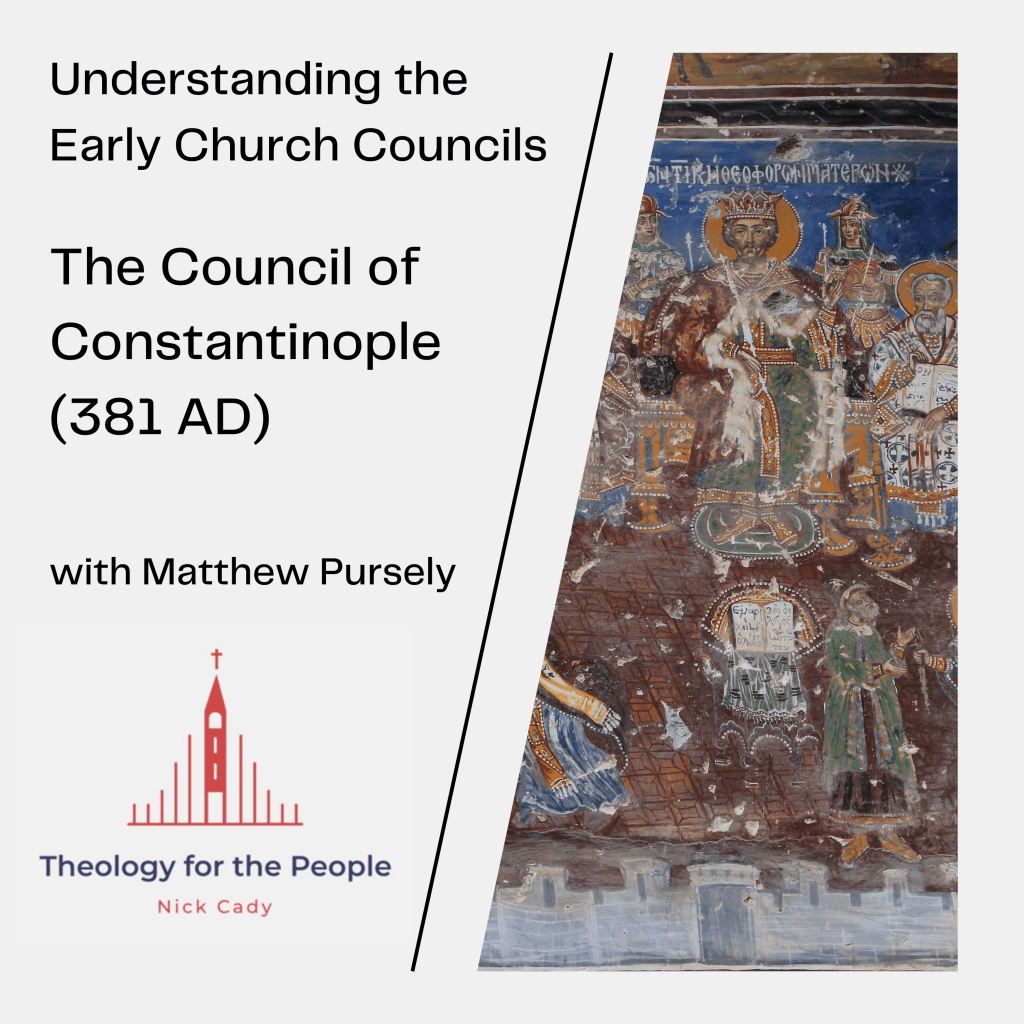
In this episode, I’m joined again by Matthew Pursley, Executive Pastor at Park Hill Church in San Diego, CA, and an expert in historical theology. Last time, we discussed the Council of Nicaea, and in this episode, we continue the conversation by diving into the Second Ecumenical Council—Constantinople (381 AD).
We discuss why the Council of Constantinople was necessary even after Nicaea, the role of the Cappadocian Fathers in defining the Trinity, the Filioque controversy, and how this council still shapes our faith to this day.
How did the early church come to a clear understanding of who Jesus is and how the Holy Spirit relates to the Father and the Son? And why did it take more than one council to settle these questions?In this episode, I'm joined again by Matt Pursley, Executive Pastor at Park Hill Church in San Diego, CA, and an expert in historical theology. Last time, we discussed the Council of Nicaea, and in this episode, we continue the conversation by diving into the Second Ecumenical Council—Constantinople (381 AD).We discuss why the Council of Constantinople was necessary even after Nicaea, the role of the Cappadocian Fathers in defining the Trinity, the Filioque controversy, and how this council still shapes our faith to this day. Make sure to visit the Theology for the People website.
Does it describe events which are yet to come (futurist view)?
Does it describe events which were already completed in 70 A.D. (preterist view)?
Or does it not describe any concrete events in the past or present, but poetically describes the battle between good and evil which will rage in every generation until Jesus returns (idealist view)?
One of the biggest factors in determining how Revelation is meant to be understood has to do with the question of WHEN Revelation was written.
Why I Hold a Futurist View of Revelation
I hold a futurist view of Revelation. This is based on a few factors, including internal evidence from the book, such as Revelation 1:19, where Jesus tells John, “Write therefore the things that you have seen, those that are and those that are to take place after this.” This verse gives us the outline of the Book of Revelation:
“The things that you have seen” = Chapter 1: The vision of Jesus Christ
“Those that are (now)” = Chapters 2-3: The messages to the seven churches
“Those that are to take place after this” = Chapters 4-22
The words “after this” in Greek are: “Meta tauta.” Revelation chapter 4 begins with those exact words in Greek: “Meta tauta” – which indicates that this is the beginning of the section that will describe the things which are “to come,” i.e. future events.
Additionally, I hold a Futurist view of Revelation because I find the find the Idealist and Preterist views to be unconvincing and/or problematic.
When it comes to the Idealist view, I find it to be too simplistic. This view suggests that Revelation is a fantastical, poetic description of the ongoing battle between good and evil, and that in the end Jesus will win, and that it was written in order to encourage beleaguered and persecuted believers throughout history. If that is the case, then the length of the book is confusing; why write such a long and detailed book if none of the symbols actually correlate to anything concrete? Why not just say, “Things will be hard, but Jesus will win in the end.” Is this book some sort of ancient Manga or Fan Fiction? It seems to be more than that. Also, the book isn’t written only to encourage persecuted Christians, but to challenge complacent Christians.
Why Preterism Requires an Early Date for the Writing of Revelation
Whereas the Idealist view of Revelation takes an allegorical view of what is written in the text, the Preterist and Futurist positions both take a more literal approach to reading Revelation.
So, when we read in Revelation 1:3 that Revelation is a “prophecy” – that indicates that it is describing events which were yet to take place when the book was written.
Preterists read Revelation through the interpretive lens which views Revelation as a fantastical description of the destruction of Jerusalem, which took place in 70 A.D.. Adherents of this view believe that this was God’s judgment upon the Jewish people of that city for rejecting Jesus as the Messiah, and that this was the fulfillment of Jesus’ promise in Matthew 24 that He would “return.” They say that Jesus did not return physically or literally, but that He returned “figuratively” in the Roman military, in order to bring judgment upon the Jewish residents of Jerusalem who had rejected Him and had Him crucified, and who persecuted the early Christians.
In order for this view to work, Revelation must have been written in the 60’s A.D. in order to be a prophecy which foretold future events.
There are at least two major issues with this view:
In this case, the book of Revelation would have only been a prophecy which spoke about future events for just a few years.
Early Christian writings tell us that John wrote Revelation in the 90’s A.D.. The Preterist view is a later view, which was not held by those closest to the writing of the book, and it requires a person to dismiss the witness of those who were lived just a few decades after it was written and who tell us when John wrote the book.
Early Christian Sources Universally Support the View that Revelation was Written in the 90’s A.D.
The earliest and most authoritative historical source for the dating of Revelation is Irenaeus (c. A.D. 180). In his work Against Heresies (5.30.3), Irenaeus states that John received his apocalyptic vision “almost in our own generation, at the close of Domitian’s reign.”
Emperor Domitian reigned from 81 to 96 AD.
This testimony is significant because Irenaeus was a disciple of Polycarp, who was a disciple of John himself. If Revelation had been written in the 60’s A.D. during the reign of Nero, we would expect Irenaeus to have been aware of this and to have mentioned it. Instead, he places John’s vision in the time of Domitian, around A.D. 95-96.
Other early church fathers affirm John’s exile under Domitian:
Clement of Alexandria (c. A.D. 200) states that John was released from his banishment to Patmos after the death of “the tyrant,” and that after John’s time on Patmos, he returned to Ephesus and ministered there until his death (Salvation of the Rich 42).
Victorinus (late 3rd century), in his commentary on Revelation, explicitly states that “He [John] was on the island of Patmos, condemned to the mines by Caesar Domitian, where he saw the apocalypse, which he published after being released on the death of the emperor.”
Eusebius (early 4th century), in Church History (3.18.1), confirms that John was exiled under Domitian and returned after his reign ended.
Pliny the Younger, not a church father, but a Roman historian, writes that Nerva, who began ruling Rome in 96 A.D. after Domitian’s death, immediately pardoned all of Domitian’s exiles and allowed them to return home (Epistles 1.5.10;9.13.5) – which supports the claim that John was exiled by Domitian on Patmos and was released from exile upon Domitian’s death.
This early testimony is quite clear, and dates the book to the 90’s A.D.. If Revelation had been written under Nero in the 60’s, we would expect at least some early Christian writers to talk about it, but instead they only describe a later date.
Thus, since Revelation itself tells us that it is a prophecy describing future events, that means that the things described in Revelation must all be things which were not fulfilled in the destruction of Jerusalem in 70 A.D.
Internal Evidence Also Supports the Later Date
In addition to the historical evidence, some internal clues in Revelation itself support a post-A.D. 70 date, such as the description of the church in Laodicea in Revelation 3:17, where it is described as wealthy and complacent. Historically, Laodicea suffered a devastating earthquake in A.D. 60, but it had fully recovered by Domitian’s time. If Revelation were written before A.D. 70, it is unlikely that Laodicea would have been in such a prosperous condition.
Conclusion
The argument for an early date of Revelation is largely driven by a theological presupposition that needs to find a way for Revelation to have been written before 70 A.D.. I would argue that this is not the right way to do theology. The historical evidence, particularly the testimony of early Christian sources, supports a later date. The fact that John was exiled to Patmos under Domitian aligns with everything we know from early church history and Roman history.
Sources:
Weima, The Sermons to the Seven Churches of Revelation, Baker Academic, 2021
The symbol of the cross is universally recognized today as the symbol of Christianity; for many in the Western world it is familiar and welcome. However, in the ancient world, in the first century AD, when this symbol was first used by early Christians, it was downright scandalous.
Paul the Apostle refers to the message of the cross as foolishness to the Greeks, a stumbling block to the Jews, and an offense to all. (1 Corinthians 1:22-23, Galatians 5:11)
The reason is because, for people in the ancient world, the cross was a terrible instrument of torture and execution.
The thing that made crucifixion so terrible is that it didn’t kill you right away; it was designed to make a person suffer as much as possible, for as long as possible. And for this reason, crucifixion was reserved for only the very worst kinds of criminals.
Because of how terrible crucifixion was, the Romans did not allow their own citizens to be killed by crucifixion, no matter how dastardly their crimes; only slaves and those without rights were allowed to be crucified, since it was exceedingly inhumane.
Cicero, the Roman statesman and philosopher said that crucifixion was so horrible, that the word “cross” should never be mentioned in polite society.
Let the very word ‘cross,’ be far removed from not only the bodies of Roman citizens, but even from their thoughts, their eyes, and their ears.
Cicero, 106-43BC, Pro Rabirio Postump 16
For the Jewish people in particular — to be crucified on a cross was considered a fate worse than death, because according to the Jewish Scriptures, anyone who was killed by being hanged upon a tree was considered “accursed”. (Deuteronomy 21:22-23)
And so, just imagine if you told someone back then that you were a follower of Jesus — a man who had been crucified… That person would have thought: “Whoa… Even if he was innocent, that’s probably something you should keep to yourself! That’s not something you want to go around advertising, because: that’s humiliating!”
But: here’s what’s interesting: for the early Christians, the fact that Jesus had been killed upon a cross was not something they tried to hide. Instead, the symbol of the cross became the main symbol they used to identify themselves – which is surprising, because the cross was generally consider to be the ultimate symbol of humiliation and defeat.
Furthermore, the message that the early Christians embraced and wanted to share with the world was what they called, “the message of the cross,” and “the good news of Christ, and him crucified.”
Paul the Apostle knew that the message of the cross was difficult for many people to accept. For the Jews, the idea of a crucified Messiah was a stumbling block. For Greeks, the idea that you could be saved through the death of an executed Jew seemed ridiculous. The idea that God would come to Earth and allow himself to be beaten, mocked, rejected and crucified, seemed completely unreasonable. They couldn’t wrap their heads around it. The Greek gods made humans serve them; they didn’t serve people – and they would never sacrifice themselves to save guilty people.
Just as the message of the cross ran contrary to popular thinking back then, the message of the cross also runs contrary to popular thinking today.
The message of the Cross requires you to admit that you have sinned and fallen short of the glory of God and that you are powerless to save yourself. This is why Paul talks about “the offense of the cross” (Galatians 5:11)
The message of the cross offends our sensibilities and our pride by telling us that we are sinners who need a Savior, and that we cannot save ourselves. In order to receive this salvation, you have to humble yourself before God.
Another part of the offense of the Cross is that the message of the gospel is exceedingly simple. Many people in Corinth seemed to believe that in order to “find God,” you had to be really smart, or exceedingly “good.” And yet, God chose to bring salvation to the world in a way that was so simple that even even a child could understand it, and in a way that it was available to people who had lived immoral lives.
Another part of the “offense of the cross” is that God says that His reason for saving you was not because you are better than other people. Salvation is simply an act of God’s grace: completely undeserved and totally unearned. You can’t take credit for it. The message of the cross leaves no room for pride or arrogance.
And when you really embrace the message of the cross, on the one hand it forces you to be incredibly humble, but on the other hand it fills you with an incredible sense of confidence – because the message of the Cross is that God loves you, and He has acted to redeem you, and if you have put your faith in what Jesus did for you, then God has sealed you and made you His own: He has adopted you as His Child, and placed His Spirit inside of you — and therefore you can be incredibly confident, knowing that you have nothing to fear in life or in death because God has promised that He will cause all things to work together for your ultimate good and for His ultimate glory.
they dragged Jason and some of the brothers before the city authorities, shouting, “These men who have turned the world upside down have come here also, (Acts 17:6 ESV)
The early Christians were not occupied with bemoaning what the world was coming to, rather they were occupied with celebrating that which had come into the world.
May God use us to turn the world upside down in our generation as they did in theirs.
The Kingdom of God has often been referred to as the “Upside-Down Kingdom”, because many of the values of God's Kingdom are the exact opposite of values that popular society espouses, for example: humility over pride, sacrifice over opportunism, etc. (More on that here)
However the question is: Is it actually God's values that are upside down, or are they only viewed as being upside down by an upside down world? I believe it's the latter.
To turn this world upside down, then, is to truly make things right-side up.



 Theology for the People