
Charitable Giving Habits of Americans

Living abroad for many years, one of the things which I came to realize and be impressed with, is how much American citizens give to charitable causes.

I was living in Hungary when the monster earthquake hit Haiti, and Hungarians were blown away to hear that average people in the United States were giving generously to help provide aid and relief for people they had never met in some faraway country. They were used to governments giving aid to regions with humanitarian crises, but for regular people to do such a thing was surprising to them.

It could be because people in the United States have more expendable income than people in most parts of the world, and that our currency is strong and goes further than other currencies. But that doesn’t detract from the fact that there is a culture here in the United States of using what we have to do good for other people.

Perhaps it comes from our history: having been a nation of immigrants, whose ancestors moved here to seek a better life or to escape poverty, and so it is built into our collective psyche, to use what we have to help others, knowing that we have experienced divine providential fortune to live in this country.

It also can’t be ignored, that a great number of Americans identify as ‘religious’. Part of the Judeo-Christian ethic is that, like Abraham, if we have been blessed, it is so we might be a blessing to others – that God wants to bless other people through us (Genesis 12:2).

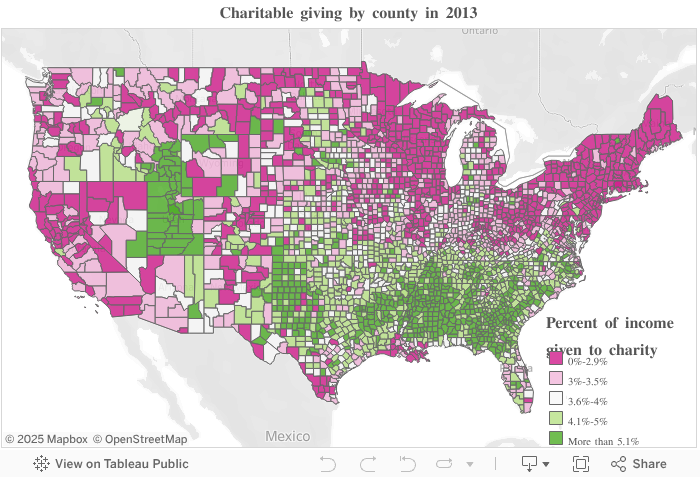
The Sacramento Bee published an article last month, showing the Adjusted Gross Income of every county in the US compared to how much was given in that county to charitable causes, non-profits and churches.

Interestingly, although perhaps not surprisingly, it was the poorer counties which gave more per capita than the richer ones. One of the major factors in how much people in a given county gave to charity seems to be religious affiliation; places with more people who attend religious services saw higher rates of charitable giving.

The idea that people who have less tend to give more may not be surprising to everyone. Jesus drew the attention of his disciples to a woman in the temple who gave her last 2 mites – all that she had, whereas other people who had more gave less of what they had. Preachers have long cited statistics which show the same thing: ironically, the more one accrues, the more miserly they tend to become with it.

How about Boulder County, Colorado, where yours truly is located? 2.6% of income was given to charity. That’s pretty low, and pretty ironic, because people in Boulder County, in my experience, talk a lot about being “locally minded and globally conscious” and caring about the well-being of other people, even if most of them are not Christian or attend religious services of any kind.

Neighboring Weld County was not much better at 2.7%, Larimer County came in at 3.2% (there are quite a few more church-going folks up there).

Here is the map with each county’s income versus charitable giving:

http://public.tableau.com/javascripts/api/viz_v1.js
Dashboard 1

 
Do you give charitably? The Bible recommends 10% of one’s income. The only places that came close to that number were the heavily Mormon populated counties of Utah.

Where do you direct your giving towards?
 

Dynel Lane, the Media and a Contradiction of Terms

20160219_091150_dynel

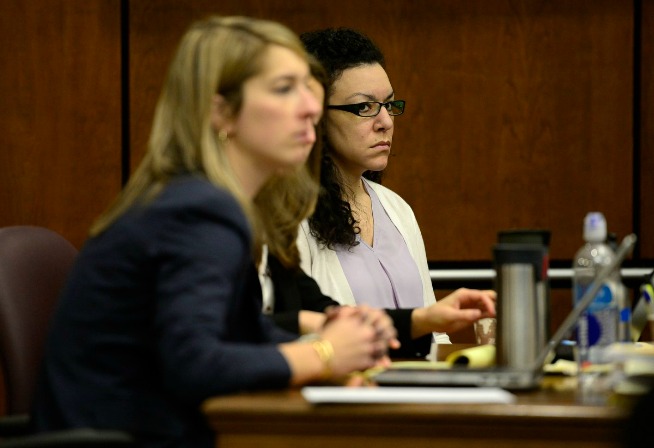
Almost a year ago, a tragedy happened here in Longmont: a pregnant woman responded to a Craigslist ad for free baby clothes, only to be attacked and to have her baby cut from her womb and abducted.

The baby did not survive, and the assailant, Dynel Lane is currently on trial this week in the Boulder District Court, however she is not being charged with murder, but with suspicion of attempted first-degree murder, first-degree assault and child abuse knowingly and recklessly resulting in death and unlawful termination of a pregnancy.

Colorado law does not count the death of an unborn child as murder, only if the child lived outside of the womb for some time. The issue in this case is that it’s not possible to prove how long the child lived outside of the womb – so Colorado’s wording of the law will not allow a murder charge in this case, even though wrongful death is obvious.

Dynel Lane has pleaded not guilty to these charges and has come back saying that it was Michelle Wilkins who attacked and tried to stab her, and that she was only trying to defend herself, and the reason she cut the baby out of Michelle’s womb was because she thought Michelle was dead and was trying to save the baby. This however, gives no explanation for why Dynel Lane told medical personal at Longmont United Hospital that the baby was hers, until they realized that she hadn’t given birth and the baby couldn’t be hers.

You can read Dynel Lane’s testimony here.

Today closing arguments are being presented by both sides.

This case presents a conundrum, not only for the wording of the law, but for the media in telling the story.  As one friend pointed out: The Denver Post reported that Dynel Lane “…cut out Wilkins’ fetus before taking the baby to Longmont United Hospital…”

Did you catch that?  She cut out a “fetus” and then took the “baby” to Longmont United Hospital.

It’s a very careful choosing of words which reflects a fundamental belief: that unborn children are not actually children.

The word they’ve coined to help create this false dichotomy – which this case so painfully exposes – is “fetus.” What’s ironic, is that this is based on a failure to grasp the fact that the word fetus is simply Latin for “young person.”

Fetus is Latin for “young person”

Did you catch that?  Young PERSON.    Not “young mass of tissue, akin more to cancer than to a human being.”

This case presents a conundrum for lawmakers and the media, because it shows that a fetus and a baby are not two separate things. Everyone knows that what this woman did was wrong, because she killed a baby… But if we stick with strictly considering the unborn unhuman, then why is this crime so heinous?

Is a baby only a baby if its mother wants it?   Clearly the answer is no.

I will be interested to see what happens in this case. Hoping for justice for Dynel Lane’s crime and mercy for her soul.


Longmont Baby Abductor Will Not Be Charged With Murder

I was talking to a friend in Romania the other day and he said it feels like he is always seeing Longmont in the news.

It’s true. Longmont has made national (and apparently international) headlines a lot in the past few years, and not for good reasons: catastrophic floods, carjackings involving kids, and most recently a fetal abduction in which a woman who was 7 months pregnant responded to a Craigslist ad for free baby clothes was beaten, stabbed and had her baby cut from her womb and kidnapped.

For what it’s worth – crime rates in Longmont have actually decreased in the last year, as opposed to Boulder, which has higher crime rates which haven’t decreased, but this kind of stuff, although not characteristic of this fine town, gets a lot of publicity – as it should.

The suspect’s arraignment will be today at 1:30, but the Times-Call reported that the DA has already stated that murder will not be among the charges brought against this woman, the reason being that Colorado law does not count the death of an unborn child as murder, unless the child lived outside of the womb for some time. The issue in this case is that it’s not possible to prove that the child lived outside of the womb, and if so, for how long – so Colorado’s wording of the law will not allow a murder charge in this case.

People in Longmont were protesting this and picketing on Main Street last week when it was first announced. The charges expected to be brought against the suspect are: suspicion of attempted first-degree murder, first-degree assault and child abuse knowingly and recklessly resulting in death.

The problem with those charges are that even all together they will not lead to as strong of a sentence as if murder or manslaughter had been part of it. Since the mother survived, and there is no proof that the baby lived outside of the womb, Colorado law has no way to charge her with anything stronger.

What do you think?  Is this justice?

The sad part of this is that if this attack had not happened, this baby would have lived. The baby’s life was clearly taken by this attack. I find it hard to accept that we have no way to prosecute that.

Opinion Article in Longmont Times-Call Advocates that Fertilized Eggs are Human

I was surprised to see today that the Longmont Times-Call posted an opinion article by a Longmont resident on the topic of when an unborn child becomes a true person – since this is a controversial topic which is very much at the heart of debates over abortion and human rights.

I was even more surprised when I realized that the article was advocating for seeing fertilized eggs as fully human – not what I had expected to find when I saw the title of the article.

The author, Brad Jolly, is writing in response to atheist doctor Richard Juday, who believes that humanness develops over time.

Check out the article – I found it surprisingly refreshing, especially that it appeared here in the local paper: http://www.timescall.com/columnists/opinion-local/ci_26964706/brad-jolly-fertilized-human-eggs-are-human

Thank you Longmont Times-Call for representing a broad spectrum of viewpoints!

Local Busses in Longmont Free

I took the bus today, and I liked it.

I’ve always thought about riding the bus here in Longmont; there’s a bus stop about 100 feet from my house. The thing is, that the bus doesn’t run very often, and it costs just as much as driving my car around town. I’d rather get around without my car – but there’s no real incentive to do so, until now.

Starting today, busses within Longmont are free. If you ride from Longmont to Boulder, you will be given a voucher to reduce the price for the in-town part of the ride.

Unlike my car, the bus is air-conditioned. And even though the ride to where I work on Tuesdays is 30 min by bus, as opposed to 12 min by car – I always have plenty of work I can do on my phone while I am sitting on the bus, which makes it time I can easily spend productively.

I’m not sure if this initiative is motivated by the desire to be environmentally friendly or simply because no one was riding the bus (my guess would be the latter), but I say: Good on you, Longmont! I love that this city does cool stuff like this. I will definitely be riding the bus a lot this year and using my car less.


Boulder County clerk to begin issuing same-sex marriage licenses

Boulder County clerk to begin issuing same-sex marriage licenses

Same-sex marriage has made it’s way to Colorado, and unsurprisingly, the first place it will begin is right here in Boulder County.

Boulder County will begin issuing same-sex marriage licenses immediately, County Clerk and Recorder Hillary Hall announced Wednesday afternoon.

The action was in response to the 10th Circuit U.S. Appellate Court ruling earlier in the day that Utah’s ban on same-sex marriage violates the U.S. Constitution’s guarantees of equal protection and due process.

There are a lot of opinions out there, even amongst Christians, as to what our stand on this should be.

Earlier this week, a Methodist pastor, who had been defrocked for going against church regulations and officiating his son’s wedding to another man, was reinstated.

Some Christians might say: Who cares? If homosexuals want to get married, why should I care?  There are plenty of things that are legal, but are not in accordance with God’s will or desires. It doesn’t affect me – I’m just trying to follow Jesus.  

My guess is that this is the majority opinion amongst most in the younger generation.

Others might say: Our laws shape our society’s understandings of what is acceptable and normative. Redefining marriage is bad for our society.

Here’s one thing I noticed: on social media there’s tons of praise for this. That doesn’t mean that everybody is in favor of it – it means that those who don’t like it are less and less willing to speak up and voice their opinion, because they know the kind of backlash that will come upon them if they do.

Woe to those who call evil good and good evil, who put darkness for light and light for darkness, who put bitter for sweet and sweet for bitter! (Isaiah 5:20)

Longmont church hosts Boulder county’s largest Easter egg hunt

Longmont church hosts Boulder county’s largest Easter egg hunt

20140416-112732.jpgThe front page of the Longmont Times-Call featured this article about the Easter Egg hunt outreach our church is hosting this Saturday in Roosevelt Park.

What I love about the online version of the Times-Call is the video interviews. This article has a great video interview with a couple from our church.

Check out the article, and come join us on Saturday!


The Song Sung Over London

Big Ben is the most famous clock in the world. It towers over the city of London, over Westminster Abbey and the Parliament.

What most people, in fact, what most Londoners don’t know, is that the music in the chimes that keep the time of Big Ben are from an old hymn: “I Know that My Redeemer Liveth”, from Handel’s “Messiah”.1

Every day, Londoners set their clocks and schedule their lives based on a tune about the resurrection of Jesus Christ, that sings out multiple times every day over that great city which is arguably the ‘center of the world’.

I will be preaching on the text from which the title of that song is taken this Sunday at White Fields Church in Longmont. If you’re in the area, I hope you’ll join us!

White Fields Church lg EASTER 4.10.14-page-001

1. http://www.bbc.com/news/entertainment-arts-18968027

How Safe Is Longmont?

Longmont seems to be in the news a lot in Colorado, but often for the wrong reasons. A few weeks ago a man stole a car in Longmont and led police on a high speed chase. This week a meth flop house was raided and shut down. There have been fatal stabbings and shootings. One can easily get the impression that Longmont is not a safe place to live.

One of my favorite features in the Longmont Times-Call is Johnny St Vrain, a column where readers can email in questions and get answers about anything Longmont.

One writer recently wrote in concerned about the question of public safety in Longmont. Check out that article here. The long and short of it?: Despite the bad press, Longmont is one of the safest places to live in the State of Colorado.

Here's a highlight from the article:

Longmont is statistically one of the safest cities in Colorado, a fact the Times-Call has reported. In December 2011, the city was named the second safest city in Colorado, based research by the magazine CQ. Last year, the Times-Call reported that major crime rates in Longmont have dropped 48 percent in the past decade, based on Colorado Bureau of Investigation and the Federal Bureau of Investigation numbers.

I have always felt safe in Longmont. This is a city of 90,000 people where if a bicycle gets stolen they report it in the newspaper! That says a lot about the city right there! In other places I've lived, I've had my house broken into, I've been mugged, robbed, assaulted – I even had a bicycle stolen, but those things didn't count as “news” in those places. Safe to say that Longmont's pretty safe.

How safe do you feel in Longmont?


“The Dopest Job Ever”

IMG_2541

Yesterday, while riding the lift at Eldora, I had an interesting conversation with a guy who, like me, was up snowboarding alone.

He was from Boulder, probably in his late 20’s or early 30’s, and works in some area of the tech industry.

He was very interested when he found out I was a pastor, because he said he’d always been interested in what goes on in churches, but had never been to church himself.  Here’s how our conversation went:

  • “Wow, you’re a pastor?!  Like in a church?”
    • “Yeah”
  • “So, what do you do there?”
    • “I teach the Bible and counsel people and lead the church as an organization in all the endeavors we are involved in.”
  • “Do you like emcee the shows and stuff?”
    • “You mean the church services?  Yes, I lead the worship services.”
  • “So you’re kinda like an emcee!  That’s dope!”
  • “Wait, so you’re married?  (I had mentioned my wife and kids to him)
    • “Yeah, I’m married”
  • “I thought priests couldn’t get married”
    • “Well, that’s a rule in the Catholic church – but we’re not Catholic. In fact, even in the Catholic church, they only introduced that rule a couple hundred years after Jesus lived and established the church, so most Christians don’t follow that rule, and most pastors get married.”
  • “Wow. I always thought that would be a pretty dope job, but the one downside is that you couldn’t have girls. But, you know, if you can have girls, then that’s like the dopest job ever!”
    • “Well, I mean, as a pastor, you can’t just go around having lots of girls – you can have a wife and a family, but it has to be monogamous.”
      • “Yeah, but same thing – you get to have a girl. That’s dope!”

About this time the lift reached the top of the mountain – and I encouraged him that he should really check out a church sometime for himself, and that he ought to give some consideration to who Jesus was and what he taught. After that, we bid each other farewell and got off the lift, and went separate ways. Who knows if we’ll ever meet again.

It did surprise me though, how little this man knew about church and about Jesus. It served as a reminder that we live in a post-Christendom society. Boulder has long been considered a trend-setting, cultural hub for Colorado and the Western United States. That means that as Christians, increasingly we can no longer expect that most people in our society have a basic understanding of Christian doctrine and practice, and know who Jesus was and what God requires of them. More and more people in our society are growing up without that, and we as Christians need to be prepared to present Jesus and the message of the Gospel to people without the assumption that they have some basic background understanding of Christianity – because more and more do not.