
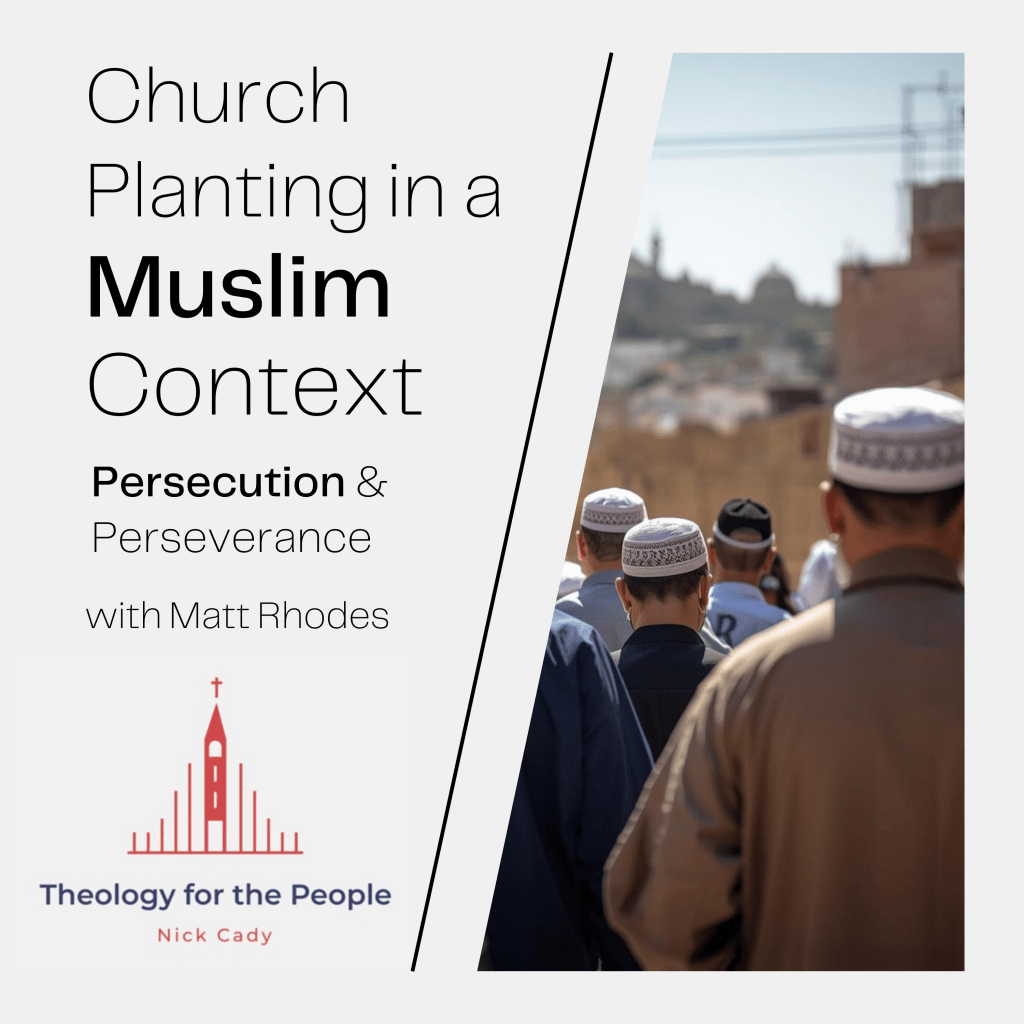
Church Planting in a Muslim Context: Persecution & Perseverance

What does persecution actually look like in the places where the gospel is least known? And how should Christians think about persecution in relation to missions?

In this episode of the Theology for the People Podcast, I speak with Matt Rhodes. Matt is a missionary and author, who has been serving for 15 years as a church planter in North Africa among a Muslim-majority tribals communities. Matt shares stories from the field and discusses the central thesis of his book Persecution and Missions: A Practical Theology.

One of Matt’s key insights is that persecution is not merely an occasional obstacle to mission—it is often a structural reality in places where the gospel is advancing. In many communities, the greatest barrier to faith in Christ isn’t intellectual objections but the social and familial cost of conversion. Whereas many people espouse the benefits that persecution has on the church, Matt points out that the threat of persecution does keep many from even considering the claims of Christ out of fear of reprisal.

In this episode Matt and I discuss:

  • Why persecution often prevents people from even exploring Christianity
  • The immense social cost faced by converts from Muslim backgrounds
  • Common mistakes Western missionaries make when discipling persecuted believers
  • The tension between contextualization and compromise in missions
  • How the New Testament frames persecution through the lens of the Exodus and the Promised Land
  • Why missionaries must be honest about the cost of following Jesus
  • The dangers of wealth, financial incentives, and dependency in missions

Matt also shares practical wisdom from his experience serving in a village context in North Africa and offers specific ways listeners can pray for believers who face intense pressure for their faith.

This conversation offers an important reminder: following Jesus has always come with a cost—but the hope of resurrection and eternal reward makes that cost worthwhile.

📘 Matt’s book: Persecution and Missions: A Practical Theology

Watch or Listen to the Episode Here:

Follow Theology for the People on YouTube⁠https://www.youtube.com/@theologyforthepeople

Click here to listen to the episode, or listen in the embedded player below.

Church Planting in a Muslim Context – with Matt Rhodes Theology for the People

What does persecution actually look like in the places where the gospel is least known? And how should Christians think about persecution in relation to missions?In this episode of Theology for the People, Nick Cady speaks with missionary and author Matt Rhodes about his 15 years serving as a church planter in North Africa among a Muslim-majority tribal community. Matt shares stories from the field and discusses the central thesis of his book Persecution and Missions: A Practical Theology.One of Matt’s key insights is that persecution is not merely an occasional obstacle to mission—it is often a structural reality in places where the gospel is advancing. In many communities, the greatest barrier to faith in Christ isn’t intellectual objections but the social and familial cost of conversion.Nick and Matt discuss:Why persecution often prevents people from even exploring ChristianityThe immense social cost faced by converts from Muslim backgroundsCommon mistakes Western missionaries make when discipling persecuted believersThe tension between contextualization and compromise in missionsHow the New Testament frames persecution through the lens of the Exodus and the Promised LandWhy missionaries must be honest about the cost of following JesusThe dangers of wealth, financial incentives, and dependency in missionsMatt also shares practical wisdom from his experience serving in a village context in North Africa and offers specific ways listeners can pray for believers who face intense pressure for their faith.This conversation offers an important reminder: following Jesus has always come with a cost—but the hope of resurrection and eternal reward makes that cost worthwhile.📘 Matt’s book: Persecution and Missions: A Practical Theology

This episode is audio only for the safety of the people to whom Matt ministers, but the audio can be found on YouTube here:

“I never made a sacrifice”

This past Sunday at White Fields church I spoke about how when we give everything over to God, although we often fear what we will lose, the reality is that we always get more than we bargained for. Like Jesus said, it is when we give our life fully over to him that we find true life and really start living. (you can listen to the audio of that sermon here)

One example of this that came to my mind, but I didn’t share on Sunday was a quote by David Livingstone – the 19th century British missionary who gave his entire life in service to Christ, exploring and evangelizing the interior of Africa. Today, as a direct result of his work, sub-Saharan Africa has become a place where Christianity thrives, where 200 years ago it was almost non-existent.

David Livingstone – Missionary and Explorer of the interior of Africa

Livingstone made several trips back to England during his time as a missionary in Africa, in which he would go on speaking tours. He was considered a national hero in England, and was invited to speak at universities and to dignitaries.

One of the questions most frequently asked of Livingstone was how he was able to make such a great sacrifice, as to give his life in service as a missionary. He was an educated man who could have had a comfortable, upper-class life in England, but instead he chose to spend the prime of his life in the bush of Africa.

Here is what Livingstone said in response to this question in a speech he gave at Cambridge University in 1857:

For my own part, I have never ceased to rejoice that God has appointed me to such an office. People talk of the sacrifice I have made in spending so much of my life in Africa. . . . Is that a sacrifice which brings its own blest reward in healthful activity, the consciousness of doing good, peace of mind, and a bright hope of a glorious destiny hereafter? Away with the word in such a view, and with such a thought! It is emphatically no sacrifice. Say rather it is a privilege. Anxiety, sickness, suffering, or danger, now and then, with a foregoing of the common conveniences and charities of this life, may make us pause, and cause the spirit to waver, and the soul to sink; but let this only be for a moment. All these are nothing when compared with the glory which shall be revealed in and for us. I never made a sacrifice.