Something Worth Fighting For

A few days ago I was talking with a friend, who is also a pastor, and we got on the topic of marijuana legalization here in Colorado, and the issue of Christians and recreational weed.

This pastor friend of mine said something to the effect of: our twenty-somethings are already so apathetic, the last thing they need is to get stoned all the time.

While I agree that getting stoned and checking out on life is dissipation, I told this friend of mine that I strongly disagree with his generalization about young people being apathetic.

The words I would use to describe those coming out of high school and college would be much different. I would say rather than “apathetic”, they are heroic. They are idealistic. They are people of action.

It is a highly discussed phenomenon, that young people, especially in the age range of 18-30 tend to disappear from church, only to reappear in their 30’s. A plethora of conferences, books and blog articles try to solve the problem of how to get these people to stay in church. Many theories as the to reason for this have been postulated, such as that young people need to come to faith on their own, or that they go off to “enjoy their twenties” by sinning a bunch, and then return to the church once they are married and have kids and realize how much they need the Lord!

Here’s what I think: one of the reasons why the church has trouble retaining twenty-somethings, is not because they are apathetic, it’s because we struggle to give them sufficient outlets for their heroic aspirations to change the world and make a difference.

I believe that young people are chomping at the bit to do something significant and change the world. I was that way when I was fresh out of high school – I didn’t want to spend 4 years at college; I felt that time was of the essence, and I wanted to get out there and change the world NOW. I realize now that in order to make significant change and contribution, some investment is necessary, e.g. doctors go to school for a long time, and as a result they are able to save lives. But as a young man, I wasn’t apathetic at all, and I don’t believe young people today are apathetic in the least. I believe they are heroic.

But if young people are as heroic as I claim they are, why do so many of them waste their 20’s smoking weed and going nowhere?

I believe it’s because they don’t have sufficient vision and they don’t have sufficient outlets for their heroic longings. They haven’t been given something worth living for, something worth dying for – something worth fighting for. And so, as a result, they direct their enthusiasm towards useless things.

For many young people, the only vision the church gives them is to go to groups and sit around talking. That is less than compelling for many of them. They desire community, but they want dynamic community – and they want an outlet through which they can be used by God to change the world. I don’t think that’s wrong – in fact, I think it is very much in line with the Gospel.

Another thing about young people today, is that they don’t just want to be given a task, they want to understand the vision for WHY that task is important, necessary, crucial to a greater mission – and what the end goal of that greater mission is.

I believe the challenge for the Church today is to give direction and vision to these heroic young people for how they can be used by God to bring His love to others and instigate redemption and transformation in the world, so that their heroism doesn’t get crushed by the weight of life and turn into apathy.

I have heard it said by leaders before: “I would rather have to reign in a racehorse, than kick a mule to get it moving.”
I think that’s where we need to be with young people: giving them outlets for their heroic longings, while yet being present to teach, guide and direct, so that their enthusiasm isn’t wasted by being spread out in so many different directions.

Rustling with the Rumor

Growing up in Colorado, I took the natural beauty of this place for granted; how could I not? I didn’t know anything else, except for California and Oregon, where I spent summers with family – places which are also full of dramatic landscapes.

It took moving to Debrecen, Hungary, the center of the “Puszta” (some what of a mix between a plain and a wasteland) for me to realize how much I long for natural beauty. When it came time for me to venture out from Debrecen to plant a church, it was a great gesture of love and grace on God’s part that he called me to Eger, in the north of Hungary, flanked by the Bükk mountains on one side and the Mátra range on the other. It is a region of waterfalls and forests, very different from the rest of the country.

Living in Colorado once again, this time I appreciate it more.

Why is it though, that we have this great longing for the grand landscapes?

According to C.S. Lewis, it is because we see in nature the grandeur of beauty and grace that we yearn for for ourselves.

Blaise Pascal spoke of this longing and explained it in this way: There’s something nostalgic and reminiscent in us, that longs to get back to the place from which we have come. And that is because we came from perfection and we were made for perfection. And that is why we have this sort of lingering memory of it, and therefore we long to return to that place where everything is as God intended it to be.

Here is what C.S. Lewis wrote about this in his book, The Weight of Glory:

We do not want merely to see beauty, though, God knows, even that is bounty enough. We want something else which can hardly be put into words: to be united with the beauty we see, to pass into it, to receive it into ourselves, to bathe in it, to become part of it.

That is why we have peopled air and earth and water with gods and goddesses and nymphs and elves-that, though we cannot, yet these projections can, enjoy in themselves that beauty grace, and power of which Nature is the image. That is why the poets tell us such lovely falsehoods. They talk as if the west wind could really sweep into a human soul; but it can’t. They tell us that ‘beauty born of murmuring sound’ will pass into a human face; but it won’t. Or not yet.

For if we take the imagery of Scripture seriously, if we believe that God will one day give us the Morning Star and cause us to put on the splendour of the sun, then we may surmise that both the ancient myths and the modern poetry, so false as history, may be very near the truth as prophecy.

At present we are on the outside of the world, the wrong side of the door. We discern the freshness and purity of morning, but they do not make us fresh and pure. We cannot mingle with the splendours we see. But all the leaves of the New Testament are rustling with the rumour that it will not always be so. Someday, God willing, we shall get in.”


Every Single Day

There are certain messages that you hear, which you never forget. I remember hearing Jon Courson speak at a missions conference in Austria in the early 2000’s. I don’t remember much of what he said, but I do remember this phrase, which he repeated several times:

Read your Bible and pray,
every single day.

Novel concept for a group of missionaries and pastors, right? 

Well, it is actually. Because one rut that preachers and Bible teachers in particular tend to fall into is that of only reading your Bible to look for something to preach on or teach about: “sermon material” if you will. 

What I have found is that when I read the Bible purely to hear from the Lord and delight in His Word, it keeps me so fresh and alive as a Christian, that it makes me a better minister.

For example, yesterday I was reading through 2 Chronicles, and I read chapters 20-23. That’s one of those sections of the Bible that people like to skip over, because it’s full of hard to pronounce names and stories that are downright confusing – because it’s never clear who the “good guy” really is (hint: the only “good guy” in the story is GOD himself!).

After reading those passages, I went to meet with a brother from our church, and it just so happened that the very chapters I had read spoke directly to what he was going through in his life – in a way that was actually quite moving. And it wasn’t just one thing – it was several things from various stories in those 4 chapters. If I hadn’t been reading through the Word consistently, I’m sure I would have had something to share with this brother, but it wouldn’t have been so alive and prophetic as this was.

Another thing I remember Jon Courson saying: 

Wherever you are in the Word, that’s where you are.

That was basically Jon’s way of saying that in the providence of God, the scriptures you will read as you read through the Bible will often apply directly to the situation you are in. I have found that to be very true. 

May we never be people who only look to God’s word for “material” that we can USE in speaking to others. May we come to it always as the fountain of life.  But if you do that, you will also find that when you hide His Word in your heart, you will have plenty of “material” to share with others. 

The fear of the LORD is a fountain of life, turning a person from the snares of death. – Proverbs 14:27

We do not know what to do…

I was inspired this morning reading the story of King Jehoshaphat – he’s one of the bright spots in the chronicles of the kings of Israel and Judah.

In 2 Chronicles 20, we read how Jehoshaphat was faced with a difficult situation: the Moabites and the Ammonites, people groups who Israel had respected and lived beside peaceably as good neighbors, teamed up to attack and conquer Israel.

When Jehoshaphat received the news that these attacking armies were already in the land of Israel, on his doorstep, “he was afraid” – understandably – but look how he reacted: “[Jehoshaphat] set his face to seek the LORD, and proclaimed a fast throughout all Judah. And Judah assembled to seek help from the LORD; from all the cities of Judah they came to seek the LORD.” (2 Chronicles 20:3-4)

There are so many ways that people respond to bad news. I love the response of Jehoshaphat! Would to God that I would respond that way myself!

I once heard the statement that the key to leadership is that when you get bad news, you respond in great ways. That’s what Jehoshaphat did.

Key to leadership: When you get bad news, you respond in great ways

After calling the people together, Jehoshaphat led them in prayer – and he prayed fervently, from his heart, with faith. He says: “If disaster comes upon us, the sword, judgment, or pestilence, or famine, we will stand before this house and before you – for your name is in this house – and cry out to you in our affliction, and you will hear and save.” (2 Chronicles 20:9)

But most of all, I love the heart with which he ends the prayer: For we are powerless against this great horde that is coming against us. We do not know what to do, but our eyes are on you.” (2 Chronicles 20:12)

We do not know what to do, but our eyes are on you.

There is something about that sentiment which resonates with me. There are so many situations about which I feel the same way: I don’t know what to do. Riots in Ferguson, war in Ukraine, strife and conflict in families in our own community. The list could go on. I sympathize with the heart of Jehoshaphat: I don’t know what to do, Lord!  But his conclusion couldn’t be more right on: But our eyes are on you. Lord, we are looking to you to save and deliver and change and redeem. We can’t do it – so we look to you, Lord!

If you read the end of the story, what you find out is that Jehoshaphat and Judah win the battle; the tide turns when Jehoshaphat organizes the people to both fight and to worship. May that be true of us as well in the situations that we face – that we would have the heart of Jehoshaphat in those times.

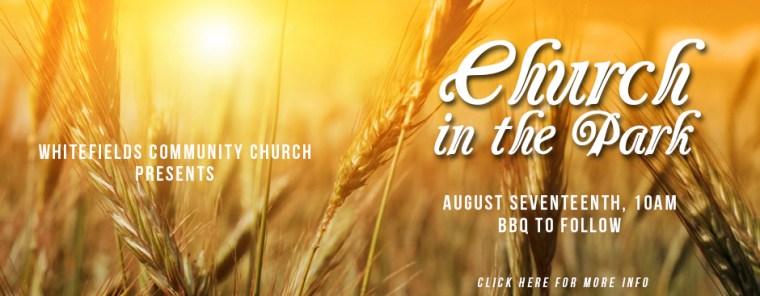
Church in the Park – upcoming event in Longmont’s Roosevelt Park

CHURCHINTHEPARK

White Fields Community Church will be hosting Church in the Park on August 17th in Longmont’s Roosevelt Park (700 Longs Peak Avenue).

This outdoor service will be held under the shade of the trees in the South-East corner of the park, right in front of the St Vrain Memorial building.

We will be joined by guest Pastor Pete Nelson, who will be sharing the Word with us.  Hope you will join us!

English Camp in Hungary

This July I was in Hungary for just under 2 weeks, leading a team from White Fields Community Church in Longmont to serve at the English Camp outreach hosted by Golgota Eger.

My wife and I started this camp when we were living in Eger and looking for a way to effectively reach young people with the Gospel. This was the 9th English Camp in the hills outside of Eger – and over the years, we have seen God do such great things through it and so much great fruit come out of it.

For the past several years, the camp has been at full capacity of what we can fit at this location, and the amount of kids we can reasonably handle and minister to well – around 130.

Here is are 2 short videos which highlight the long-term impact that this outreach is having on youth in this part of Hungary:


Make Sure You’re Fighting the Right Battle

Tomorrow I will be teaching from 1 Samuel 28.  Here’s an except:

The Philistines assembled and came and encamped at Shunem. And Saul gathered all Israel, and they encamped at Gilboa. (1 Samuel 28:4)

Here’s why that’s significant:   Because the cities of Shunem and Gilboa are located in the far NORTH of Israel — so what that means is that while Saul had taken the army off for years to chase after David, the Philistines, who were based in the South-Western corner of Israel (modern-day Gaza), had penetrated deep into Israel’s territory.    

Now, think about it:   How did that happen?   How did Saul lose all that ground? 

It was because Saul spent all his time fighting the wrong enemy.

Saul forgot who the real enemy was.   And instead of fighting the real enemy (the Philistines) — he had spent all his time waging a campaign against a brother (David).

As a result — now, when there is a real battle to fight, Saul’s completely unprepared, and the enemy has made huge inroads into territory that he once possessed.

Let me tell you: that should be a major warning for all of us!

Make sure you know who the real enemy is!   Make sure you’re spending your time fighting the RIGHT battles, and not wasting your time and energy fighting the wrong ones!

There is an enemy of your soul — but let me tell you: It’s not your wife!  It’s not your husband!   Your enemy is not your Christian brother or sister  – who has a slightly different view than you do on some secondary Christian doctrine! 

If we forget who the real enemy is, if we forget what the real battle is, and get all distracted with going on crusades against people who are really on our same team, then what happens is, like Saul – one day we turn around to realize that we’ve lost a lot of ground, and the enemy has made huge inroads into our lives…

Give…expecting nothing in return

One of the sayings of Jesus that I find most inspiring and challenging is in the Gospel of Luke, chapter 6, where Jesus says:

“If you love those who love you, what benefit is that to you? For even sinners love those who love them. And if you do good to those who do good to you, what benefit is that to you? For even sinners do the same. And if you lend to those from whom you expect to receive, what credit is that to you? Even sinners lend to sinners, to get back the same amount. But love your enemies, and do good, and lend, expecting nothing in return, and your reward will be great, and you will be sons of the Most High, for he is kind to the ungrateful and the evil.

(Luke 6:32-35 ESV)

Most of us do things for others with at least some expectation that we will receive something in return. If we are nice to others, we expect that they will be nice to us in return. If they are not, we tend to get upset about it.

Many of us give with the expectation, that at least the recipient will be appreciative of our generosity.

Many of us love, with the expectation that our love will be reciprocated – and if it is not, then we tend to “clam up”, because to love is to make oneself vulnerable, and unreciprocated love leaves us more vulnerable than reciprocated love.

But here is Jesus challenging us toward something that does not come naturally: to GIVE, expecting nothing in return.

Nothing.

Why? Because that is how God loves.  And if you do that, then you will understand the heart of the Father in a profound way, and you will be like Him. Because He gives to the ungrateful and the evil – He blesses people who don’t deserve it and don’t even appreciate it.  

If He gets nothing out of it, then why does He do it?   Because that is what divine love does: it gives, not as a means of coercion, but simply gives out of pure love.

I want to be that kind of person, to my wife, to my kids, to those around me – even to my “enemies”. This is the vision; only by the grace of God can I carry it out.

Back from Costa Mesa

Last week I was in Costa Mesa, CA for the annual Calvary Chapel Senior Pastors Conference. It was a great time of encouragement and fellowship, catching up with friends from all over the world who I only see at events like this.

This was the first SPC since Pastor Chuck Smith died, and the focus was on not forgetting the past, but not living in the past either – rather pressing ahead, building upon the foundation we’ve been given.

The messages at the conference were great, particularly what Brian Brodersen shared from Haggai ch 2, about how “the glory of the latter house will surpass that of the former”. May it be so!

Many of the sentiments shared at the conference, such as that Calvary Chapel must not be insular, but must understand its place in the wider body of Christ, and that we must stay on mission rather than being distracted by peripheral issues, definitely resonated with me.

I’m looking forward to everything that God will do through this movement in the years to come.

Reasons Why I Love Tim Howard

Team USA goaltender Tim Howard made a record 16 saves at the World Cup game between the US and Belgium, but couldn’t save the American team from being knocked out in the 2-1 Belgian win.

Did you know:

  • Tim Howard is HUNGARIAN!    Tim was born in New Jersey to an African-American father and a native Hungarian mother named Fekete Eszter!  He is a dual citizen of USA and Hungary, but unfortunately, aside from a few words, he doesn’t speak Hungarian.  Szeretünk téged, Tim! Hajrá magyarok!
  • Tim Howard is a CHRISTIAN.   Tim has spoken about his Christian faith, saying: “The most important thing in my life is Christ. He’s more important to me than winning or losing or whether I’m playing or not. Everything else is just a bonus.”
  • Tim Howard has Tourette Syndrome, an Autism Spectrum Disorder.
  • Tim is 35 years old and has been on the US national team since 2002.  I don’t know if this was his last world cup, but after this performance today, he seems like he is at the top of his game!