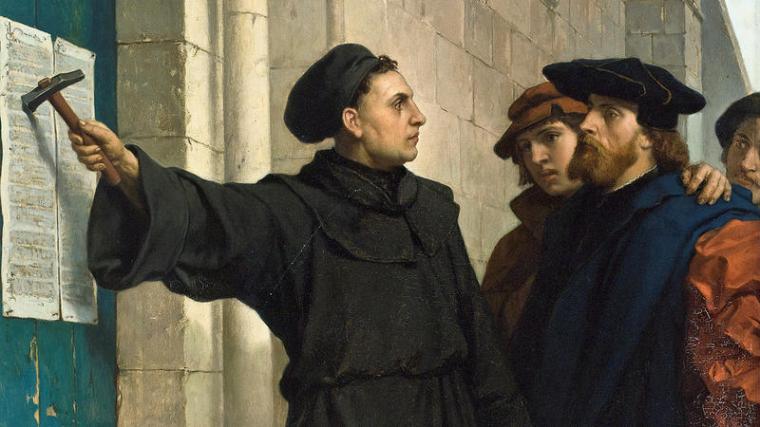
Don’t Forget the Actual Holiday Happening Today

Today is Reformation Day. On October 31, 1517 Martin Luther nailed his 95 Theses to the door of the Wittenberg Schlosskirche, sparking the Protestant Reformation.
Today is a great day to remember the work of the reformers which you unquestionably benefit from. Men who struggled for us to have the freedom to read the Bible for ourselves, in our own languages – and consider for ourselves what God says to us in the Scriptures. Today is a day to be thankful for the return to Biblical theology and the doctrine of grace that these men fought for.
Halloween: A Conundrum
A post from one year ago. This year for Halloween we’re going to be handing out coffee to parents, passing out White Fields stickers and roasting marshmallows over a fire pit and hoping to make some great connections with our neighbors, with the hope to form some great Gospel connections.
I love this question: “If Jesus can go straight to hell, stare death and devil in the face, win and come back alive, can you open your door to the 6 year old in a Batman costume and his shivering mom?”
Halloween is a conundrum for many Christians. Is it only a weird fashion show for candy, or is it something more sinister? Should Christians allow their kids to dress up in innocent costumes and go knock on their neighbors doors begging for sweets, or should we forsake participation in this whole thing altogether?
This week I read this post about Halloween by a Christian woman, which I found very insightful. She points out one very important thing: This is the only day of the year, when most of your neighbors are going to come knocking on your door. The only day.
So, what are you going to do? Are you going to go to a church event far away from your neighbors? Will you turn off the lights and refuse to answer the door? OR, are you going to use this unique opportunity to reach out to your neighbors?
View original post 484 more words
Evangelicals’ Favorite Heresies
Christianity Today posted this article about surveys done of evangelical Christians, which revealed how many American evangelicals hold views condemned as heretical by some of the most important councils of the early church.
Here’s the article:
New Poll Finds Evangelicals’ Favorite Heresies: Survey finds many American evangelicals hold unorthodox views on the Trinity, salvation, and other doctrines.
It’s worth reading. Here are a few of the poll results:


The concluding statements were also very insightful and worth taking note of:
Beth Felker Jones, professor of theology at Wheaton College, said, “Orthodoxy is life-giving, and God’s people need access to it.” Participants who gave unorthdox answers are not heretics, but probably lacked quality resources, she said. “Church leaders need to be able to teach the truth of the faith clearly and accurately, and we need to be able to show people why this matters for our lives.”
For Nichols, one way forward in understanding God and ourselves is to consult the historic church. “While slightly over half see value in church history, [nearly] 70 percent have no place for creeds in their personal discipleship,” he said. For Nichols, the church’s knowledge of its past will determine its future. Knowing heresies and how they were overcome, he says, will help the church stay on the right track theologically.
Thoughts?
Infertility and the Will of God
I received this question yesterday:
During a sermon you talked about people having it in their hearts to be parents. But then you said if that doesn’t happen God has another plan. In the Old Testament, whenever a woman was barren, it was a bad reflection on that woman. Please comment on why that isn’t the case now. It seems like in old testament it was intended for all women to be giving birth.
I know that there are many godly women who struggle with infertility and wonder about this very question.
It is important to remember that in the time of the Old Testament, the view that barrenness was a curse was generally held by all cultures and societies, and was not unique to the people of God.
In ancient cultures the measure of a woman’s worth and value was often based on how many children she could produce, since having children was essential for livelihood and security.
However, the Bible’s view is that all people have intrinsic value, being created in the image of God – and one’s value is not determined by what or how much they can produce.
The Bible, including the Old Testament, has a more nuanced view of barrenness than that it was always a bad reflection on the woman. The Bible recognizes that even godly women struggle with infertility. If you look at a list of women in the Bible who struggled with infertility, you find that almost all of them were godly women, such as Hannah at the beginning of 1 Samuel. One commonly mentioned exception to this is Michal, who we studied about last Sunday in 2 Samuel 6, but in her case, we do not know exactly what the reason for her barrenness was: Was it because after she mocked and criticized David he refused to share a bed with her any more? Was it because God didn’t allow her to have children because of her disdain for David’s heart for the Lord? Was it for some totally unrelated reason, yet it is mentioned because of it’s poetic justice in the context of that story? We can’t know for sure.
To the point that God’s intention in the Old Testament seems to be that all women would be able to give birth: infertility and miscarriages are listed in Exodus and Deuteronomy in the same category as sicknesses and afflictions which are part of the result of the Fall – and the broken world we live in. That means that infertility and miscarriages are not God’s design, and therefore we should pray for those who want to have children but struggle with infertility just as we pray for the sick.
Furthermore, God created women to be life-givers, and that is not limited only to childbearing.
On a personal note, good friends of mine, great godly people who loved the Lord and served alongside us, were not able to get pregnant for many years. Finally they came and asked us to pray for them; we had not realized they were wanting to get pregnant but couldn’t. So we prayed for them and less than a year later we welcomed their daughter into the world. It was a glorious thing.
Other friends of mine have wanted to have children, have prayed, and yet they were not able to conceive. Does God sometimes say “No” to our requests? Like we see in 2 Samuel 7 – yes, and in those cases we must trust Him, that there is a reason, even if I know it not – much like David, not knowing for years why God told him no. However, we must ask and seek and knock!
I would encourage anyone struggling with fertility issues to ask for prayer.
When God Says “No”
One of the things we’ve been doing at White Fields Church is giving people the opportunity to text or tweet us questions during the sermon.
Yesterday morning I taught 2 Samuel ch 7, which is the time when David had a desire to build a house for the Lord, but God said “No!” That has some interesting implications, because what David wanted to do was a good thing, and it was a biblical thing – yet God said “no”.
This question was texted in during that sermon:
This morning in the sermon, you discussed having a desire to be a missionary, pastor, etc. If we have that desire in our hearts, didn’t God put that there? So why would He close The door if He put that desire there?
That is a great question! The first question is a particularly important one: Did God put that desire there? I believe that as we get closer to the heart of God – delighting ourselves in the Lord, as David said (Psalm 37:4) – that our desires are changed and become more aligned with His desires.
In the story we studied yesterday in 2 Samuel 7: David had a desire. It was a good, noble desire – it was even a Biblical desire. Did God put that desire there? Maybe! Or maybe not. We don’t know for sure. There is a way in which we could argue that God did put that desire in David’s heart – but that David’s role in fulfilling that was not to be directly involved in the building of the temple, but indirectly – as we saw, how David got the ball rolling with the building of the temple and had all of the items made which would be used in the temple.
Let me share an example from my own life: I gave my life to the Lord when I was 16, and almost immediately I developed a desire to minister to the people of the former Soviet Union, specifically Ukraine, where my family had immigrated from. When I was 18, I was invited to go on a ministry trip to Budapest, Hungary – to a conference for Calvary Chapel churches from Hungary and Ukraine. It was the Ukrainian part which I was interested in, and I went there with the hope that I could connect with some ministries in Ukraine. I was able to do that, but interestingly all of the “doors of opportunity” for me to serve in Ukraine seemed closed, however there was an incredible open door and an invitation for me to serve in Debrecen, Hungary – the pastor there told me he had been praying for someone exactly like me to come and work with them. I had no real desire to go to Hungary, my desire was to serve the Lord in Ukraine – but I prayed about it and came to the conviction that this is what God had for me at that point, and after serving there for a little while I could move to Ukraine, where I really desired to be. I committed to go to Debrecen, Hungary for 8 months. During those 8 months, I prayed for Ukraine constantly, I even tried to go to Ukraine to work with some of the people I had met the year before at the conference in Budapest, but once again all the doors of opportunity were closed! My feeling was: God, why did you give me this desire to serve you in Ukraine, and then close all the doors before me?! Yet, in the meantime, I had become very proficient in Hungarian and was involved in some very exciting and fruitful ministry in Hungary. I came to see that perhaps God had given me that desire to serve Him in Ukraine in order to get me to pray and to get me to Hungary – which hadn’t even been on my radar, but which ended up being the “land of blessing” for me, where I met my future wife, where I became a pastor, where my 3 kids were born, where I was involved in years of fruitful and wonderful ministry. Was it God who put that desire to serve Him in Ukraine in my heart? I’m not sure. But He certainly used that desire in my life to lead me to where He wanted me to be.
My desire to serve the Lord in Ukraine never went away; I still have it. But I have come to rest in believing that God gave me that desire not in order to move me to Ukraine, but so that I would carry the people of that country on my heart and pray for them, and support what God is doing through other people there – which is exactly what I strive to do! This desire to serve the Lord in Ukraine led me to start taking teams from our church in Eger up to a Hungarian-speaking region of Ukraine, where we would do evangelism and support ministries in that region. I also had the opportunity to take extended trips to Ukraine and teach in a Bible school there. Who knows what God has for the future, but I very much can relate to David – who, although he was not allowed to be directly involved in the building of the temple, found a way to still be involved in it in a signifiant and meaningful way, indirectly.
So, to the question: If you have a desire to be a pastor, missionary, etc. – did God put it there? If so, why would he then shut the door? I think that 2 Samuel 7 shows us that even if God is the one who put that noble desire in your heart to serve the Lord in a particular way, perhaps the fulfillment of that desire is not found in you fulfilling the role you specifically have in mind – perhaps the fulfillment of that desire will come in a way that is completely from God, and has a greater impact, even in your own life, than you could have ever imagined.
Christian Artists vs. Christians who are Artists

This past Thursday night Lecrae performed a sold out show at the Paramount Theater in downtown Denver along with Trip Lee and Andy Mineo. A lot of my friends went to the show, and I wanted to go, but wasn’t able to make it.
All three of these guys are straightforward about their Christian faith (Trip Lee is a Reformed Baptist pastor), and their music reflects their faith, but at the same time they have wanted to avoid being labeled as “Christian artists”.
Lecrae and Andy Mineo have both won Dove awards, but yet Lecrae especially has been very successful at crossing over into the mainstream market. Lecrae recently performed on the Tonight Show with Jimmy Fallon and, most notably, IMO, reached #1 on the Billboard charts with his album Anomaly.
A friend of mine gave me the Anomaly album, and I have to say that I loved it. I’ve never considered myself a fan of hip hop, but what I love about the album is how thoughtful and intelligent it is. Lecrae’s lyrics aren’t shallow and predictable. The topics he covers are deep and sometimes difficult – like in my favorite song off the album: Good, Bad, Ugly.
Today I ran across this video of Trip Lee on the BET website talking about how he doesn’t want to be known as a Christian artist, but as an artist who is a Christian.
Why don’t these guys want to be known as “Christian artists”? There are several reasons.
One big reason is because they want their music to be heard outside of Christian circles. How can you influence – which is unquestionably one of their objectives – if your only audience is people who already think like you do?
Another reason is because Christian art simply has a terrible reputation for being subpar copycat art, with a capital SUBPAR. If this were not the case, then why do the Dove awards even exist in the first place? Is it not because Christian music is rarely good enough to win Grammys? Sure, the case might be made that “Christian artists” get written off by the pop music community – but Lecrae has done it and so have other Christian artists who are making legitimately good art.
I think it is a much more thoughtful, mission-aware approach to be an “artist who is a Christian”, whether you’re a painter or a rapper or a photographer or a baker.
There are many things about the modern evangelical subculture which are much more cultural than they are “evangelical” in the true sense of the word – and I believe that if Christians are going to be heard by people outside of our own camp, we must distance ourselves from those things.
For example, a friend of mine (who happens to be a pastor) recently recounted a trip to a local Christian bookstore:
My trip to the Christian bookstore on Friday was downright surreal. 10 different Duck Dynasty books, assorted “Christian” candies, a $50 faux pumpkin, a prescription bottle with Bible verses inside and a “legalize prayer” t-shirt…Legalize prayer? Is that a shirt for North Koreans? Wow.
I have to admit I couldn’t bring myself to purchase the embellished Thomas Kincade Painting for $7500:)
These kinds of things, IMO, lend themselves towards an inwardly focused subculture that approaches faith like a hobby rather than a mission from God to save the world. With this in mind, I appreciate the attitudes of those who want to be known as artists who are Christians rather than Christian artists.
The American Religion of Parenting
A few days ago I was scanning Twitter and was intrigued by the title of an article: How American parenting is killing the American marriage
The article is a very insightful critique of the culture of parenting – or “religion of parenting”, as the author calls it – in our society, and the results of it.
Of particular interest to me was how the author points out that there is an unspoken understanding in our society that the value of a human life peaks out at birth and diminishes from there.
The origins of the parenthood religion are obscure, but one of its first manifestations may have been the “baby on board” placards that became popular in the mid-1980s. Nobody would have placed such a sign on a car if it were not already understood by society that the life of a human achieves its peak value at birth and declines thereafter. A toddler is almost as precious as a baby, but a teenager less so, and by the time that baby turns fifty, it seems that nobody cares much anymore if someone crashes into her car. You don’t see a lot of vehicles with placards that read, “Middle-aged accountant on board.”
Today I talked with a great lady from our church who heads up an outreach called “Project Greatest Gift”, in which we provide Christmas gifts for children in foster care. Weld County told us that many of the children in foster care are living with elderly people, and they asked if we might be willing to provide gifts for the caretakers this year as well.
This seems like a great opportunity for us to show that we value all human life, both young and old.
Another important insight of the article is how this religion of parenting has led to a quickly rising divorce rate among empty nesters:
In the 21st century, most Americans marry for love. We choose partners who we hope will be our soulmates for life. When children come along, we believe that we can press pause on the soulmate narrative, because parenthood has become our new priority and religion. We raise our children as best we can, and we know that we have succeeded if they leave us, going out into the world to find partners and have children of their own. Once our gods have left us, we try to pick up the pieces of our long neglected marriages and find new purpose. Is it surprising that divorce rates are rising fastest for new empty nesters?
I think that one of the things the Christian church has done well is championing marriage. The writer to the Hebrews says: “Let marriage be held in honor among all.” (Hebrews 13:4 ESV) I have had the privilege to see successful Christians marriages that thrived even after the kids left the house, because they made their marriage and not their children the center of their family.
Where Two or More are Gathered… But Why?
You have probably heard the verse before: “For where two or three are gathered in my name, there am I among them.”
These words, spoken by Jesus, and recorded for us in Matthew 18:20, are often used with good intention in many settings to refer to the way that God’s presence is specially manifested in the gathering of believers.
But here’s the thing: Most people who quote that verse, although not incorrect in what they are stating, are taking those words of Jesus out of context.
Do you know what the context was in which Jesus said that famous statement?
Wait for it…
CHURCH DISCIPLINE!
Here’s the entire context:
“If your brother sins against you, go and tell him his fault, between you and him alone. If he listens to you, you have gained your brother. But if he does not listen, take one or two others along with you, that every charge may be established by the evidence of two or three witnesses. If he refuses to listen to them, tell it to the church. And if he refuses to listen even to the church, let him be to you as a Gentile and a tax collector. Truly, I say to you, whatever you bind on earth shall be bound in heaven, and whatever you loose on earth shall be loosed in heaven. Again I say to you, if two of you agree on earth about anything they ask, it will be done for them by my Father in heaven. For where two or three are gathered in my name, there am I among them.” (Matthew 18:15-20)
The full context of what Jesus was saying is about addressing Christians in the church who are in sin. He urges Christians to lovingly confront each other if they are in sin, for the purposes of repentance, reconciliation and restoration. This loving confrontation is to be done in the smallest circle possible, because it is not meant to shame a person or embarrass them, but to lovingly confront them because sin by nature is destructive and detrimental, not only to the person who sins, but it has an overflow affect to those around them. Sin never happens in vacuum.
If that person won’t listen to the one who lovingly confronts them, then other objective Christian brothers or sisters are to be brought along, to talk to that person and pray for them to have a change of heart and turn back to the Lord.
It is in this regard, that God says: know that I will with you when you gather together to do this, as a word of reassurance and encouragement to those seeking to do the difficult job of confronting someone in love and urging them towards repentance.
Eric Bargerhuff sums it up well:
Essentially, Jesus is teaching that interpersonal sin and conflict should not be ignored or dismissed, because Christians in general should be committed to maintaining healthy, wholesome, and fully reconciled relationships. After all, this is ultimately why Christ died, so that we first could be reconciled with God and second, reconciled to one another. So we must guard and protect our relationships from sin, especially those relationships between believers.
Jesus is saying that whenever the church is pursuing and is involved in a reconciliation process with someone who has refused to repent, they can rest assured that God’s blessing is with them in their efforts. In other words, as the church renders judicial decisions on matters of right and wrong that are based on the truth of God’s Word, they should be confident that they are doing the right thing and that Christ himself is right there with them, spiritually present in their midst.
From: The Most Misused Verses in the Bible
Why People Post Annoying Status Updates on Facebook
Interesting thoughts on what Facebook posts reveal about a person.