Should Christians Try to Improve Society?

Tomorrow morning I’ll be teaching on Jesus’ salt and light metaphors from the Sermon on the Mount, as part of our CounterCulture series at White Fields.

I found this quote in a book by John Stott, about the social responsibility of Christians as part of our identity as the salt of the Earth. Since salt has a healing and preserving effect, the idea is that Christians should have a healing and preserving effect on society.

There are some who would say, What’s the point in trying to make society better?  If Jesus could come back any minute, and this life is short anyway, then shouldn’t all our efforts be towards saving people out of this world, rather than “polishing a turd”, to put it crassly?

However, it seems to me that it is an inherent part of the calling of a Christian to make the world a better place, if for no other reason than to “let your light shine before others so that they may see your good works and glorify your Father who is in Heaven.” (Matthew 5:16)

Here is that John Stott quote:

Too often evangelical Christians have interpreted their social responsibility in terms only of helping the casualties of a sick society, and have done nothing to change the structures which cause the casualties. Just as doctors are concerned not only with the treatment of patients but also with preventive medicine and public health, so we should concern ourselves with what might be called preventive social medicine and higher standards of moral hygiene. However small our part may be, we cannot opt out of seeking to create better social structures, which guarantee justice in legislation and law enforcement, the freedom and dignity of the individual, civil rights for minorities and the abolition of social and racial discrimination. We should neither despise these things nor avoid our responsibility for them. They are part of God’s purpose for his people. Whenever Christians are conscientious citizens, they are acting like salt in the community.

As Sir Frederick Catherwood put it:‘To try to improve society is not worldliness but love. To wash your hands of society is not love but worldliness.’

Stott goes on to say that SALT is not all that the world needs. The world also needs LIGHT – the truth of God, ultimately found in the Gospel.

The Longmont Pastor on the Radio!

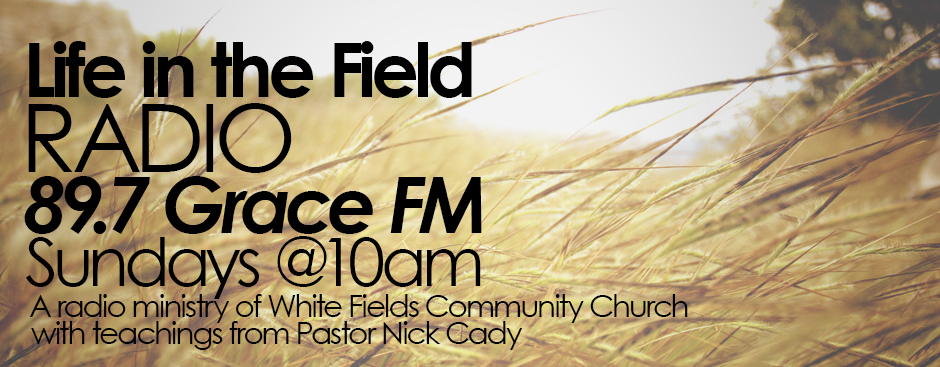
Life in the FieldAs of this past Sunday (March 8), those of you on Colorado’s Front Range can now hear me on the radio every Sunday morning on GraceFM (89.7 for Denver, Boulder, Fort Collins areas & 101.7 in Colorado Springs) from 10:00-10:30 AM.

Our church service at White Fields starts at 10:00 AM – as do many other churches. So why this time slot? Because our aim is to reach people who are not in church!

The program is titled Life in the Field, because our desire is to bring the Gospel message of Jesus Christ into people’s lives, so that they can live out God’s mission in his mission field – hence: Life in the Field.

In addition to our weekly broadcasts, we’re also archiving all of our episodes on SoundCloud (click here for our SoundCloud account), so you can listen to them at your connivence on any device.


How to Make a Difference in the World

I love the way John Piper speaks about God.

If there’s one thing you can say for the man – it’s that he is certainly not indifferent about the Gospel or the things of God. I may not always agree with everything he says, but when I hear him speak about God, there is no doubt in my mind that he is a man who loves God.

Here’s some classic John Piper for your listening pleasure:

Family Christian Stores Files For Bankruptcy

America’s largest Christian retailer, Family Christian Stores, has filed for chapter 11 bankruptcy protection.

This doesn’t mean that they are closing down; they are doing this in order to save their company. They are going to restructure and try to stay in business.

Perhaps most interesting though, is that while Family Christian Stores is floundering, Lifeway Christian Bookstores is expanding.

What’s the difference between these two?  In short, I would put it this way: Lifeway has higher standards about what they sell and how they do business.

Earlier this year, when it came out that a certain big name pastor/author had committed rampant plagiarism, Lifeway immediately dropped his books from their shelves. Family Christian Stores, on the other hand specializes in cheesy Christian paraphernalia and selling whatever sells. I remember going into one of their stores once and being surprised to see a particular book on their shelves. My wife asked the manager why they sold that book – his response was very telling: he said he was ashamed to have that book on their shelves too, but corporate said that they had to, because they are first and foremost a business and people buy that product.

It would seem to me that the reason Family Christian Stores is struggling whereas Lifeway is flourishing must somehow be attributed to the fact that Christians actually have higher standards and are more discerning as to where they spend their money and what values they want their retailers to represent than Family Christians Stores gave them credit for.


The Eschatological Significance of the Christian Sunday

Following up on a previous post on why Christians worship on Sunday and the correlation between the Jewish Sabbath and the Christian Sunday, I recently read something I found interesting.

While many people assume that Christianity just took the Jewish idea of Sabbath and moved it to Sunday, it turns out the reason for the Christian Sunday is deeply eschatological.

Check it out:

Jewish Sabbath

  • End (Saturday)
  • Rest from Creation
  • Happens after creation, within time: retrospective
  • Keeping of obligations
  • Preservation

Christian Sunday

  • Beginning (Sunday)
  • Commencement of the New Creation
  • Speaks to the aim of new creation: eternity = future-oriented
  • Celebrates that the obligations have been met by God through Christ
  • Resurrection

Christianity was not just a rebranding of Jewish practices, but an eschatological fulfillment of them.

The Christian Sunday is more than a day of rest for Christians, it is a day of new creation. In it, we remember not only to rest from our labor, but we are reminded that with the resurrection of Jesus, we stand at the dawn of eternity – and that one day soon, the Son will break over the horizon and usher in the New Day. In the death and resurrection of Jesus Christ we have witnessed the death of death and the birth of “the life that is truly life”.

When I Don’t Feel Like Going to Church

The story of told of the man whose wife came in to wake him up on a Sunday morning:

It’s time to get up honey, you need to get ready for church!  You’re going to be late!

I don’t want to go to church today!  It’s boring and the people there are all jerks and nobody is nice to me.  

But honey, you have to go to church!  You’re the pastor!

Now, just to be clear: I LOVE going to church!  And not just because I’m the pastor.  But I do know that some people sometimes struggle for various reasons with not feeling like they want to go to church.

I would encourage you with the words of Paul’s letter to the Galatians: That going to church, being in fellowship, joining in prayer, singing songs of praise and worship to God, partaking in Communion, hearing the Scriptures read aloud and expounded upon, hearing the Gospel message proclaimed and applied to real-life scenarios – these things are tantamount to “sowing to the Spirit”.

Paul says in Galatians 6:

Do not be deceived: God is not mocked, for whatever one sows, that will he also reap. For the one who sows to his own flesh will from the flesh reap corruption, but the one who sows to the Spirit will from the Spirit reap eternal life. And let us not grow weary of doing good, for in due season we will reap, if we do not give up. (Gal 6:7-9)

When you don’t feel like going to church, I encourage you to make the choice to sow to the Spirit – take that hour and a half out of your Sunday morning to sow to the Spirit and you will, in due season, reap a harvest of joy and life and righteousness.

Worship: Offering, Receiving and Shopping

Another thought-provoking comment from my studies on the history of Christian worship:

At some time in the Church’s history, attitudes seem to have moved from an earlier sense of going to worship in order to make an offering to God (worship, adoration) to a sense of attending in order to receive something (a blessing or some kind of credit). It appears that along with this shift came an increasingly passive role for worshippers, until it seemed that simply attending was almost all that was expected. Such a development is seriously demeaning. Everything done together in worship may (and should) be viewed as an act of offering a gift to God, who is the object of reverence and praise.

Seems pretty spot on to me. I shared this quote with one of the elders of White Fields Church and his comment was that he would go so far as to say that in our consumer culture, people have gotten so passive about “worship” that they not only come with the mentality and expectation primarily to receive, but they “shop” for where they can find the best bargain.

The part of the above quote which really sticks out to me is the word “demeaning”. I think the author is right. But how do we go about shifting this consumer culture in the minds of Christian people? That is the challenge.

What Makes for Good Preaching?

What differentiates good preaching from mediocre preaching?

Surely you know it when you hear it, but it can’t be just a subjective thing – there must be some criteria that differentiate good preaching from not-as-good preaching.

I recently heard Timothy Keller differentiate between good preaching and great preaching. He said that “good preaching” is the altar and that “great preaching” is when God brings the fire upon the altar. In other words: preachers shouldn’t strive to preach “great” sermons, but should work to preach “good” sermons – because only God can take a “good” sermon and by the power of the Holy Spirit make it a “great” sermon within the hearer.

So what makes for good preaching?

Here are some thoughts:

  • A good sermon, no matter what text it is preached from, has to preach the Gospel. Just as every town in England has a road which leads from it to London, every text in the Bible has a road from it which leads to Christ. If all the Scriptures ultimately point to Him, a good sermon must preach the Good News of Jesus Christ.
  • Yet, a good sermon must be faithful to the text. It must not manipulate the text to simply be a “proof text” to back up the point that the speaker wants to make; it must be true exegesis, which determines what the author, and God through the author, intended to communicate through that text.
  • Furthermore, good preaching is an art form – it must be informative, it must be touching emotionally, and it must be moving inspirationally.  I heard Timothy Keller say that when you are preaching, people should be taking notes, but when you get to the part of your sermon that is about Jesus, you should seek to portray him as so captivating that people can’t help but stop taking notes when you talk about Him, and when they leave, they should leave wanting to do something because of what they’ve heard.
  • Another friend of mine – and an elder at White Fields Church – put it this way:
    • In our conversation he even put it this way: “A good sermon takes you to a place you’ve never been before, or it takes you to a place that is so intimate that you are emotionally moved”

What do you think?  What are other essential elements of “good” preaching? Let me know your thoughts in the comments section below.

Bad Church Statistics

I ran across this article this week about Bad Church Statistics and the lies that are commonly believed as a result. I’ve copied the 7 myths part below, which is the core of the article.

I don’t know about you, but I have heard almost all of these before. I guess the sky isn’t falling quite as bad as we’ve been told it is. But, as Winston Churchill said: “A lie gets halfway around the world before the truth has a chance to get its pants on.”

Myth #1. The divorce rate among Christians is as high as that of nonbelievers.

Reality: Christians have significantly lower divorce rates than the religiously unaffiliated. Further, the more regularly a Christian attends church, the less likely that person is to divorce.

Myth #2. Christian young people are leaving the Christian faith in record numbers.

Reality: It’s true that younger people are less affiliated with church than older people, but that’s the case in every generation since scholars began tracking it. We always need to help the next generation connect with church, but the overall percentage of Americans who affiliate with evangelical churches has remained rather stable for the last 30 years.

Myth #3. The majority of American evangelicals are poor and uneducated.

Reality: This quote from the Washington Post has some truth to it. The problematic term is “the majority of” which should be replaced with “many.” On average, evangelical Christians are less well educated than mainline Protestants, Catholics and the religiously unaffiliated. But evangelicals cover a wide spectrum from poorly educated to highly educated. Themajority, however, are not poor and uneducated.

Myth #4. The prayer life of American evangelicals is diminishing.

Reality: It turns out that evangelical prayer is on the increase. For example, 75% of evangelicals today pray on a daily basis, compared to 64% of those in the 1980s.

Myth #5. Evangelicals are less active in sharing their faith with others.

Reality: About half of all evangelicals report sharing their faith with non-believers, and rates of evangelism have held rather steady over the past several decades. This evangelism rate is more than double the rate of mainline Protestants and Catholics, and is higher than most other religions. We all have family and friends who seek a closer relationship with God, plus we know of entire people groups that have little exposure to the Gospel, so let’s keep ramping up our efforts.

Myth #6. Evangelicals preach one thing about sex outside marriage, but practice another.

Reality: Actually, evangelicals have relatively low rates of adultery, premarital sex and pornography usage, and these decrease with more frequent church attendance.

Myth #7. The more educated you become, the more likely you are to give up your faith.

Reality: Belief and practice grow stronger with increased education, evangelicals included.