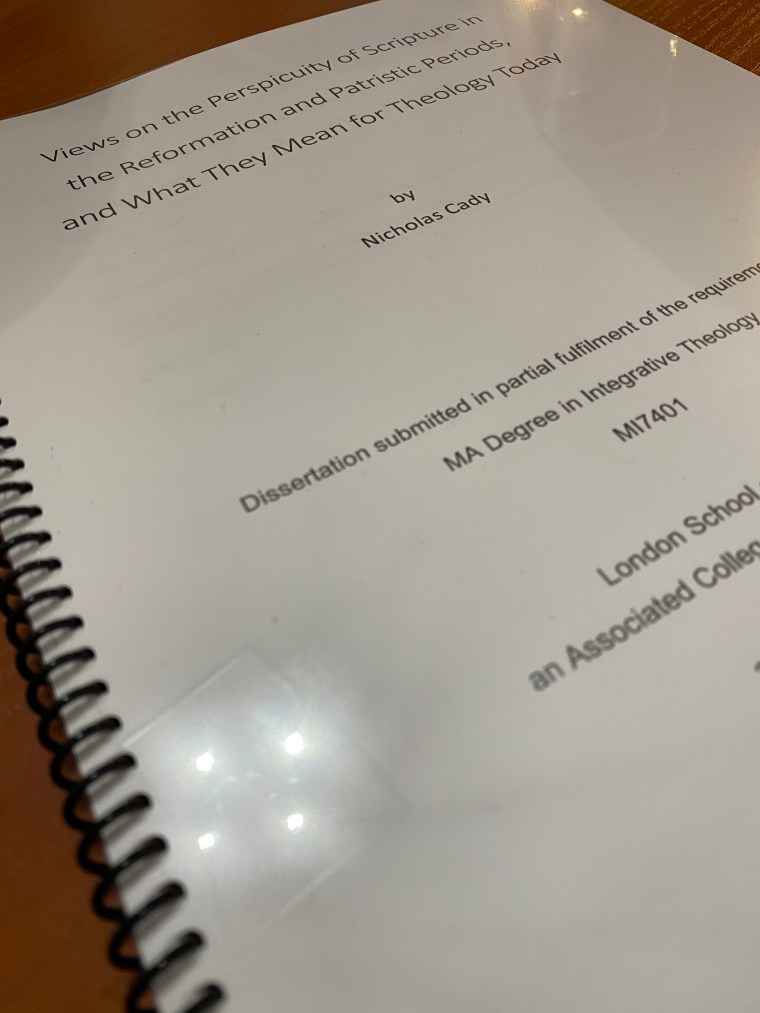
Three years ago I wrote this post announcing that I would continue my theological education at London School of Theology, to get a Masters in Integrative Theology.
This was a 3-year program, and earlier this week I submitted my dissertation, which I worked on for the past year. I learned so much over the past three years, but I am also glad to be finished.
The title of my dissertation was “Views on the Perspicuity of Scripture in the Reformation and Patristic Periods, and What They Mean for Theology Today”
Working on my dissertation is the main reason why I have not been writing as much lately on this blog.
Now that I’m done with school, I intend to write more, including several articles based on the topic of my dissertation, in case you’re curious what the “perspicuity of Scripture” is or what conclusions I came to.
I just hope they won’t cancel the graduation ceremony, as a trip to London when I was finished was part of how I got my wife and kids on board with supporting me to do this program!
The Bible Learning Center is something that has been on my heart for a long time, and I’m excited to see it begin.
In the past we have taught classroom-style classes at White Fields on topics such as Church History, Christocentric Hermeneutics, and more, but over the past year I handed the development of the Bible Learning Center off to a team who have really laid the groundwork for this to become more of what we originally envisioned:
I like to describe it as: “Bible college for people who don’t have time to go to Bible college.” Think: community college meets Bible college.
The Bible Learning Center will have a two-year non-accredited credit based curriculum, aimed at preparing believers for ministry in the world, whether relational or vocational. If you only want to take a few classes which interest you, that’s possible. If you want to do the entire program, which seeks to give a well-rounded offering of essential and elective classes, that is also possible.
This first semester will be limited because of COVID-19, but we will be offering three 6-week classes starting October 5, 2020:
Monday nights, 7:00 PM: Walk Through the Bible with Pastor Nick Cady
Monday nights, 7:00 PM: Worship Guitar Workshop with Pastor Michael Payne
Tuesday nights, 7:00 PM: Spiritual Transformation – a study of 1 Peter with Pastor Ken Cartlidge
A lot of people say children are a gift from God. If that’s true, then why would God give a pedophile children?
It isn’t just people who say that children are a gift from God; God himself says that children are a gift from Him.
Psalm 127:3 says, “Behold, children are a gift of the LORD, The fruit of the womb is a reward.” (NASB)
In the 1989 movie Parenthood, Keanu Reeves’ character says something profound:
You know Mrs. Buckman, you need a license to buy a dog. You need a license to drive a car. Hell, you even need a license to catch a fish. But they’ll let any butt-reaming a**hole be a father.
Keanu Reeves as Tod Higgins in Parenthood
Keanu Reeves in Parenthood
When we lived in Hungary, we adopted a child whom we had guardianship over for years. The process included a gauntlet of intrusive tasks: home inspections, psychological examinations, classes, fees. During a week-long class, one of the other prospective adoptive parents expressed his frustration that it seems unfair people who want to help children in need by adopting them are put through such a rigorous process, when someone who becomes a parent biologically doesn’t have to do anything.
At the same time, we also visited orphanages where children were abandoned because they were either unwanted, or the parents were unable to care for them.
Here in Colorado, our church is involved in helping children in kinship and foster care, who oftentimes end up in these situations because of abuse or neglect.
We’ve known people over the years who would have been great parents, but struggled with infertility, or were unable to have children because of other medical issues.
It seems like an incredible injustice that many who want to have children cannot, while many who should not have children do. Is God somehow irresponsible in his distribution of children? And if it is merely a natural, biological occurrence, then why does the Bible insist that children are a gift from God?
The Principle
The reason for the principle, that children are a gift, is intended to shape the way we think about human life.
Life, the Bible says, is sacred. Human beings are created in the image of God, and though we are fallen, we continue to bear the image of the divine, even if it is marred within us. Alone out of all creation, this is unique to human beings. This is why it is allowed for human beings to ethically kill and eat animals, but human life is different.
Many ancient people considered children to be a nuisance. God wanted people to treat children as treasures.
This can be seen with Jesus; when his disciples tried to shoo away the children who wanted to come to Jesus, assuming that their master was too great a person to be bothered by annoying little children, Jesus corrected them and said, “Allow the little ones to come to me, for to such belongs the Kingdom of Heaven.”
One reason why little children were not valued very highly in ancient society is because they were not able to contribute or produce anything. Furthermore, young children were particularly susceptible to disease and death. So the feeling of many was that once (and if) the child grew to the point where they could be a contributing member of society, then their life would have value. God said: No, children are not a drain, they are a gift.
The principle is that children are to be considered a gift, and human life is to be treasured.
The Curse
As human beings, we are fallen. We ourselves and the world we live in languish under a curse: the curse of sin and death. This curse has far-reaching implications: it means that the world does not work the way it was originally designed to, and neither do we.
The results of this curse include sickness, hatred, envy, strife, selfish and hurtful actions, as well as all kinds of deviant behavior, and ultimately death.
We were not designed to struggle with infertility, we were not designed to abuse others, nor to suffer abuse at the hands of others.
Every human being lives under the cloud of this curse their entire life, and we all suffer from its effects in all kinds of forms. This is tragic. So tragic, that God became one of us in Jesus Christ to put an end to it forever.
Human life is still a gift and is still precious, even though human beings suffer here on Earth.
Identity and Responsibility
To say that someone is a pedophile is to define them by their sin. Rather than saying that God gives children to pedophiles, it would be more accurate to say that God gives children to people, and tragically, some people choose to harm children.
Here is how the Bible explains this:
Let no one say when he is tempted, “I am being tempted by God,” for God cannot be tempted with evil, and he himself tempts no one. But each person is tempted when he is lured and enticed by his own desire. Then desire when it has conceived gives birth to sin, and sin when it is fully grown brings forth death.
James 1:13-15
To ask the question of why God allows people to be parents if he knows ahead of time that they will one day commit abusive acts against their children is akin to taking responsibility away from the sinner and placing it upon God, and this issue gets into the classic Trilemma of Theodicy:
A trilemma is like a dilemma, only instead of two issues (di) that are at odds with each other, in a trilemma there are three (tri).
The trilemma of theodicy states that there are three things the Bible states are true about God, which cannot all be true at the same time:
God is loving
God is all-powerful
Evil exists
The argument goes that since evil exists, either: God must not really be loving, or God must not really be all-powerful. Either God is incapable of stopping evil, even though he’d like to – in which case he is not all-powerful, or God is capable of stopping evil, but chooses not to, in which case he must not be truly loving.
The logical flaw in the trilemma
The big flaw in this thinking is that it takes into account only two of God’s attributes: his love and his power.
But does God have only two attributes? Certainly not! God has a myriad of attributes, including that he is: all-knowing, providential, eternal, etc. Simply adding another attribute of God to the equation changes it fundamentally, and removes the “lemma” out of the tri-lemma!
For example, if we say that God is not only loving and all-powerful, but also all-knowing and/or providential, it changes things completely. It means that it is possible for God to allow bad things and use them for good purposes, and even for our ultimate benefit. The fact that God is eternal reminds us that comfort in this life is not the pinnacle of existence, therefore it is also possible for an eternal God to allow temporal hardship in order to work an eternal good purpose. The Bible says this explicitly in 2 Corinthians 4:17 – For this light momentary affliction is preparing for us an eternal weight of glory beyond all comparison.
Thankfully, even in the most horrific situations, there is hope:
The Hope
Why is human life still a gift, if a person suffers abuse?
While on the one hand, the human experience is irreconcilably tainted by suffering, human life is a gift because it carries with it the hope of redemption.
The promise of the gospel is that no matter what horrors a person might suffer here on Earth, in this broken world at the hands of broken and evil people, because of what Jesus did, redemption is possible.
And what redemption looks like is a new world, in which all that is wrong is made right: in which injustice and evil are judged, in which an end is put to suffering once and for all.
Then I saw a new heaven and a new earth, for the first heaven and the first earth had passed away, and the sea was no more. And I saw the holy city, new Jerusalem, coming down out of heaven from God, prepared as a bride adorned for her husband. And I heard a loud voice from the throne saying, “Behold, the dwelling place of God is with man. He will dwell with them, and they will be his people, and God himself will be with them as their God. He will wipe away every tear from their eyes, and death shall be no more, neither shall there be mourning, nor crying, nor pain anymore, for the former things have passed away.”
Revelation 22:1-4
Human life, despite its suffering, carries with it the hope of eternal life and redemption.
Speaking of this redemption, Paul the Apostle says:
For I consider that the sufferings of this present time are not worth comparing with the glory that is to be revealed to us. For in this hope we were saved.
Romans 8:18,24a
The pages of Scripture are full of the story of the people who suffered greatly.
Some were tortured, refusing to accept release, so that they might rise again to a better life. Others suffered mocking and flogging, and even chains and imprisonment. They were stoned, they were sawn in two, they were killed with the sword. They went about in skins of sheep and goats, destitute, afflicted, mistreated… But God has provided something better for us.
Hebrews 11:35-37,40a
May we take hold of this promise and hope by faith in Jesus and what He accomplished for us, so we can experience life and redemption!
Maybe you have heard this story before as an analogy seeking to explain different religions:
The Parable
Six blind men are touching an elephant and trying to determine what it is.
One man touches the side of the great animal and says: “An elephant is a wall!” Another grabs his ear and says: “An elephant is like a fan!” Another touches the tail, and declares that an elephant is like a rope. Another touches the trunk and declares that an elephant is a type of snake.
All of these men are touching something that is real, but because the thing itself is so big, and they are only touching part of it, the determinations they make about what it is are deficient. None of them have the whole picture, and their experience, while real, leads them to describe only the part of the elephant that they experienced.
The implication is that other people’s experiences are also valid, but that each part – or each religion in this case – while reflecting a real perception of part of the divine, still falls short of understanding the whole. According to this explanation, no religions are actually wrong, nor are any fully right; we are all just blind people groping at something very big and trying to describe and make sense of our experiences.
This parable is very popular. It is often mentioned in introductions to college classes on comparative religions. It is listed on the Peace Corps website, to describe how they think their participants should view world religions.
The Problems with the Parable
There are three enormous problems with this analogy.
Problem 1: The Vantage Point
The whole story is told from the vantage point of someone who clearly knows that the elephant is an elephant. In other words, it is extremely condescending; it judges all religions as being “blind people” trying to describe something that others can clearly see.
The analogy patronizingly pats religious believers on the head and says, “Isn’t that cute, you think the elephant is a snake because you can’t see what I see.”
For an organization like the Peace Corps, or anyone else to use this analogy to describe other people’s beliefs, is patronizing and judgmental, and takes the posture of a superior looking down on inferiors who do not know as much as they do.
Problem 2: Blind Men are Lazy?
The analogy also assumes that the blind men stop their search after their first encounter with the elephant. Are these “blind men” so lazy that they never explore other parts of the elephant? Do they touch it once and then give up their research into what an elephant is?
Furthermore, it assumes that the men are incapable or unwilling to communicate with one another. Again, this is not a fair description of what faith in God entails.
Problem 3: What if the Elephant Talks?
On the one hand, this analogy is a good description of the grandness of God and the human inability to fully grasp the divine, as well as our state of “blindness” when it comes to spiritual matters.
But the story never considers one paradigm-shattering question: What if the elephant talks?
What if the elephant could tell the blind men, “That wall-like part is actually my side. The fan-like part is my ear. That’s not a rope, it’s a tail. What feels like a snake is my trunk.”
If the elephant were to say these things, it would be a form of self-revelation.
Furthermore, if one of those who could see the entire elephant were to come and describe it to the blind men, and explain it to them, then they would understand.
What we have in the God of the Bible, and in Christianity in particular, is that God has revealed himself to us, both by sending us prophets and messengers, and by speaking directly to us through His Word and ultimately through His Son – the Word of God embodied in a human person: Jesus Christ.
Long ago, at many times and in many ways, God spoke to our fathers by the prophets, but in these last days he has spoken to us by his Son
Hebrews 1:1-2
By God’s grace and because of His love, we are not condemned to merely grope around in the dark, trying to make sense of the divine for ourselves by our own limited experiences. He has made Himself known in His Word and through His Son.
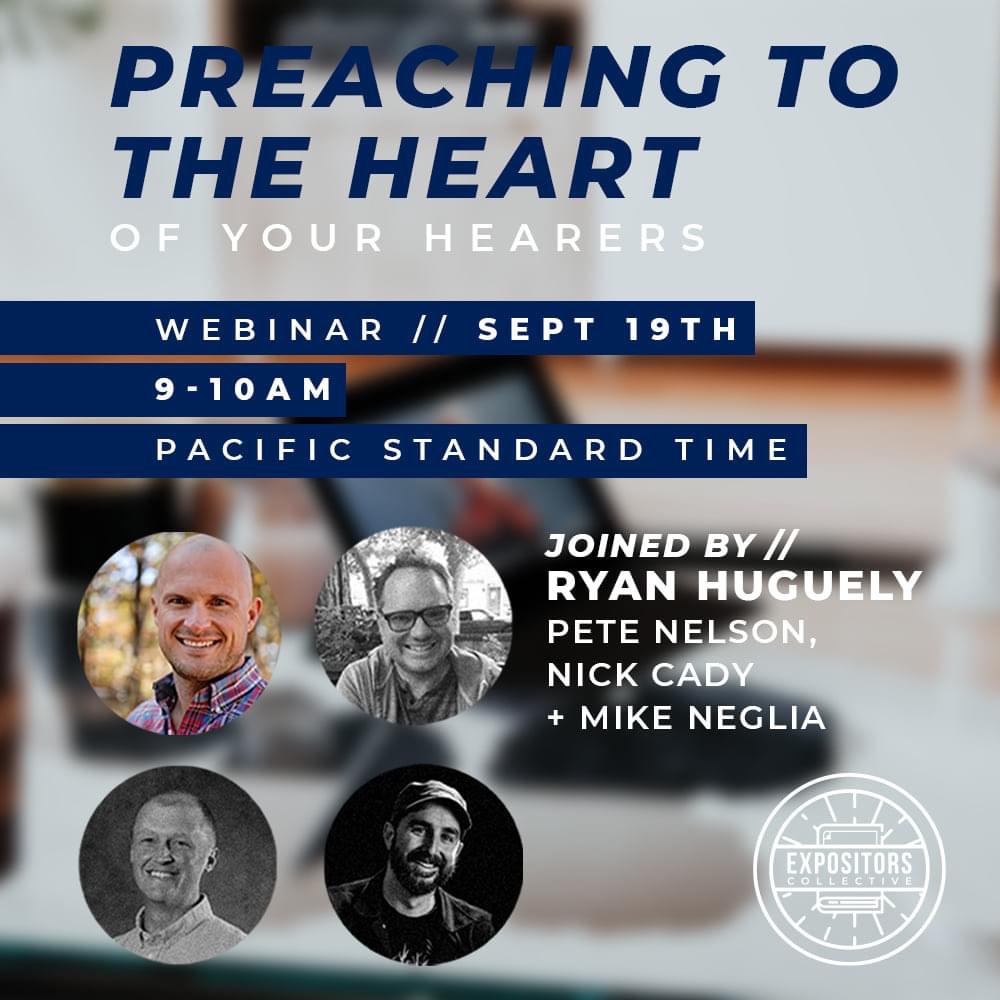
Because of the ongoing Coronavirus situation we postponed the Expositors Collective in-person two-day training weekends in Seattle and Honolulu, but we continue to look for ways to continue our mission to equip, encourage, and mentor the next generation of expository Bible teachers and preachers.
Our next webinar will be on September 19, 2020 from 9:00-10:00 AM Pacific Time (10:00-11:00 AM Mountain Time), and the theme is: Preaching to the Heart of Our Hearers.
Ryan has a heart to help teachers and preachers grow in their calling. He has been a guest on the Expositors Collective Podcast and we are excited to have him join us for this webinar which will include a short message followed by an opportunity to ask questions and discuss topics.
Here’s an audio clip from Ryan introducing the webinar:
This is a free event, but is limited to the first 100 who sign up, which you can do by clicking the button below.
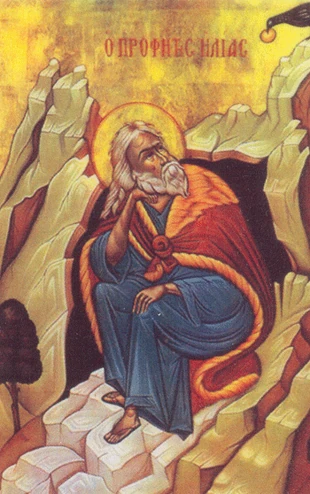
One of the questions this brings up, is in regard to the identity of John the Baptist. Was John the Baptist actually the return, or the reincarnation of Elijah?
Here are the key issues:
Elijah Never Died…
Elijah is one of only a handful of people in the Bible who never tasted death. Another is Enoch, in Genesis 5.
Some people speculate that maybe Moses never actually died, but was also taken by God before tasting death. The reason for that has to do with something in Revelation 11, which I will address further down in this article, but Deuteronomy 34:5 clearly states that “Moses died in the land of Moab according to the word of the Lord.” The speculation here comes from the idea that this chapter of Deuteronomy was not written by Moses, and therefore the writer only assumed that Moses died. That conclusion seems to be clearly in contradiction of what the text clearly states, however, and as people who believe in the inspiration of the Bible, we should reject it.
The Prophecies
Malachi 3:1, speaking about the coming of the Messiah, says: “Behold, I send my messenger, and he will prepare the way before me. And the Lord whom you seek will suddenly come to his temple; and the messenger of the covenant in whom you delight, behold, he is coming, says the LORD of hosts.”
Malachi 4:5, also speaking about the Day of the Lord and the coming of the Messiah says: “Behold, I will send you Elijah the prophet before the great and awesome day of the LORD comes. And he will turn the hearts of fathers to their children and the hearts of children to their fathers, lest I come and strike the land with a decree of utter destruction.”
The Words of Jesus
Here’s what Jesus had to say about John the Baptist:
As they went away, Jesus began to speak to the crowds concerning John: “What did you go out into the wilderness to see? A reed shaken by the wind? What then did you go out to see? A man dressed in soft clothing? Behold, those who wear soft clothing are in kings’ houses. What then did you go out to see? A prophet? Yes, I tell you, and more than a prophet. This is he of whom it is written, “‘Behold, I send my messenger before your face, who will prepare your way before you.’ For all the Prophets and the Law prophesied until John, and if you are willing to accept it, he is Elijah who is to come. He who has ears to hear, let him hear.
Matthew 11:7-15
Two important things here:
Jesus is claiming that John is the promised messenger from Isaiah 40:3 who would prepare the way for the coming of the Messiah.
Jesus is claiming that John is the fulfillment of Malachi’s prophecy about the messenger in Malachi 3:1.
This statement of Jesus that “if you are willing to accept it, he is Elijah who is to come” has led some people to believe that John was the return, or reincarnation of Elijah. However…
The Claim of John the Baptist Himself
John the Baptist explicitly denied being Elijah the Prophet:
And this is the testimony of John, when the Jews sent priests and Levites from Jerusalem to ask him, “Who are you?” He confessed, and did not deny, but confessed, “I am not the Christ.” And they asked him, “What then? Are you Elijah?” He said, “I am not.” “Are you the Prophet?” And he answered, “No.” So they said to him, “Who are you? We need to give an answer to those who sent us. What do you say about yourself?” He said, “I am the voice of one crying out in the wilderness, ‘Make straight the way of the Lord,’ as the prophet Isaiah said.”
John 1:19-23
Rather, John identifies himself as the promised messenger from Isaiah 40:3, which Jesus also identified him as.
Are John and Jesus contradicting each other?
Some people believe that John was in denial about his identity as Elijah…
I don’t believe either of these options to be true, rather there is a simple explanation:
“The Spirit and Power of Elijah”
In the Gospel of Luke, chapter 1, when the angel Gabriel is telling Zechariah (John the Baptist’s Father) about who his son will be, he says that John “will turn many of the children of Israel to the Lord their God, and he will go before him in the spirit and power of Elijah, to turn the hearts of the fathers to the children, and the disobedient to the wisdom of the just, to make ready for the Lord a people prepared.” (Luke 1:15-17)
Here, Gabriel is quoting from Malachi 3:1 and 4:5. This tells us that those verses are speaking about the same person, and it tells us that that person is John.
In conclusion, John the Baptist was not literally Elijah, i.e. the reincarnation of Elijah, rather he is a prophet sent by God in the spirit and the power of Elijah.
This is why Jesus said John “was Elijah, if you are willing to accept it.” In other words, John is the fulfillment of the coming of the prophet Elijah in the sense that he came in the spirit and power of Elijah, but he is also not literally Elijah reincarnated.
The Transfiguration
Further proof of this fact is that Elijah himself appeared at Jesus’ transfiguration (Matthew 17:11-12), not John the Baptist.
Furthermore, both Herod and the people distinguished between Elijah and John the Baptist (see Mark 16:14-16 & 8:28)
Will Elijah Come Again During the Great Tribulation?
Revelation 11 describes two witnesses who will come on the scene during the Tribulation, a time of great trouble for the world before the return of Jesus.
And I will grant authority to my two witnesses, and they will prophesy for 1,260 days, clothed in sackcloth.” These are the two olive trees and the two lampstands that stand before the Lord of the earth. And if anyone would harm them, fire pours from their mouth and consumes their foes. If anyone would harm them, this is how he is doomed to be killed. They have the power to shut the sky, that no rain may fall during the days of their prophesying, and they have power over the waters to turn them into blood and to strike the earth with every kind of plague, as often as they desire. And when they have finished their testimony, the beast that rises from the bottomless pit will make war on them and conquer them and kill them, and their dead bodies will lie in the street of the great city that symbolically is called Sodom and Egypt, where their Lord was crucified. For three and a half days some from the peoples and tribes and languages and nations will gaze at their dead bodies and refuse to let them be placed in a tomb, and those who dwell on the earth will rejoice over them and make merry and exchange presents, because these two prophets had been a torment to those who dwell on the earth. But after the three and a half days a breath of life from God entered them, and they stood up on their feet, and great fear fell on those who saw them. Then they heard a loud voice from heaven saying to them, “Come up here!” And they went up to heaven in a cloud, and their enemies watched them.
Revelation 11:3-12
From the descriptions given of the two witnesses, it seems clear that allusions are being made to Elijah and Moses.
In 2 Kings 1, when Ahaziah sent soldiers to arrest and assumedly kill Elijah, Elijah called down fire from Heaven to consume them. This isn’t exactly “fire pouring from their mouths to consume their foes” but it is similar.
Elijah did shut the sky by his prayers so it did not rain (1 Kings 17 & James 5), and Moses struck the waters and they turned to blood.
Some people assume that it is because Elijah did not die that he is able to return, and that this might be a further fulfillment of Malachi 4:5, in this case Elijah returning in the flesh as opposed to John the Baptist coming in the spirit and power of Elijah. This is also the reason why some people assume that Moses never died, because they assume that the reason Elijah is able to come back is because he never tasted physical death. Others speculate that perhaps the second witness is Enoch, the other person in the Bible who never tasted death.
However, I am not convinced that having never died is a prerequisite for being one of these witnesses. Although they didn’t die physically, their Earthly lives did end.
Furthermore, it seems that if John the Baptist could fulfill Malachi 4:5 by coming in the spirit and power of Elijah, it is not necessary that these two witnesses be the literal reincarnations or reappearances of Elijah and Moses; they could be people who come in the spirit and power of those men.
Conclusion
In summary: John the Baptist was Elijah in that he came in fulfillment of Malachi 3:1 & 4:5, and he came in the spirit and power of Elijah, but he was not a reincarnation of Elijah himself.
COVID-19, social unrest, natural disasters… A lot of people have been asking what these current events mean in light of Bible prophecy.
Does the Bible speak about these events – and if so, what does it say?
Furthermore, if the return of Jesus is imminent, what does it mean for us to be “ready” for His return?
Some people believe that to be ready means to stockpile food and guns – you know, so you can shoot your neighbors when they get hungry and try to take your food, right?! I’m quite sure that’s not what Jesus wants us to do, and it’s not what it means to be ready for his return.
So, what does it mean for us to be “ready” for Jesus’ return? If we are living in the last days, what should we be doing?
Mike and I sat down to discuss these questions in our latest video. Check it out:
Doctors tell us that children in the womb are able to recognize their mother’s voice and differentiate it from the voices of others. Even though they’ve never seen their mother, they know and respond to her voice.
How are babies able to differentiate their mother’s voice from other voices they hear? Because their mother’s voice is the voice they hear and listen to most often.
What voices are you listening to the most?
Right now, more than ever before, there are a lot of voices out there vying for your attention. It used to be that everybody had an opinion, but now everyone has a platform.
Mobile devices are designed not primarily for creating content, but consuming it.
If you don’t think that you are being shaped by the content you consume, think again. So choose wisely!
You can spend your time listening to the voices of political pundits, reading all kinds of articles, you can spend your time listening to the voices of everyone on social media…
The content you consume not only conveys information, it has a teleology, in other words: it aims to lead you somewhere. To use a biblical term: they seek to make you disciples of their beliefs and attitudes.
Just like a baby in its mother’s womb: whose voice do you want to be most familiar with? Whose voice do you want filling your ears and shaping your thoughts the most?
Many people today are being discipled more by social media, politicians, and influencers than by Moses, Isaiah, Paul, and Jesus.
May I encourage you instead to spend more time listening to the voice of God than to all those other voices?
As you immerse yourself in the Word of God, it tunes your heart to God’s voice and it familiarizes you with his voice. As you read and study the Bible, you get to know God’s voice and God’s heart, and you become familiar with the kinds of things God says.
Jesus described himself as the Good Shepherd, and he said that his sheep know his voice and will not follow the voice of another. (John 10:4-5)
When it comes to hearing God’s voice: the most reliable, most certain way to hear God’s voice is to immerse yourself in the words of Scripture.
Let me encourage you to make His voice the voice you listen to the most. He alone has the words of eternal life, and everything that pertains to life and godliness.
Here is a recent message I taught at White Fields Church on the topic of hearing God’s voice:
Men, join me September 11-12, 2020 in Cheyenne, Wyoming for a men’s conference. I will be teaching two messages from the life of Gideon in the Book of Judges.
Details about the conference are in the image below:
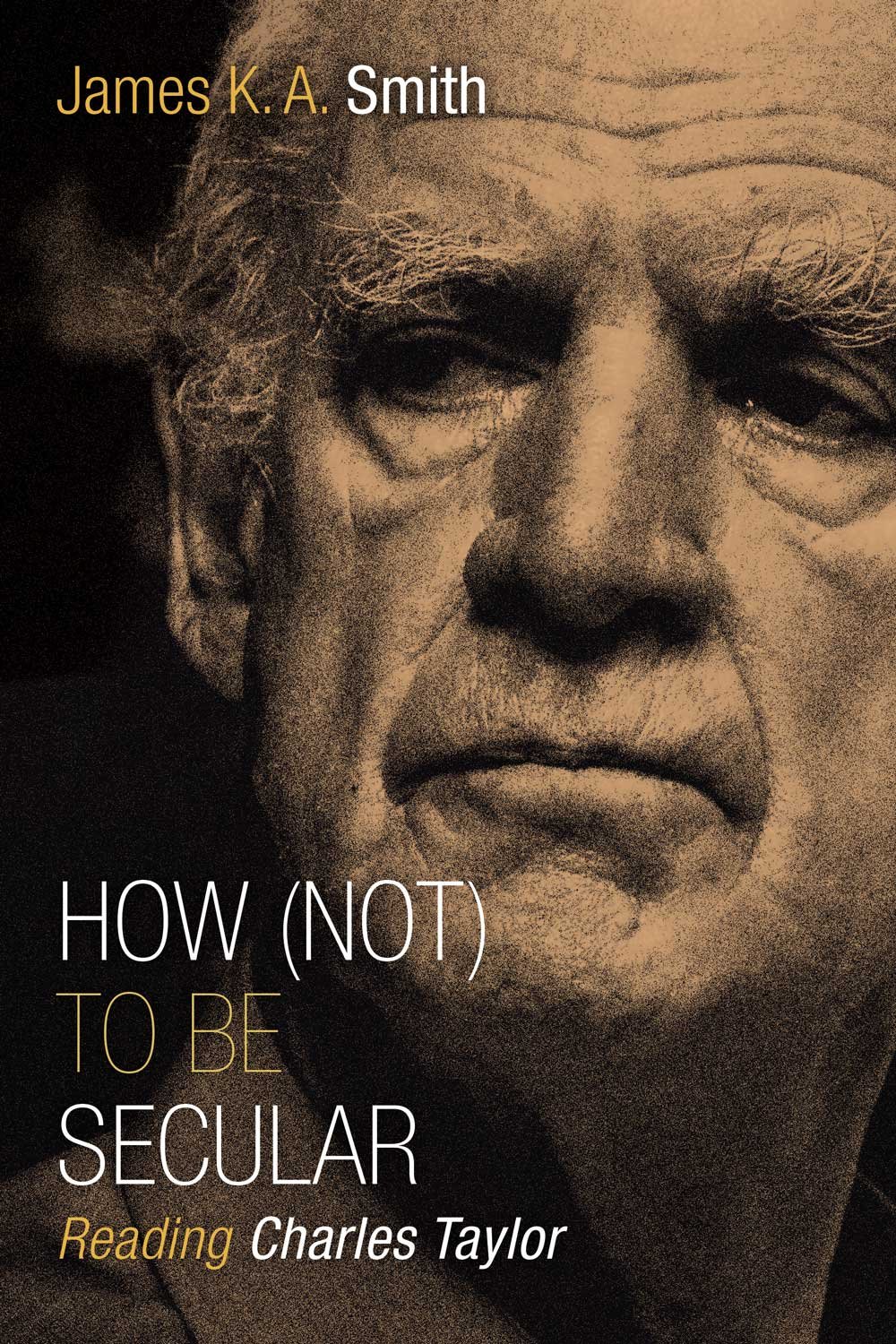
Looking for some light reading? How about an audio book for your next leisurely drive? This might not be it. If you’re looking for a short but extremely thoughtful book with intensely helpful cultural insights, then here you go:
Smith’s purpose in writing a book about a book is that A Secular Age is both intimidating in its size and is written in a way which is inaccessible to many readers who would benefit from its content. I for one, though I am intrigued by Taylor’s book and its analysis of modern secular culture, balked at the 900+ page tome.
The Imminent Frame: Haunted by Transcendence
Smith’s book introduces you to Taylor’s key concepts and arguments, as well as some of his key terms, such as his analysis of the secular mindset as the “imminent frame.” This reminded me of a conversation I had with a relative years ago, who is my same age (an older millennial); when we started talking about the existence of God, she said, “Maybe God does exist, but: who cares?”
The imminent frame is only concerned with what is right in front of them, “the here and now”, and yet, Taylor explains that exclusive humanists who inhabit the imminent frame are “haunted by transcendence.” Smith points this out by quoting lyrics from The Postal Service:
And I’m looking through the glass Where the light bends at the cracks And I’m screaming at the top of my lungs Pretending the echoes belong to someone Someone I used to know
The Postal Service, “We Will Become Silhouettes”
Basically, no matter how much a person claims to not care whether God exists, or there is life after death, they are haunted by thoughts of it. I remember another family member describing how utterly terrified she was of dying, yet when I asked her what she believed about life after death, she said she doesn’t know, and assumes there is nothing. I don’t believe her: why be afraid of nothing? There is a nagging, haunting hunch in the heart and mind of every person, that there is something more than this life and this world… A God to whom they will answer, an existence beyond the grave.
Another aspect of the secular, exclusive humanism is the concept Taylor called “the buffered self”, which refers to the idea that an individual is an island unto themselves: that there is a firm boundary between the self and others, as opposed to the “porous self” which characterized people in previous eras.
Epistemic Pelagianism
James K.A. Smith’s book is not just a summary though, he also applies many of Taylor’s ideas to Christianity: both how Christianity contributed to and is influenced by this modern secular age.
I first listened to half of this book via audiobook on a drive to climb La Plata Peak, a Colorado 14-er. Later on, I picked up a hard copy to read as well, as there are some parts of the book which aren’t particularly well-suited for digesting properly listening at 1.5 speed while driving at dawn through the mountains.
One phrase Smith used, which my friend who was listening with me in the car ended up discussing for a while afterwards was: Epistemic Pelagianism. It’s the kind of phrase that forces you to hit the pause button and break it down in order to unpack what these two words together mean.
Epistemology = the theory of knowledge, especially with regard to its methods, validity, and scope. Epistemology is the investigation of what distinguishes justified belief from opinion. Epistemology deals with questions like, “How can we know that what we believe is really accurate or true? To what degree do we have the capacity to accurately discern truth and/or reality?”
Pelagianism = Pelagius (354 – 418 AD) was a theologian who denied the doctrine of original sin. He argued for the innate goodness of human beings and for absolute free will. Pelagius argued for these things in contrast to Augustine of Hippo, who taught from the Scriptures that human beings are fallen, and our fallen condition affects our will and nature.
“Epistemic Pelagianism” therefore refers to the idea that as human beings, we are capable of figuring everything out by ourselves, without any help from God.
Epistemic pelagianism denies the fact that we don’t see everything clearly. It denies the idea that, apart from God’s intervention in our lives, we are fallen, limited beings whose hearts are not pure. It places far to much confidence, to the point of hubris, in our ability to accurately discern and interpret the data we take in, in a way that can lead us to all truth, apart from any intervention or help from God.
Rather than epistemic pelagianism, the Bible teaches us that without God’s help, we cannot see clearly, and are incapable of objectively assessing and interpreting things. We need God to remove the blinders from our eyes, in order for us to see clearly.
This biblical epistemology leads us to humility rather than hubris; it leads us to the conclusion that we can’t see or know everything, that we can be wrong.
The Bible teaches that we only see in part, as in a mirror dimly (1 Corinthians 13:12), that a natural person is incapable of comprehending all truth apart (1 Corinthians 1:14), that our hearts are fundamentally broken and have a tendency to mislead us (Jeremiah 17:9), and therefore it is possible to hear and not understand, to see and not perceive (Acts 28:26).
There are things that we can know (Romans 1:19), but even in those cases we have a tendency to suppress that knowledge if we don’t like the conclusions it would lead to (Romans 1:18)
Thus, confidence in our ability, or willingness for that matter, to comprehend and follow the truth, apart from God’s intervention, is misguided. Instead, we need to take a more realistic and humble view of ourselves, which admits that we need outside assistance in order to receive, comprehend, and appropriately respond to the truth.
Conclusion
Ultimately, we see that theology shapes the way you view all of life. Modern exclusive secularism is based, at least in some part, on bad theology which is clearly refuted in the Bible. Good, robust, comprehensive Biblical theology therefore, is an antidote to many modern philosophical pitfalls.
If you’re looking for an accessible book that helps you understand Charles Taylor’s piercing insights into the exclusive humanism which is prevalent in many of today’s Western cities, as well as the cracks in those theories, and ways in which the gospel uniquely speaks to people today, check out James K.A. Smith’s book How (Not) to Be Secular, but make sure to take the time to break down and digest each sentence.





![The Blind Men and the Elephant. [the BIG picture] | by Sophia Tepe | Betterism | Medium](https://nickcady.org/wp-content/uploads/2020/09/963fc-1-fxkvfupjw6oudlto3czha.jpeg)


 Theology for the People