This past Sunday at White Fields Church, we studied Hebrews 4:14-16, which describes Jesus as our compassionate high priest, who offered himself as the ultimate sacrifice to atone for our sins. You can listen to or watch that message here.
One of the questions that thoughtful listeners and readers of the Bible often ask is: “What do Jews today do to atone for sins since they haven’t had a temple in Jerusalem for almost 2000 years?”
As Christians, we have no need for further sacrifices to atone for sins, since Jesus was the ultimate sacrifice to atone for the sins of all people at all times (see 1 John 2:2). But what about the Jews? How do they make sense of their own law, and their inability to perform the sacrifices mandated in that law?
Clearly, the Law of Moses requires animal sacrifices to be made in order to remove guilt and atone for sins of individuals and the nation collectively, but since the temple was destroyed in 70 AD, what have Jews done with these texts?
What did the Jews do during the Babylonian captivity when the first temple was destroyed? Are there Jews today who want to reinstate animal sacrifices?
Furthermore, how is it that Jewish people still celebrate Yom Kippur (the Day of Atonement) if they are not able to make the sacrifice for atonement which was the whole point of the Day of Atonement?
Join us on Christmas Eve and Christmas Day for church services at White Fields Community Church in Longmont, Colorado.
Christmas Eve – 4:00 & 5:30 PM
On Christmas, we celebrate that God became a child so that we could become children of God.
We will have a special Christmas choir, sing classic Christ-centered Christmas carols, and have a candle-lighting at the end of the service.
Childcare will be available at the 4:00 PM service, and both services will be family-friendly.
Join us and bring a friend or family member!
Christmas Day – 9:15 AM
We are excited to have a service on Christmas Day this year! Join us as we celebrate how in Jesus, God became one of us in order to redeem us from sin and death, and give us the light of life.
Some time ago, I addressed some common, but incorrect claims that the origins of Easter are pagan: “Does Easter Come from Ishtar?”
But what about Christmas? Does Christmas have pagan origins?
Saturnalia and the Winter Solstice
Did Christians simply take over the Roman pagan festival of Saturnalia and repurpose it as a celebration of Jesus’ birth Is that why we celebrate Christmas around the same time as the winter solstice?
I used to believe this one myself. However, upon further investigation, it would seem this is not how the celebration of Christmas on December 25 came about. Here’s why:
We don’t actually know what time of year Jesus was born. The one thing we know is that it was almost certainly not in late December. The reason for this is because Luke’s Gospel tells us that the shepherds were watching their flocks by night, sleeping in the fields. In Israel it gets too cold in the winter for that; shepherds sleep outside from about March-September. Clement of Alexandria wrote that some believed May 20 was Jesus’ birthday, others believed it was April 19 or 20, still others believed it was in late March. [1]
Early Christians, along with the majority of ancient cultures, did not celebrate birthdays in the same way we do today. Only two of the four Gospels talk about Jesus’ birth. The early Christian writer Origen dismissed birthdays as something only celebrated by tyrants, such as Pharaoh and Herod in the Bible. [2]
Things changed in the early 300’s AD with the beginning of the celebration of Epiphany, which commemorated the revealing of the Messiah to the Gentiles at the coming of the Magi to see Jesus after his birth. This was celebrated in early January in the Eastern church, not because they believed this to be the birthday of Jesus, but because of how it fit into the liturgical calendar which gave a plan for teaching through key events in the Gospels every year.
The Western (Latin speaking) part of the church wanted to have a festival similar to Epiphany, and decided that since they did not know when exactly Jesus was born, they would have their festival of the celebration of the incarnation and the birth of Jesus in late December, before Epiphany – since the Magi would have arrived after the birth of Jesus.
Again, the decision of this date was based on liturgical calendars, not on the taking over of pagan festivals. It was considered significant, however, that the coming of “the light of the world” should be celebrated at the time of the year which is darkest in the Northern Hemisphere. After this date, the days get longer and the darkness wanes. This symbolism was not lost on early Christians, but rather considered to be a great symbol of the effect of Jesus’ entrance into the world.
Here’s what’s so interesting: there is a document from about 350 AD which tells us that Romans celebrated the festival of Sol Invictus Natali (the birth of the unconquered sun) on December 25, and that same document also tells us that Christians celebrated the birth of Jesus on this same day. There is no earlier evidence or report of a Roman pagan festival on December 25. In other words, it is just as likely that the pagan Romans chose this day for their pagan festivals because Christians were already celebrating the birth of Jesus on this day, and wanted to have their own counter-festival, than that Christians chose this day because of an existing pagan festival.
Furthermore, there is nothing particularly pagan about celebrating anything at the darkest part of year, right before the days start getting brighter. Judaism, for example, celebrates Chanukah – the Festival of Lights, in which they light candles in the darkness to celebrate God’s faithfulness at this same time of year. Pagans don’t own the symbolism inherent to the orbit of the Earth.
Are Christmas Trees Pagan?
There is some evidence that Roman pagans liked to decorate their homes with greenery during winter festivals, and that early Christians decorated their houses with greenery during Epiphany as well.
It should be remembered that in the ancient world, decorating with greenery in the winter was also common because it was bleak outside and they didn’t have Wayfair.com to depend on for affordable home decor.
Some people claim that these verses in Jeremiah are speaking about the practice of Christmas trees:
“Learn not the way of the nations…for the customs of the peoples are vanity. A tree from the forest is cut down and worked with an axe by the hands of a craftsman. They decorate it with silver and gold; they fasten it with hammer and nails so that it cannot move.
Jeremiah 10:1-5
Sounds like a Christmas tree, right? Except that’s not what it’s describing. What Jeremiah is describing is the creation of a household idol out of wood. Isaiah talks about a similar practice in which people would fashion an idol out of wood, stone, or metal, and then worship the very object they had just created.
The history of the Christmas tree dates back to medieval Europe, in the 14th and 15th centuries, during which December 24 was celebrated as “Adam and Eve Day” which was celebrated with the decorating of “paradise trees” by attaching apples to them (think how much bulbs look like apples) – a rarity during the winter, so they were considered treats. Because it was winter, and especially in Northern Europe, evergreen trees were popular to use for this. [3]
Modern Pagan Christmas?
Perhaps of bigger concern is the way in which our modern consumeristic Christmas traditions can detract from the celebration of Jesus and the incarnation which Christmas is meant to celebrate.
May we, even in the joys and the fun of our modern celebrations, not lose sight of what it is that we are celebrating this season: that to people like us who live in deep darkness, a light has shone; the promised Messiah has come to save us from our sins and give us the light of life forever! That is certainly something worth celebrating.
Justice Roberts was asked to give the commencement speech for his son’s graduating class, but the speech he gave was different than the advice and platitudes commonly given at such events. Rather than wishing them good luck, he essentially told them that he wished they would experience hardship, because of the important things which can only be learned through these experiences.
Now the commencement speakers will typically also wish you good luck and extend good wishes to you. I will not do that, and I’ll tell you why.
From time to time in the years to come, I hope you will be treated unfairly, so that you will come to know the value of justice. I hope that you will suffer betrayal because that will teach you the importance of loyalty. Sorry to say, but I hope you will be lonely from time to time so that you don’t take friends for granted.
I wish you bad luck, again, from time to time so that you will be conscious of the role of chance in life and understand that your success is not completely deserved and that the failure of others is not completely deserved either. And when you lose, as you will from time to time,
I hope every now and then, your opponent will gloat over your failure. It is a way for you to understand the importance of sportsmanship. I hope you’ll be ignored so you know the importance of listening to others, and I hope you will have just enough pain to learn compassion.
Whether I wish these things or not, they’re going to happen. And whether you benefit from them or not will depend upon your ability to see the message in your misfortunes.
What John Roberts says here is true. Some of the most formative moments in my life have been as a result of experiencing pain and hurt from other people. Sometimes we develop our most deeply held convictions and values as a result of negative experiences.
In ministry, I know that some of the most important lessons I’ve learned have been from negative examples and experiences, which I then determined not to replicate or perpetuate.
Sometimes we learn to treat people well, as a result of being treating poorly and realizing that it isn’t right.
If we are able to turn those negative experiences into positive lessons, rather than becoming bitter, it can be something that helps us grow more into the image of Christ.
This is why James is able to say: “Count it all joy, my brothers, when you meet trials of various kinds, for you know that the testing of your faith produces steadfastness. And let steadfastness have its full effect, that you may be perfect and complete, lacking in nothing.” (James 1:2-4)
It’s why Paul is able to write that we, as Christians, rejoice not only in the hope of the glory of God, but we can also “rejoice in our sufferings, knowing that suffering produces endurance, and endurance produces character, and character produces hope, and hope does not put us to shame, because God’s love has been poured into our hearts through the Holy Spirit who has been given to us.” (Romans 5:3-5)
May the painful things we experience in this life be used by God to shape us more into the image of Christ, to the glory of God, and may it better equip us to show the compassion and love of Christ to others.
Several groups have told me that that they have used the book for group studies, for small groups at their church and for youth groups. One person told me about a lunchtime study group she started at her workplace using the book.
Study Guide Coming Soon
To help those who want to use the book for group studies, I am currently writing a Group Study Guide resource to be a companion to the book, and I’m doing it by teaching the youth group at our church, White Fields Community Church. I’ve had some great help in creating the content from some of the excellent leaders at White Fields.
When the guide comes out, each session will include a group activity, a synopsis, and several study questions which correspond to the content of each chapter. Additionally, we are planning to create a series of videos which can be watched along with the study guide, for groups to use.
That study guide should be coming out in early 2023.
New book in the works
Additionally, I am working on another book called, So That You May Believe, which will be based on the evidence given in the Gospel of John about who Jesus is, and why you should believe in him.
Since my first book was The God I Won’t Believe In, hopefully this next book will be a good follow-up or companion, showing people the evidence for who Jesus is and why he came, So That You May Believe.
I hope to be able to release that book by the end of 2023.
Aaron Damiani is a pastor and the author of the book: Earth Filled with Heaven — Finding Life in Liturgy, Sacraments and other Ancient Practices of the Church.
In this episode, Aaron and I discuss some of the practices that Christians have traditionally done in their worship services, and how Christians today can benefit from incorporating some of those formative practices.
Additionally, we discussion some of the pitfalls or potential downsides of a liturgical approach to worship and discipleship, and some ways that High Church and Low Church Protestants can learn from each other in order to create an intentional order or service which helps develop healthy disciples of Jesus.
Aaron Damiani is a pastor and the author of the book: Earth Filled with Heaven — Finding Life in Liturgy, Sacraments and other Ancient Practices of the Church.
In this episode, Aaron and I discuss some of the practices that Christians have traditionally done in their worship services, and how Christians today can benefit from incorporating some of those formative practices.
Additionally, we discussion some of the pitfalls or potential downsides of a liturgical approach to worship and discipleship, and some ways that High Church and Low Church Protestants can learn from each other in order to create an intentional order or service which helps develop healthy disciples of Jesus.
If you benefited from this episode, please share it with others, and if you would like to help the podcast, the best way to do that is by leaving a rating or review on your podcast app.
Gluttony is one of the “Seven Deadly Sins” – but why is gluttony a sin? And what constitutes gluttony? Is calling gluttony a sin actually a form of “fat-shaming” – or it is actually a danger to your soul?
In this episode, Mike and I talk about the origin of the Seven Deadly Sins and what the Bible has to say about gluttony.
Gluttony is one of the "Seven Deadly Sins" – but why is gluttony a sin? And what constitutes gluttony? Is calling gluttony a sin actually a form of "fat-shaming" – or it is actually a danger to your soul?
In this episode I speak with Mike Neglia about the origin of the Seven Deadly Sins and what the Bible has to say about gluttony.
Mike is the Lead Pastor of Calvary Cork in Cork, Ireland. He is also the leader of Expositors Collective, and the host of the Expositors Collective Podcast.
For more articles and content, visit the Theology for the People blog at nickcady.org
We are excited to announce the second annual Northern Front Range Calvary Chapel Men’s Conference on September 23-24, 2022 hosted at White Fields Community Church: 2950 Colorful Ave. Longmont, CO 80504.
I will be speaking, as will Shaun Sells (Calvary Chapel Cheyenne) and John Nunnally (Legacy Christian Fellowship).
Our theme for this year is “Under Construction.” Our building at White Fields is currently under construction, and it’s a visual reminder that all of us men are also people under construction, but God has promised us that he will bring to completion the good work that he has begun in us.
We will begin on Friday, September 23 at 6:30 PM with a time of worship, teaching, and fellowship, and will end on Saturday with a steak lunch. The cost is $25/person.
This conference is open to anyone who would like to come, so feel free to invite friends and family!
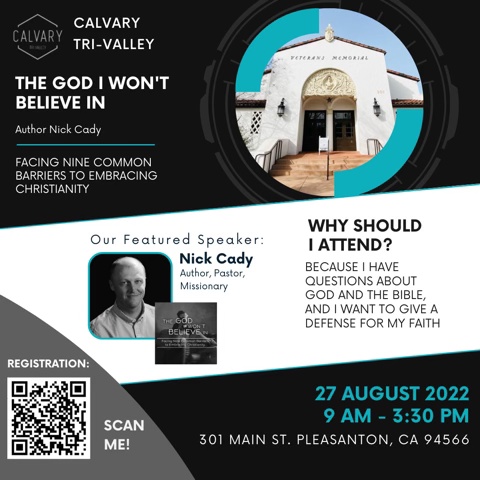
If you or someone you know has questions about God or the Bible that they feel makes it difficult or impossible for them to be a Christian, join me for a one-day apologetics conference in Pleasanton, California on August 27, 2022.
This free conference will be based on my book, The God I Won’t Believe In: Facing Nine Common Barriers to Embracing Christianity. At the event there will be three presentations, each looking at one of the 3 broad areas of struggle addressed in the book: Empirical questions, Moral issues, and Personal struggles – as well as a time for Q&A.
There was an interesting exchange that took place this week between Alex Jones and the judge overseeing his trial related to the shooting at Sandy Hook Elementary School.
In it, the judge insisted that Jones needed to tell the truth under oath. Jones then claimed that he believed that what he was saying was true, to which the judge responded that it did not matter if he believed what he said was true or not; either it was or it wasn’t.
“Just because you claim to think something is true, does not make it true.”
Finally, it came out through evidence that Jones had actually done something which he claimed he hadn’t done. Jones claims that this was an honest mistake, whereas others assert that he intentionally lied.
Here’s a recording of that exchange:
An Interesting Cultural Moment
Whatever your opinion of Alex Jones or this legal proceeding, this is an interesting moment in our culture, because – despite the attempts of some to relativize “the truth,” here we have an argument which acknowledges the existence of objective reality.
In recent history in the United States and the Western world, there has been a lot of debate over what makes something “true.” Phrases like “speak your truth,” or the idea that what is true for one person might not be true for others, make it seem like the truth is relative. Furthermore, the idea that what a person believes about themselves cannot be argued against, e.g. when it comes to gender identity, can make it seem like empirical evidence no longer matters in determining what is “true.”
Yet here is a conversation in our society about the importance of truth.
Note the words of the judge: “Just because you claim to think something is true, does not make it true.”
I wonder what would happen if we applied this same logic to other issues as well. Should this apply to how we think about gender and sexuality? How about how we believe about God, the Bible, and even the topics of sin and judgment?
What Does Truth Mean for Us as Christians?
As Christians, we believe in objective truth. We believe that God exists. We believe that some actions are sinful. We believe that there is a day coming when God will judge the living and the dead. We believe that Jesus Christ was God incarnate, come to do for us what we could not do for ourselves by living a life of perfect obedience to God, dying a sacrificial death to take the judgment we deserved in our place, and rising from the grave to everlasting life.
Knowledge of these truths – regarding sin, judgment, and the love and grace of God displayed in Jesus’ saving actions on our behalf – compels us, as Paul the Apostle explains in 2 Corinthians 5, to do two things: to persuade people of the truth of these matters (2 Corinthians 5:11), and to beseech them to receive the reconciling grace of God (2 Corinthians 5:20)!
Compelled to Persuade
The Bible tells us that because we know of God’s judgment (2 Corinthians 5:10), we are compelled to persuade people (2 Corinthians 5:11). To persuade, in this sense, means to remove intellectual barriers, to overcome prejudice and ignorance, to convince by argument and testimony, and by the straightforward proclamation of the gospel.
Compelled to Implore
Furthermore, Paul says that because we know of God’s grace and the offer of salvation, we are compelled to beseech people to receive the gift of what Jesus has done for them, so they can be reconciled to God (2 Corinthians 5:20). Paul even uses the word “implore” to describe how we appeal to people in light of the truths of sin, judgment, and the possibility of redemption through Jesus. To implore, according to Lexico, means “to beg someone earnestly and desperately.”
It’s important to take note in this cultural moment that, no matter how much we might try to suppress it, we as human beings know there is such a thing as truth which is independent of our personal claims, opinions, or feelings. As the people of God we should be lovers of the truth.
Finally, if what the Bible says is true about God, sin, judgment, and redemption – and we have abundant evidence to believe it is (see here for more on that), then it behooves us to persuade and implore those around us of the veracity of these things and the need to be reconciled to God through the grace God has extended to us in Christ.
May God help us to be lovers of the truth, and may the Holy Spirit cause us to be compelled all the more by the love of Christ, to live not for ourselves, but for Him who for our sakes died and was raised (cf. 2 Corinthians 5:15).









 Theology for the People