Christianity and Singleness

When I lived in Hungary, we used to take our church to a summer conference every year in Vajta, where the group of churches we belonged to ran a Bible college and conference center in an old castle. Every year various pastors from our churches would speak at the conference; I spoke several times.

One of the sessions I remember most vividly, I remember not for good reasons: one year a particular pastor was asked to speak on the topic of singleness for an afternoon session. When he stood up to the platform, he said something to the effect of: “I don’t know why they asked me to teach on singleness. I’m not single and I haven’t been single for a long time. So I decided that I’m not going to speak about singleness, I’m just going to teach a Bible study about something else, since this is the only chance they gave me to speak.” You probably won’t be surprised to hear that this person was never asked to speak at a conference again.

But that wasn’t the only memorable part of his session. Half-way through his session, the speaker got annoyed at some people who were whispering to each other while he was speaking, and he stopped everything and proceeded to call them out, and kick them out of the session, making them take the walk of shame past over 100 people who were gathered in the hall for the study. I admit, I was kind of jealous that they got to leave…

This session should be contrasted with the one on singleness which had been held at the previous year’s conference, at which a younger pastor had spoken about singleness in a message that was so well presented and so encouraging to me (I was single at that time), that I still remember his opening lines: “You are in a race!” He then went on to teach about the biblical perspective on the goodness of singleness from 1 Corinthians.

It was a hugely different perspective: the first man I mentioned had disdained the thought of teaching about singleness – he clearly saw it as unimportant. The second man taught in a way that was encouraging and edifying to the single person.

The other day I posted some thoughts about the topic of gender roles in marriage and how the biblical view on this is based on theological views about the relationship between the persons of the Trinity. I got several comments on it from a single person who expressed feelings that Christianity tends to over-emphasize marriage over singleness. There is some validity to this point – however, statistically most people will be married at some point in their lifetime – and, just because some people are not married does not mean we should not talk about marriage, just like the fact that some people are not airplane pilots doesn’t mean that we should never talk about airplane pilots.

However, these comments did lead me to look into some things about Christian teachings about singleness, and what I found was significant.

Stanley Hauerwas, one of the great theologians of our age, argues that Christianity was the very first religion to hold up single adulthood as a viable way of life. This was a clear difference between Christianity and all other traditional religions, including Judaism, all of which made family and the bearing of children an absolute value, without which there was no honor.1

In ancient culture, long-term single adults were considered to be living a human life that was less than fully realized. But along came Christianity – whose founder was an adult single man and whose great theologian (the Apostle Paul) was also single and advocated for the value and goodness of singleness.

Timothy Keller points out that in Christianity, “single adults cannot be seen as somehow less fully formed or realized human beings than married persons because Jesus Christ, a single man, was the perfect man (Hebrews 4:15; 1 Peter 2:22).”

He goes on to say that, “Paul’s assessment in 1 Corinthians 7 is that singleness is a good condition blessed by God, and in many circumstances is actually better than marriage. As a result of this revolutionary attitude, the early church did not pressure people to marry and institutionally supported poor widows so they did not have to remarry.”2

Keller points to Rodney Stark, a social historian, who states, “Pagan widows faced great social pressure to remarry; Augustus even had widows fined if they failed to marry within two years. In contrast, among Christians, widowhood was highly respected. The church stood ready to sustain widows, allowing them a choice as to whether or not to remarry, and single widows were active in care-giving and good deeds.3

As opposed to societies which idolized family as the only means of giving a person significance, the Christian gospel offers a greater hope and a greater source of significance.

Singleness, according to Christianity, is not Plan B – it is a viable option for those who choose it.

In our modern pop culture, it is not family which is idolized so much as romance. Think about Hollywood and even Disney narratives: they begin telling the story of a person seeking true love, and once two people do come together, the story ends! The message is that what matters in life is finding romance, everything else is only leading up to that, and what happens after that is not worth spending too much time on. This is also reflected in the huge amount of focus which is given to weddings in our culture.

The Christian church provides the space for single people of different genders to worship, serve and study together, to know and be known by each other, without the pressures of our romance-driven culture.

Churches don’t always do a great job at making single people feel that they belong and not pressuring them to get married and treating them as if until they are married, they are incomplete – however, it is in the design. At our church, we have purposefully sought to change the language we use away from always speaking of “you and your family” – so that we don’t communicate the wrong thing to single people who call our church their home.

Interestingly, Timothy Keller, who pastors a church in NYC which is majority single people, points out that single people and married people alike need good teaching about marriage and relationships, so that marriage is held to its biblical place of honor (Hebrews 13:4), without idolizing it as the end-all be-all of human existence.


1. [Stanley Hauerwas, A Community of Character, p.174]
2. [Timothy Keller, The Meaning of Marriage, pp.222-223]
3. [Rodney Stark, The Rise of Christianity: A Sociologist Reconsiders Historyp.104]
 

Gender Roles in Marriage and Perichoresis: the Dance of the Trinity

Recently at White Fields I taught on Colossians 3:12-25. The first part of that text is the one I usually use when I officiate weddings. The title of my message was “Gospel Reenactment” (audio of that message can be listened to here).

Included in this section is a verse which can be controversial for some people: Wives submit to your husbands as is fitting in the Lord.  The idea of defined gender roles in marriage is not the most popular subject in our day and age, where more and more often, gender is considered a social construct and something which is fluid rather than fixed. Furthermore, it is no secret that some who have held to biblically defined gender roles in marriage have at times used them as an excuse to act tyrannically or even cruelly towards their spouse.

However, what I discovered in studying this passage in Colossians, is that it gives a picture of marriage as a reenactment of the Gospel (who Jesus is and what He did for us), particularly as regards the nature of God: One God, creator of Heaven and Earth, of all things seen and unseen, who eternally exists in 3 co-equal persons: Father, Son and Holy Spirit. The term Son does not speak of origin but of rank: the Son willingly submitted Himself to the leadership of the Father, even though they are eternally co-equal and one. This is the model of what marriage is: two become one, but in that one, they take on different, complementary roles for the sake of a mission.

This is something which the church fathers, such as Gregory of Nazianzus and John of Damascus, and more recently Jürgen Moltmann and Miroslav Wolf, have referred to as ‘The Dance of the Trinity’ – or ‘Perichoresis’ in Greek. It refers to the dynamic relationship which exists between the 3 persons of the Trinity:

The Father loves the Son and the Son loves the Father, the Spirit glorifies the Son and the Son glorifies the Father. The Father sends the Son and the Son obeys the Father. The Son sends the Spirit, and the Spirit and the Son together bring glory to the Father. The Spirit exalts the Son, the Son exalts the Father. The Father exalts the Son and glorifies the Son.

It’s a harmonious set of relationship in which there is mutual giving and receiving. This relationship is called love, and it’s what the Trinity is all about. The perichoresis is the dance of love.  – Jonathan Marlowe

The relationships between the three Persons of the Trinity — “dynamic, interactive, loving, serving” — form the model for our human dance. – Michael Spencer

In their book The Meaning of MarriageTim and Kathy Keller write about gender roles. This is one of the best books I have read on marriage, and I would recommend it highly. Here are some things that Kathy in particular had to say on the topic of gender roles:

Every cell in our body is stamped XX or XY. This means I cannot understand myself if I try to ignore the way God designed me or if I despise the gifts he may have given me to help me fulfill my calling. If the postmodern to view that gender is wholly a “social construct” were true, then we could follow whatever path seems good to us. If our gender is at the heart of our nature, however, we risk losing a key part of ourselves if we abandon our distinctive male and female roles.

[Philippians 2] is one of the primary places where the “dance of the Trinity” becomes visible. The Son defers to his father, taking the subordinate role. The Father accepts the gift, but then exalts the Sons to the highest place. Each wishes to please the other; each wishes to exalt the other. Love and honor are given, accepted, and given again. There is no inequality of ability or dignity.

The Son’s role shows not his weakness but his greatness.

[In God’s Kingdom, leaders] are called to be a servant-leaders. In the dance of the Trinity, the greatest is the one who is most self-effacing, most sacrificial, most devoted to the good of the other. Jesus redefined – or, more truly, defined properly – headship and authority, taking the toxicity of it away or, at least for those who live by his definition rather than by the world’s understanding.

Jesus as a master made himself into a servant who has washed his disciples’ feet, thus demonstrating in the most dramatic way that authority and leadership mean that you become the servant, you die to self in order to love and serve the Other. Jesus redefined authority as servant-authority.

In Jesus we see all the authoritarianism of authority laid to rest, and all the humility of submission glorified. Rather than demeaning Christ, his submission led to his ultimate glorification, where God “exalted him to the highest place and gave him the name that is above every name.”

Both men and women get to “play the Jesus role” in marriage – Jesus in his sacrificial authority, Jesus in his sacrificial submission.

– The Meaning of Marriage, pp. 194-201

Part of the redemption that we have in Jesus is an invitation into the Perichoresis – the ‘dance of the Trinity’ – and in addition to our relationship with God, this serves as a model and a motivation for our relationships in marriage, work and beyond.

The God Who Likes You

I was talking with a friend from church last night and we got to talking about the topic of “brokenness”.

This friend of mine referenced Psalm 51:17 “My sacrifice, O God, is a broken spirit; a broken and contrite heart you, God, will not despise.” – and then he said a phrase which I found particularly interesting: “My God likes broken people.”

He wasn’t saying that God likes to break people – he was saying that, much rather than despising broken people, the God of the Bible actually likes them, in the sense of having affinity for them.

That reminded me of something: We as Christians tend to use the word “love” so much that it can lose it’s impact and weight; and even though “love” is supposed to be more than “like”, it would seem that because of our overuse, and perhaps mis-portrayal of the nature of “love”, “like” might actually have more significance to it.

Here’s what I mean: I have heard Christians say things to this effect: “I guess I have to love that person because I’m a Christian… but I sure don’t like them!”

I think that many times we even portray God’s love as a begrudging obligation which he has to do, but that doesn’t mean he has to “like” you!   For example:  “Well, I’m sure God loves that person (because He’s God and He doesn’t have a choice because He has to love everybody…)  but I’m sure that God LIKES me more than He likes that person…”

When we portray love as a dutiful thing which God and Christians are required to do, even if they don’t want to, “liking” people is what is left (at least in this perspective) to a person’s choice. It is in this sense that it actually means more to “like” someone than it does to “love” someone, because loving them is an obligation, but liking them is a choice.

I believe that God’s message to us would be: I don’t only love you, but I even like you!  I like the unique person I’ve made you to be!  I may not like your faults, but I came and died for those things, so that they could be put to death and the person I created you to be could be revealed to an ever-increasing degree. 

Furthermore, I believe that God would call us to not only “love” people out of obligation and duty, something you begrudgingly have to do, but I believe that God would call us to genuinely like people, choosing to have affinity for them and the unique people that God created them to be.

The other important area this gets into is the understanding that “Love”, as described in the Bible, is not primarily a feeling, but an action. To truly love someone is to will and to act for their good. Liking someone, on the other hand, is a feeling rather than an action.

Where our culture has gotten things mixed up is that we forget that love is primarily an action, not an emotion, and the result of this is that we end up contriving “loving” feelings for people for whom we feel no affinity. What is required of us is not the feeling of affinity, but the action of love. However, it is my experience that the feelings of affinity are one of the direct results of actions of love.

God showed his love for you in this: that while you were yet at enmity with him, he gave his son for you. Why? Because he wanted to save you and spend eternity with you. Why? Because he actually likes you.


Peaked Out Weekend

This past weekend was a busy one for us, full of many good things.

It began on Saturday with the Longmont Sunrise Stampede. My wife and 8 year old son ran the 2 mile race, and I ran the 10k. On the one hand, we were excited to run a race here in Longmont, but an added bonus was that the race went to support a great cause: proceeds went to help fund special education in the St Vrain Valley School District.

I was proud of my son for finishing his first race, and getting a time he could be proud of.

wp-1471379365344.jpg
Before the 2 mile race

I finished my 10k race in 54:51 which was a personal record time for that distance and even better than I had hoped to do.

wp-1471379626026.png
At 9.5 km of the 10k race which ended at Silver Creek HS

We then went up to Bailey, to a picnic for pastors and their families put on by Crossroads Church of Denver, my old church which sent me to Hungary.

We then went to Denver for the Lego BrickFest, which our kids loved, and then finished the day by having dinner with family and friends.

wp-1471379912162.jpg

On Sunday we had church. I taught on Colossians 3:1-11 in a message titled “A New You”, about which I got a surprising amount of positive feedback. One of the key concepts I discussed was the “Already… but Not Yet” nature of the gospel. If you’d like to listen to it, you can find the audio of that message here.

I got an email after church that a couple from Texas had been at church that day, and that they had come because they read this blog and were in the area! That encouraged me to be writing here more.

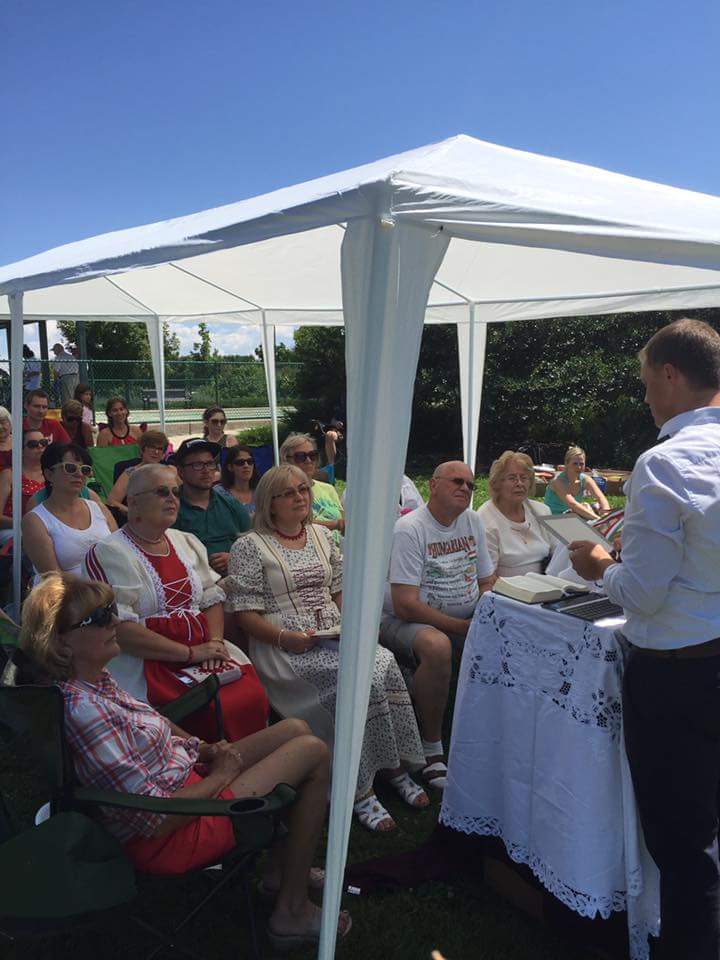
Right after church at White Fields, we went down to Littleton, where the Colorado Hungarian community was having their annual picnic for Szent István (St. Stephen) Day. István was the first king of Hungary, who after converting to Christianity as an adult, established Hungary as a Christian kingdom in 1000. He was declared a saint on August 20, 1083 and because of that, August 20 is the national holiday of Hungary.

wp-1471380135628.jpg
Hungarian language church service in Littleton

At this picnic, I lead a church service in Hungarian for the Hungarian Reformed Church of Denver, at which I preached on one of my favorite scriptures, Matthew 13:44 – “The kingdom of heaven is like treasure hidden in a field, which a man found and covered up. Then in his joy he goes and sells all that he has and buys that field.” I really enjoyed preaching in Hungarian again! I get to do it sometimes when I visit Hungary, but felt great to do it here in Colorado.

On Sunday night, I left home at 11pm with two friends from church to climb Longs Peak.

wp-1471377631837.jpg
My wife took this picture of Longs Peak and Mt Meeker as we drove into Longmont Saturday evening. We love when the light highlights the layers in the mountains.

It was the 2nd time I’ve climbed it, and it was just as beautiful and difficult of a climb as I remember it being! It’s a 15 mile round trip hike, with 5100 feet of elevation gain. The most difficult part of the hike, mentally, is the last 2.5 miles, when you descend back into the forest and it feels like it will never end. The most technically difficult part is probably “The Trough.” Here’s a description of the route.

wp-1471377684896.jpg
The view from the top of Longs Peak looking South-West towards the Indian Peaks. The lake on the left is Barker Reservoir in Nederland.

wp-1471377684881.jpg
The Twin Peaks – Longs and Meeker, from the split off to Chasm Lake

Today the kids went back to school, which is bittersweet for us as parents. On the one hand, we are going to miss having them around, but on the other hand, it was a lot of work keeping them occupied and on task at home, and we see how good it is for them to be with the other kids and learning.

We took a trip last week up to the Mount Evans as a family to celebrate the end of summer vacation. It was my wife and kids’ first time up above 14,000 feet.

wp-1471379398701.jpg
Mt Evans summit (14,270 ft)

I can’t get enough of these Rocky Mountains…


The IOC on Religion: Nothing New Under the Sun


One of the things we do at White Fields Church every week is invite people to text or tweet questions during the sermon and then I respond to them on our members’ website called The City. I really enjoy this aspect of it, and I think that such engagement aides in the learning process.

For the past several weeks I have been teaching through Paul’s letter to the Colossians, and what I have found most interesting about it is that the core message of the book is something which is incredibly relevant to our day, which is the uniqueness of the Christian gospel as it relates to every other religion and philosophy in the world.

When you look into the culture of the Roman Empire, interestingly what you find is a society which was very similar to modern Western society in many ways. It was a pluralistic society, a multi-cultural, multi-ethnic society, in which there was freedom of religion – and yet… the prevailing notion was that in order for there to be peace in a mixed society, no one should say that their tradition or religion was any better or more true than anyone else’s – only that it was different. Furthermore, a person’s religion or tradition was considered to be something they were born into rather than something they had a responsibility to choose for themselves, and therefore it was considered taboo, rude and even wrong to try to “convert” someone to another religion than that which they were born into or brought up in.

Now, if that doesn’t sound familiar to our day and age, then you should check your pulse.

I discussed this in more detail this past Sunday. If you’re interested, check out the audio of that message here.

In response to that teaching, a member of our church texted in:

The unifying/melting pot of religions that Paul is warning the Colossians about in today’s passage is the same message delivered by the president of the IOC at the opening of the Olympic Games. It’s clear that making exclusive claims about right or wrong in regard to religion is frowned upon internationally.

I unfortunately missed the opening ceremony of the Rio Olympics, and have not been able to find a way to watch the whole thing online – if anyone knows a way, please let me know!

Although I am not surprised by this, I am surprised by the naivety in thinking which it represents. For educated people to say that no one should make exclusive claims is to ignore the fact that EVERYONE makes exclusive claims, including the people who say that you should not make exclusive claims. For example, if you say that it is wrong to say that something is wrong, you are doing the same thing which you are claiming should not be done. I only wonder if this overlooking of the obvious is sincere/naive in nature, or it is it a willful ignorance for the sake of pragmatism; in this case that everyone would just get along. Either way, to make such a claim reveals a sort of patronizing disregard for the validity of the claims of any and all religious beliefs, which is itself a form of judgment about them… Oh the irony…

Don’t fall for this underdeveloped, recycled logic. We can absolutely live in a free society where honest and open dialogue of the validity of certain ideas, traditions, practices and beliefs exists.

One Day


What all of us long for is nothing less than redemption.

This young Israeli couple have been posting videos of their music for a while. This video, according to their Facebook page, was recorded a cappella in their car because the original recording had audio problems, but there is something very lovely and beautiful about both the way they sing and what they are singing about.

What makes it so beautiful, is that they are singing about a day in the future when there will be no more wars and strife, when things will be the way we all innately feel that they should be and the way that all people deep down hope it will be.

What all of us long for is nothing less than redemption. 

And that’s because we were made for perfection, but we’re fallen… and yet we have a sort of ancestral memory of it; we know that even though death and strife and sickness are the realities of the world we live it, even though that may be how it is, we still believe that it’s not the way it should be, and so we long for and we sing and dream and write about a world where these things are no more and everything is finally as it is supposed to be:

No more death. No more violence. No more pain. No more parting from those we love. No more infirmity. Love that lasts forever. True peace. Overcoming the limitations we experience now with frustration.

That is why this song is so moving. That is why all of the movies which make you cry have the same common themes: heroic self-sacrifice, good overcoming evil, immortality and overcoming death itself.

The message of the Gospel is that God loves you so much that He made a way for you to be redeemed through Jesus, so that one day that hope could become reality, so that everything your heart longs for deep down could not only be a wish, but a reality.

One day…


If you’re interested in more from these guys, here’s a link to their YouTube channel, and here is another song of theirs, this one in Hebrew (English translation can be found in the comments section on YouTube) – it’s a song of praise and worship to God: