When God Says “No”

One of the things we’ve been doing at White Fields Church is giving people the opportunity to text or tweet us questions during the sermon.

Yesterday morning I taught 2 Samuel ch 7, which is the time when David had a desire to build a house for the Lord, but God said “No!”  That has some interesting implications, because what David wanted to do was a good thing, and it was a biblical thing – yet God said “no”.

This question was texted in during that sermon:

This morning in the sermon, you discussed having a desire to be a missionary, pastor, etc. If we have that desire in our hearts, didn’t God put that there? So why would He close The door if He put that desire there?

That is a great question!  The first question is a particularly important one: Did God put that desire there?  I believe that as we get closer to the heart of God – delighting ourselves in the Lord, as David said (Psalm 37:4) – that our desires are changed and become more aligned with His desires. 

In the story we studied yesterday in 2 Samuel 7: David had a desire. It was a good, noble desire – it was even a Biblical desire. Did God put that desire there? Maybe! Or maybe not. We don’t know for sure. There is a way in which we could argue that God did put that desire in David’s heart – but that David’s role in fulfilling that was not to be directly involved in the building of the temple, but indirectly – as we saw, how David got the ball rolling with the building of the temple and had all of the items made which would be used in the temple.

Let me share an example from my own life: I gave my life to the Lord when I was 16, and almost immediately I developed a desire to minister to the people of the former Soviet Union, specifically Ukraine, where my family had immigrated from. When I was 18, I was invited to go on a ministry trip to Budapest, Hungary – to a conference for Calvary Chapel churches from Hungary and Ukraine. It was the Ukrainian part which I was interested in, and I went there with the hope that I could connect with some ministries in Ukraine. I was able to do that, but interestingly all of the “doors of opportunity” for me to serve in Ukraine seemed closed, however there was an incredible open door and an invitation for me to serve in Debrecen, Hungary – the pastor there told me he had been praying for someone exactly like me to come and work with them. I had no real desire to go to Hungary, my desire was to serve the Lord in Ukraine – but I prayed about it and came to the conviction that this is what God had for me at that point, and after serving there for a little while I could move to Ukraine, where I really desired to be. I committed to go to Debrecen, Hungary for 8 months. During those 8 months, I prayed for Ukraine constantly, I even tried to go to Ukraine to work with some of the people I had met the year before at the conference in Budapest, but once again all the doors of opportunity were closed!  My feeling was: God, why did you give me this desire to serve you in Ukraine, and then close all the doors before me?!  Yet, in the meantime, I had become very proficient in Hungarian and was involved in some very exciting and fruitful ministry in Hungary. I came to see that perhaps God had given me that desire to serve Him in Ukraine in order to get me to pray and to get me to Hungary – which hadn’t even been on my radar, but which ended up being the “land of blessing” for me, where I met my future wife, where I became a pastor, where my 3 kids were born, where I was involved in years of fruitful and wonderful ministry. Was it God who put that desire to serve Him in Ukraine in my heart? I’m not sure. But He certainly used that desire in my life to lead me to where He wanted me to be.

My desire to serve the Lord in Ukraine never went away; I still have it. But I have come to rest in believing that God gave me that desire not in order to move me to Ukraine, but so that I would carry the people of that country on my heart and pray for them, and support what God is doing through other people there – which is exactly what I strive to do! This desire to serve the Lord in Ukraine led me to start taking teams from our church in Eger up to a Hungarian-speaking region of Ukraine, where we would do evangelism and support ministries in that region. I also had the opportunity to take extended trips to Ukraine and teach in a Bible school there. Who knows what God has for the future, but I very much can relate to David – who, although he was not allowed to be directly involved in the building of the temple, found a way to still be involved in it in a signifiant and meaningful way, indirectly.

So, to the question: If you have a desire to be a pastor, missionary, etc. – did God put it there? If so, why would he then shut the door?    I think that 2 Samuel 7 shows us that even if God is the one who put that noble desire in your heart to serve the Lord in a particular way, perhaps the fulfillment of that desire is not found in you fulfilling the role you specifically have in mind – perhaps the fulfillment of that desire will come in a way that is completely from God, and has a greater impact, even in your own life, than you could have ever imagined.

The Interactive Sermon

The past 2 Sundays at White Fields we’ve been trying something new, where our background slide invites people to text or tweet their questions in during the sermon. Once we get these questions, I will answer some during the service if we have time, or I will answer them on The City – our church’s in-house social network.

The response we’ve gotten to this has been really good! I’ve really enjoyed engaging with people and answering their questions. You can read some of those discussions here. Look for the posts titled “Sermon Follow-Up”.

I think that in this day and age, with the proliferation of the internet especially, sermons need to be more interactive. Finding the right way to do this though, is what is hard.

Timothy Keller, at his Sunday night services in NYC, has had a question and answer time for years. It’s a main part of the service – and it invites skeptics to come and do what New Yorkers do best: be skeptical and inquisitive. Tim Keller has said that the average young adult in New York is a thinker and thinkers have questions, and if you want them to really consider Christianity, you have to give them a chance to have their questions answered.

Nowadays, any news article you read online gives readers the option to engage in a comments section, where they can have a discussion about the content of the article. Any attitude in churches of “don’t question anything” is completely disconnected from where our culture is at today, especially with young people. Furthermore, I feel that if pastors are not answering the real questions that people are asking and struggling with, if we are not addressing the issues that people are really wondering about and discussing, then we have become irrelevant talking heads. If everywhere in the world there is transparency and discussion is encouraged, but at church we have smokescreens and we don’t like questions, what does that communicate to people? Perhaps that we lack the confidence that is required to allow people to ask questions? That shouldn’t be the case.

However, the danger in opening up to engagement like this, is that it inevitably gives a platform to haters – people who don’t have sincere questions, but who ask questions in order to be critical or in an attempt to trip others up. This is something that Jesus dealt with a lot from the Pharisees and Sadducees, who put a lot of effort into tripping him up. I’m sure that Timothy Keller gets tons of people like this as well, but it doesn’t deter him from encouraging people to ask questions and give him the chance to offer a biblical answer.

What are your thoughts on encouraging engagement with sermons? How have you seen it done effectively – or ineffectively?

What Are We Fighting For?

Recently I have been reading the biography of Dietrich Bonhoeffer by Eric Metaxas: Bonhoeffer: Pastor, Martyr, Prophet, Spy.

I’ve been very impressed with the way that Bonhoeffer acted as a Christian during the Nazi period, in which EVERY Christian was faced with an intense ethical dilemma because of the evils acted out by the Nazi regime.

This Sunday at White Fields I taught 1 Samuel 11. In that chapter the town of Jabesh-Gilead is attacked by the Ammonites, and Saul, hearing the news, sends a message to all the men of Israel that they need to come to the defense of the people of Jabesh-Gilead, or else.
This was a time in Israel, when it would have been wrong to do nothing.

Surely, Bonhoeffer lived in such a time as well – when it would have been ethically wrong to do nothing in the face of the evils of the Nazi regime. If being a Christian is all about being conformed to the image of Christ (Romans 8:29), and as those who are part of the body of Christ, God would have us do His work, being his mouthpiece, his hands and his feet – there are great implications, as Bonhoeffer knew better any, for us as Christians and how we act and respond in the face of evil, injustice and other things which God is opposed to.

Bonhoeffer famously said:

“Silence in the face of evil is itself evil: God will not hold us guiltless. Not to speak is to speak. Not to act is to act.” ― Dietrich Bonhoeffer

In light of this, I can’t help but wonder what the great issues of our day, and our time and place are. What are the things that God would have us as Christians stand up for and fight against in this day?

It says there in 1 Samuel 11, that when Saul heard about how the people of Jabesh-Gilead were being mistreated, the Spirit of the Lord came upon him, and he became angry. That anger moved him to action.

I wonder what the issues are in our day that we should rightly be upset about, and that God would move us to righteous action for.

Yesterday, Eric Metaxas, the author of that biography about Bonhoeffer wrote this on Twitter:

Do you agree?  If so, what are the issues in our day that we should be pushing hard about?

To add a counterpoint, this is what Timothy Keller posted on Facebook today:

Jesus didn’t come to solve the economic, political, and social problems of the world. He came to forgive our sins. – Timothy Keller

It is true that Jesus did come to redeem the world, not by fixing the social problems of the day, or by driving out the Romans, but by dying on the cross for our sins.

What does this mean for us as Christians? Should our focus be other-worldly, i.e. saving people from this world unto the next life and the world which is to come, since this world will soon pass away — or, since eternal life starts now (John 17:3), should we be seeking to do the will of God here and now by coming against evil social structures and injustice, working to put an end to human suffering? Certainly this was a major theme of the Old Testament, but not something addressed much in the New Testament.

Are these two concepts at odds with each other, or can they be reconciled?

I don’t believe they are at odds – I think there is a healthy “both this and that” approach, but finding that balance of focus and knowing which hills God would have us fight on is something for which we must seek wisdom and guidance from God.

I’d love to hear your thoughts! Feel free to comment below.

Marriage Retreat in Estes Park!

Whether your marriage is the strongest it’s ever been, or is hanging on by a string, or is anywhere in between – you are invited to join us for a marriage retreat in Estes Park on March 7-8, 2014.

We look forward to a refreshing time of quality time together getting back to the foundational principles that make for a happy and healthy marriage.

You can find all the info and sign-up information here.

Here is a video of our guest speaker, Pastor Tommy Schneider of Calvary Chapel Vail Valley, talking about his heart and vision for the retreat:

Hope you will join us!

The Fat Belongs to the Lord

This Sunday at White Fields I taught 1 Samuel 2 and the story of Hophni and Phineas, the priests who were doing shameful things in the Tabernacle. (Click here for audio of that sermon: “Messed-Up Ministry”). There was a detail of that story that at first seems a bit odd and obscure, but is worth serious consideration.

In 1 Samuel 2:15-17 we read about how the Law required that the fat be burned off the meat before it was eaten. The law about this is found in the Book of Leviticus – and as I mentioned on Sunday, the reason for this is because at that time, the fat of the meat was considered the best, most luxurious part. But God required that when a sacrifice was made as an act of worship, the fat be burned, which would create a lot of smoke and it would be a “fragrant offering” unto the Lord.  Any of you who like the smell of bacon cooking know what I’m talking about. Those of you who are vegans, well, you can eat your tofu bacon and pretend you know what I’m talking about!  

The fat belongs to the Lord

But the idea that the fat belonged to the Lord represented a fundamental belief that we should give the best to God. Many people are in the habit of doing just the opposite – keeping the best for themselves, and giving the rest (the left-overs) to God. Rather than making their offering check the first check they write every month, they wait until the end of the month to see if they have anything left over. God asks that we give him the best, not the rest.

But there’s something else worth taking note of here: when the people in those days gave the fat of the meat to the Lord, they thought they were really giving up a lot – they were really “sacrificing” something, in obedience to God. They were giving up luxury and “the good life”. However, what we now know is that fat kills. At our last men’s prayer breakfast, one man brought a creation called the “bacon explosion” made of various lard extracts which I am convinced reduced my life span by 2 months per bite!
But here’s the point: by telling them to sacrifice the fat on the altar, not only was God teaching them an important values lesson, but he was also sparing them from something which was bad for them, even though they couldn’t possibly know that yet! It would only be thousands of years later that people would realize that God wasn’t only asking them to give something up, he was actually protecting them – even though they didn’t understand it yet, much like all of us parents do with our children.

God is good and all his ordinances – the things he tells you to do and what he tells you to steer clear of – each and every one flows out of his love and care for you.

“I never made a sacrifice”

This past Sunday at White Fields church I spoke about how when we give everything over to God, although we often fear what we will lose, the reality is that we always get more than we bargained for. Like Jesus said, it is when we give our life fully over to him that we find true life and really start living. (you can listen to the audio of that sermon here)

One example of this that came to my mind, but I didn’t share on Sunday was a quote by David Livingstone – the 19th century British missionary who gave his entire life in service to Christ, exploring and evangelizing the interior of Africa. Today, as a direct result of his work, sub-Saharan Africa has become a place where Christianity thrives, where 200 years ago it was almost non-existent.

David Livingstone – Missionary and Explorer of the interior of Africa

Livingstone made several trips back to England during his time as a missionary in Africa, in which he would go on speaking tours. He was considered a national hero in England, and was invited to speak at universities and to dignitaries.

One of the questions most frequently asked of Livingstone was how he was able to make such a great sacrifice, as to give his life in service as a missionary. He was an educated man who could have had a comfortable, upper-class life in England, but instead he chose to spend the prime of his life in the bush of Africa.

Here is what Livingstone said in response to this question in a speech he gave at Cambridge University in 1857:

For my own part, I have never ceased to rejoice that God has appointed me to such an office. People talk of the sacrifice I have made in spending so much of my life in Africa. . . . Is that a sacrifice which brings its own blest reward in healthful activity, the consciousness of doing good, peace of mind, and a bright hope of a glorious destiny hereafter? Away with the word in such a view, and with such a thought! It is emphatically no sacrifice. Say rather it is a privilege. Anxiety, sickness, suffering, or danger, now and then, with a foregoing of the common conveniences and charities of this life, may make us pause, and cause the spirit to waver, and the soul to sink; but let this only be for a moment. All these are nothing when compared with the glory which shall be revealed in and for us. I never made a sacrifice.

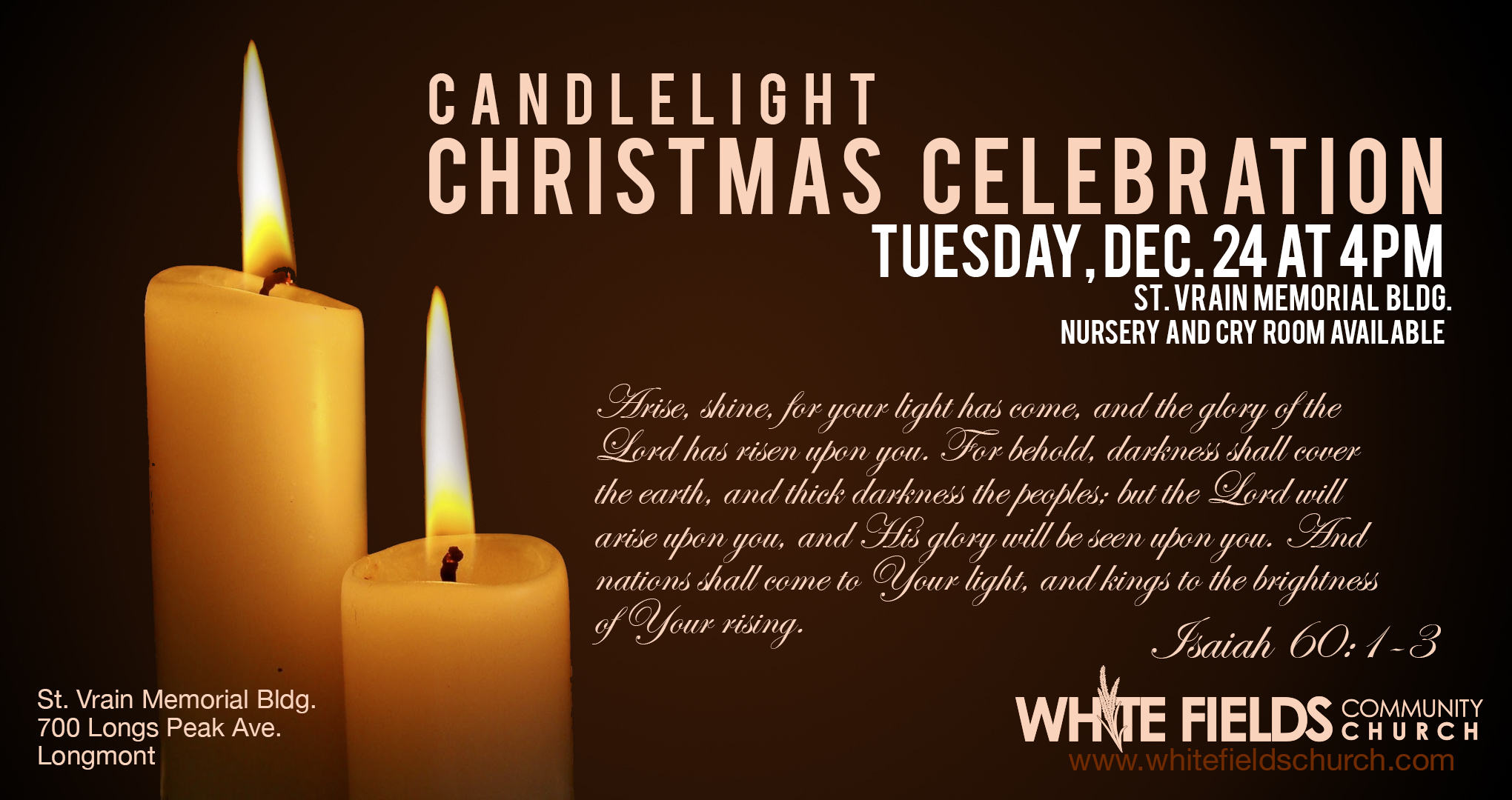
Join us on Christmas Eve at White Fields!

Image

If you live near Longmont, then I’d like to invite you to join us on Christmas Eve for our Candlelight Christmas Celebration.

We will have a special band leading us in Christmas carols and worship, as well as a children’s choir and “glad tidings of great joy for all people”.

Hope you will join us!

Young Life in Longmont

A few months ago, my wife and I were talking with some people from White Fields – and the topic of Young Life came up. This friend of ours was telling us how she had been involved in volunteering at a YL camp up near Winter Park. Then another friend from White Fields told us that he had applied for a job up at that same camp.

So my wife and I had this conversation: “I wonder if Young Life is doing anything in Longmont…”

A few weeks later, historic flooding happened right here in Longmont. Houses were flooded, roads were washed out. Lots of destruction.

As one does, I went to go check out the destruction. Here’s the picture we took of Sunset Street in Longmont:

Image
Sunset Street – owned by the St Vrain River

As we’re standing there, some other guys come up and stand right on the edge of the road. I tell the guy: “Hey, watch out, that’s not stable!” Then somehow we got to talking – they asked if I was from Longmont, they told me they recently moved to town from Boulder. I asked what brought them to Longmont – and they told me: “We moved here to start a Young Life branch for the St. Vrain Valley.”

“Really?” I said. “I’m the pastor of a church here in town and my wife and I and some people from church were just talking about how we would love to work with Young Life here in Longmont.”

And that is how I met Ben and Tim, who are heading up the new Young Life branch in the St Vrain Valley.

Since then, they’ve started doing Wyld Life meetings for middle schoolers here in town, and had great turnouts. I’ve gotten together with them a few times – in fact, I just had lunch with them again today. They are great guys, doing great work.

Check out what they are doing – it’s great stuff. The meetings they do are fun and are a safe environment for kids in middle school – and they love parental involvement. Here is their website: St Vrain Valley Young Life


What is the best thing happening at your church?

About 2 months ago I got invited to a pastors’ lunch up in Berthoud. There were about 12 of us there from different churches in Northern Colorado – I was the only one from Longmont. There was a guest speaker, Ray, who pastors a large church in Sacramento.

I’ve been to these kinds of meetings before – but this one was different, because Ray asked a question that I wasn’t expecting:

“What is the best thing happening at your church?”

That was the question which he opened the meeting with, and it caught me off guard! I had expected Ray to talk about the great things that he is doing, or to ask: ‘what needs to change at your church?’ – but I wasn’t ready for that question: “What is the BEST thing happening at your church?”

It seems that the other pastors in the room were caught off guard by it too, because many of them didn’t know what to say. Quickly though, momentum picked up and everyone had plenty to say on that topic – including me.

Ray went on to explain that we need to stop focusing on what is lacking, and we need to start focusing on what is right – the areas where our church is knocking it out of the park and killing it, the things that we just naturally do well, and we need to do those things more and better!

I have found this concept to be so freeing, so invigorating and exciting and so vision-focusing – not only when it comes to visioneering for church, but when it comes to life and who God has called me to be.
The essence is: Who is it that God has uniquely gifted and called you to be? What is that niche that God has created you for and called you to?  You can’t be everything – but you can be something, and if you learn to focus on being and doing what God has uniquely called and gifted you to do and be, then you will thrive, and it won’t be contrived, it won’t be a burden – it will feel like you just stepped into the fast-current on the lazy river ride at the water park, rather than being stuck in the whirlpool.

This is important when it comes to church, because the fact is that there are other churches out there. And there are many churches that are doing things that we aren’t – or can’t. BUT – there are things that we can do better than any of them; there is a culture that we have, that they don’t. There is a place and a role that God has uniquely given us in the Body of Christ in this place. There is a reason why people come to our church – and it’s not because they don’t know that there are other churches out there.

So I’ve been asking the question: What are the greatest things happening at White Fields church?
And THOSE are the things I want to be focused on. Those are the things I want to turn the dial UP on and make better. Rather than focusing on what we aren’t (yet) – I want to focus on what we ARE and what makes us great, uniquely – and turn up the dial on that! When you start thinking that way, you are no longer “competing” with other churches, but you realize that you are each filling a different role in the Body of Christ.

The danger is, that if we spend all our energy focused on what we aren’t (yet), we can neglect the things which to us are as easy and natural as falling off a log – and then those things will suffer as a result. The end result of that? We are mediocre at EVERYTHING and great at nothing. Rather, our focus should be on being GREAT at the things which God has uniquely gifted us to be and do – and those are usually the things which come most naturally to us – which are as easy as falling off a log.

People wanted David to fight Goliath the way that Goliath was good at fighting. David knew that he could probably do that – but it wasn’t what he was good at. He knew that he wasn’t Goliath. But he also knew what he was: he was David. And he had certain abilities and strengths, that he was uniquely gifted at: he could sling a rock like no one else! So he went out to battle with his strength, and ended up victorious.
It is important to know who you are, who you aren’t – and how God has uniquely gifted and called you. Go to battle with that, and you are much more likely to be victorious.

This doesn’t just apply only to church – it applies to many areas of life, business, etc. Who has God uniquely called you to be? What is the niche that God has called you to fill?  You don’t have to be everything! But God has called you and gifted you uniquely for somethings. Focus on those things. Go and kill it in those areas, and focus on developing those areas and being GREAT at those things.

Leave me a comment below and tell me: What’s the BEST thing happening in your church?


Project Greatest Gift – A Longmont Initiative to Help Children in Foster Care

One of the great outreaches we do here at White Fields church in Longmont is a home-grown initiative called Project Greatest Gift, which is our ministry at Christmastime to children in foster care.

Project Greatest Gift has been a tradition at White Fields since the beginning of our church, but in the past it was limited in the number of families we were able bless. After looking at ways to broaden its impact on the community and considering alternative programs such as Operation Christmas Child, we decided to attempt to bless the “orphans” of Northern Colorado. Since no orphanages existed in this area, God led us to reach out to local foster families. A couple in the church was heavily involved in the foster system and they offered to make contacts within that system to find families in need. Beginning in 2009, as a result of God’s provision and their efforts, we were able to begin blessing the foster families in Weld and Adams counties through the generous gifts of the congregation at White Fields.  Over the years, we have continued to see God’s great provision for us so we are able to continue to share His abundance with others.

In past years, our church family has provided gifts for around 40 to 60 kids. This year we have had a great outpouring of generosity, and people from our congregation have signed up to provide gifts for 90 children in Adams and Weld counties!

For those of you unfamiliar with the purpose of foster care, it is safe homes, loving caregivers and other family members who take in and provide for children whose living situation is unsafe.  Unfortunately, through no fault of their own, many children live in homes with parents addicted to drugs, who are neglectful or abusive, or who do not know how to care for children appropriately.  So foster homes are critical to meet the needs of these children while birth parents work to recover and learn to parent.  Sometimes, foster homes are also where children’s needs are met while they await a forever home through adoption.  Children in foster care experience grief and loss.  Even when their living situation was unsafe, children mourn its loss, as that is all they had ever known.  Foster parents serve not only as loving caretakers, but often also as counselors as they help the children in their care through this grief and loss.  We are so thankful that we can in some way bless these foster families too by helping provide gifts at Christmastime.

In addition to the blessing of Christmas gifts, please pray for these children that they would soon have a forever family, and more importantly, that they would come to know Jesus Christ as their savior, and God as their Heavenly Daddy.