
Charitable Giving Habits of Americans

Living abroad for many years, one of the things which I came to realize and be impressed with, is how much American citizens give to charitable causes.

I was living in Hungary when the monster earthquake hit Haiti, and Hungarians were blown away to hear that average people in the United States were giving generously to help provide aid and relief for people they had never met in some faraway country. They were used to governments giving aid to regions with humanitarian crises, but for regular people to do such a thing was surprising to them.

It could be because people in the United States have more expendable income than people in most parts of the world, and that our currency is strong and goes further than other currencies. But that doesn’t detract from the fact that there is a culture here in the United States of using what we have to do good for other people.

Perhaps it comes from our history: having been a nation of immigrants, whose ancestors moved here to seek a better life or to escape poverty, and so it is built into our collective psyche, to use what we have to help others, knowing that we have experienced divine providential fortune to live in this country.

It also can’t be ignored, that a great number of Americans identify as ‘religious’. Part of the Judeo-Christian ethic is that, like Abraham, if we have been blessed, it is so we might be a blessing to others – that God wants to bless other people through us (Genesis 12:2).

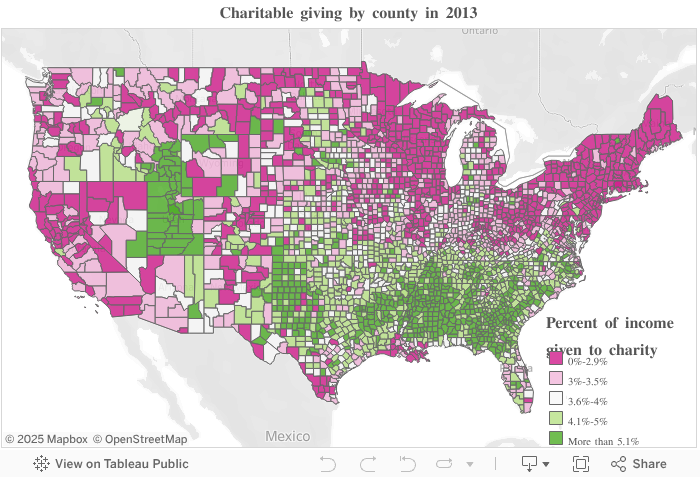
The Sacramento Bee published an article last month, showing the Adjusted Gross Income of every county in the US compared to how much was given in that county to charitable causes, non-profits and churches.

Interestingly, although perhaps not surprisingly, it was the poorer counties which gave more per capita than the richer ones. One of the major factors in how much people in a given county gave to charity seems to be religious affiliation; places with more people who attend religious services saw higher rates of charitable giving.

The idea that people who have less tend to give more may not be surprising to everyone. Jesus drew the attention of his disciples to a woman in the temple who gave her last 2 mites – all that she had, whereas other people who had more gave less of what they had. Preachers have long cited statistics which show the same thing: ironically, the more one accrues, the more miserly they tend to become with it.

How about Boulder County, Colorado, where yours truly is located? 2.6% of income was given to charity. That’s pretty low, and pretty ironic, because people in Boulder County, in my experience, talk a lot about being “locally minded and globally conscious” and caring about the well-being of other people, even if most of them are not Christian or attend religious services of any kind.

Neighboring Weld County was not much better at 2.7%, Larimer County came in at 3.2% (there are quite a few more church-going folks up there).

Here is the map with each county’s income versus charitable giving:

http://public.tableau.com/javascripts/api/viz_v1.js
Dashboard 1

 
Do you give charitably? The Bible recommends 10% of one’s income. The only places that came close to that number were the heavily Mormon populated counties of Utah.

Where do you direct your giving towards?


A “Christian Nation” and the End of an Era

Have you ever heard the term “Christendom”? I have often heard it used to refer to the “invisible community of Christians everywhere” – kind of along the lines of the term “blogosphere”.

While that use of Christendom isn’t wrong – it isn’t the historical use of the word either. Historically, Christendom referred to the “Christian nations.” It was a way of dividing up the globe, into “Christendom” and “heathendom”.

One of my professors from seminary, Llyod Pietersen, recently wrote a book titled Reading the Bible After Christendom.

In the book he includes two lists: the first is a list characterizing Constantinian Christianity and culture, and the second characterizes the shift away from it. They are particularly interesting in regard to thinking of the United States or the United Kingdom (or any country for that matter) in our modern era as a “Christian nation.”  Whether or not our founders were God-fearing people, or whether we have a history of movements of God in our country – we need to assess the reality of the modern situation. Sweden, for example, like a number of other European countries, is still technically a Christian nation, whilst practically they shifted away from Christendom long ago.

The other thing you realize from these lists is that maybe Christendom wasn’t actually as great as people think it was. One of the great downfalls of a “Christian nation” is that you give people a false sense of security in their salvation – simply because they were born into a “Christian” culture or society. At least in a pluralistic society (which is what we are in – but was also the situation Paul the Apostle and the Christians in the Book of Acts were in!) people realize the immediate and pressing need for them to make a choice to follow Jesus, and the radical implications that come with it!

Rather than bemoaning the end of Christendom, I believe that Christians are faced with a great new opportunity in pluralistic society – the opportunity to bring to bear on all people the challenges of the Gospel and the call to follow Jesus Christ, because being a Christian is no longer a “given”.

Here are those lists:

Characteristics of the shift to Christendom:

  • The adoption of Christianity as the official religion of city, state, or empire.
  • Movement of the church from the margins to the center of society.
  • The creation and progressive development of a Christian culture or civilization.
  • The assumption that all citizens (except Jews) were Christian by birth.
  • The development of a “sacral society,” corpus Christianum, where there was no freedom of religion and political power was divinely authenticated.
  • The definition of “orthodoxy” as the belief all shared, determined by powerful church leaders with state support.
  • Imposition, by legislation and custom, of a supposedly Christian morality on the entire society (though normally Old Testament morality was applied).
  • Infant baptism as the symbol of obligatory incorporation into Christian society.
  • The defense of Christianity by legal sanctions to restrain heresy, immorality, and schism.
  • A hierarchical ecclesiastical system based on a diocesan and parish arrangement, analogous to the state hierarchy and buttressed by state support.
  • A generic distinction between clergy and laity, and relegation of laity to a largely passive role.
  • Two-tier ethics, with higher standards of discipleship (“evangelical counsels”) expected of clergy and those in religious orders.
  • Sunday as an official holiday and obligatory church attendance, with penalties for non-compliance.
  • The requirement of oaths of allegiance and oaths in law court to encourage truth telling.
  • The construction of massive and ornate church buildings and the formation of huge congregations.
  • Increased wealth of the church and obligatory tithes to fund the system.
  • Division of the globe in “Christendom” and “heathendom” and wars waged in the name of Christ and the church.
  • Use of political and military force to impose Christianity, regardless of personal conviction.
  • Reliance on the Old Testament, rather than the New, to justify these changes.

Characteristics of the shift into post-Christendom:

  • The Christian story and churches have moved from the center to the margins.
  • Christians are now a minority.
  • Christians therefore no longer feel at home in the dominant culture.
  • Christians no longer enjoy automatic privileges but find themselves as one community among many in a plural society.
  • The church no longer exercises control over society but instead Christians can exercise influence only through faithful witness to the Christian story and its implications.
  • The emphasis is now no longer on maintaining the status quo but on mission in an contested environment.
  • Churches can no longer operate mainly in institutional mode, but must learn to operate once again as part of a movement.


What do you think?  Are there any Christian nations these days?  Do we really want to be one?

Jesus didn’t live in a Christian nation, neither did Paul. And I don’t think they thought our goal as Christians was to establish them either.