Ukraine’s Religious War: Protestants in Donetsk

I appreciate the work of Vice News in reporting on the ground the conflict in Ukraine this past year.

Watch this video. What’s being done by the Russian-backed rebels in the so-called Donetsk People’s Republic against non-Orthodox Christians is deplorable. The world needs to know. Pray for these Christians and for Ukraine.

When God Says “No”

One of the things we’ve been doing at White Fields Church is giving people the opportunity to text or tweet us questions during the sermon.

Yesterday morning I taught 2 Samuel ch 7, which is the time when David had a desire to build a house for the Lord, but God said “No!”  That has some interesting implications, because what David wanted to do was a good thing, and it was a biblical thing – yet God said “no”.

This question was texted in during that sermon:

This morning in the sermon, you discussed having a desire to be a missionary, pastor, etc. If we have that desire in our hearts, didn’t God put that there? So why would He close The door if He put that desire there?

That is a great question!  The first question is a particularly important one: Did God put that desire there?  I believe that as we get closer to the heart of God – delighting ourselves in the Lord, as David said (Psalm 37:4) – that our desires are changed and become more aligned with His desires. 

In the story we studied yesterday in 2 Samuel 7: David had a desire. It was a good, noble desire – it was even a Biblical desire. Did God put that desire there? Maybe! Or maybe not. We don’t know for sure. There is a way in which we could argue that God did put that desire in David’s heart – but that David’s role in fulfilling that was not to be directly involved in the building of the temple, but indirectly – as we saw, how David got the ball rolling with the building of the temple and had all of the items made which would be used in the temple.

Let me share an example from my own life: I gave my life to the Lord when I was 16, and almost immediately I developed a desire to minister to the people of the former Soviet Union, specifically Ukraine, where my family had immigrated from. When I was 18, I was invited to go on a ministry trip to Budapest, Hungary – to a conference for Calvary Chapel churches from Hungary and Ukraine. It was the Ukrainian part which I was interested in, and I went there with the hope that I could connect with some ministries in Ukraine. I was able to do that, but interestingly all of the “doors of opportunity” for me to serve in Ukraine seemed closed, however there was an incredible open door and an invitation for me to serve in Debrecen, Hungary – the pastor there told me he had been praying for someone exactly like me to come and work with them. I had no real desire to go to Hungary, my desire was to serve the Lord in Ukraine – but I prayed about it and came to the conviction that this is what God had for me at that point, and after serving there for a little while I could move to Ukraine, where I really desired to be. I committed to go to Debrecen, Hungary for 8 months. During those 8 months, I prayed for Ukraine constantly, I even tried to go to Ukraine to work with some of the people I had met the year before at the conference in Budapest, but once again all the doors of opportunity were closed!  My feeling was: God, why did you give me this desire to serve you in Ukraine, and then close all the doors before me?!  Yet, in the meantime, I had become very proficient in Hungarian and was involved in some very exciting and fruitful ministry in Hungary. I came to see that perhaps God had given me that desire to serve Him in Ukraine in order to get me to pray and to get me to Hungary – which hadn’t even been on my radar, but which ended up being the “land of blessing” for me, where I met my future wife, where I became a pastor, where my 3 kids were born, where I was involved in years of fruitful and wonderful ministry. Was it God who put that desire to serve Him in Ukraine in my heart? I’m not sure. But He certainly used that desire in my life to lead me to where He wanted me to be.

My desire to serve the Lord in Ukraine never went away; I still have it. But I have come to rest in believing that God gave me that desire not in order to move me to Ukraine, but so that I would carry the people of that country on my heart and pray for them, and support what God is doing through other people there – which is exactly what I strive to do! This desire to serve the Lord in Ukraine led me to start taking teams from our church in Eger up to a Hungarian-speaking region of Ukraine, where we would do evangelism and support ministries in that region. I also had the opportunity to take extended trips to Ukraine and teach in a Bible school there. Who knows what God has for the future, but I very much can relate to David – who, although he was not allowed to be directly involved in the building of the temple, found a way to still be involved in it in a signifiant and meaningful way, indirectly.

So, to the question: If you have a desire to be a pastor, missionary, etc. – did God put it there? If so, why would he then shut the door?    I think that 2 Samuel 7 shows us that even if God is the one who put that noble desire in your heart to serve the Lord in a particular way, perhaps the fulfillment of that desire is not found in you fulfilling the role you specifically have in mind – perhaps the fulfillment of that desire will come in a way that is completely from God, and has a greater impact, even in your own life, than you could have ever imagined.

We do not know what to do…

I was inspired this morning reading the story of King Jehoshaphat – he’s one of the bright spots in the chronicles of the kings of Israel and Judah.

In 2 Chronicles 20, we read how Jehoshaphat was faced with a difficult situation: the Moabites and the Ammonites, people groups who Israel had respected and lived beside peaceably as good neighbors, teamed up to attack and conquer Israel.

When Jehoshaphat received the news that these attacking armies were already in the land of Israel, on his doorstep, “he was afraid” – understandably – but look how he reacted: “[Jehoshaphat] set his face to seek the LORD, and proclaimed a fast throughout all Judah. And Judah assembled to seek help from the LORD; from all the cities of Judah they came to seek the LORD.” (2 Chronicles 20:3-4)

There are so many ways that people respond to bad news. I love the response of Jehoshaphat! Would to God that I would respond that way myself!

I once heard the statement that the key to leadership is that when you get bad news, you respond in great ways. That’s what Jehoshaphat did.

Key to leadership: When you get bad news, you respond in great ways

After calling the people together, Jehoshaphat led them in prayer – and he prayed fervently, from his heart, with faith. He says: “If disaster comes upon us, the sword, judgment, or pestilence, or famine, we will stand before this house and before you – for your name is in this house – and cry out to you in our affliction, and you will hear and save.” (2 Chronicles 20:9)

But most of all, I love the heart with which he ends the prayer: For we are powerless against this great horde that is coming against us. We do not know what to do, but our eyes are on you.” (2 Chronicles 20:12)

We do not know what to do, but our eyes are on you.

There is something about that sentiment which resonates with me. There are so many situations about which I feel the same way: I don’t know what to do. Riots in Ferguson, war in Ukraine, strife and conflict in families in our own community. The list could go on. I sympathize with the heart of Jehoshaphat: I don’t know what to do, Lord!  But his conclusion couldn’t be more right on: But our eyes are on you. Lord, we are looking to you to save and deliver and change and redeem. We can’t do it – so we look to you, Lord!

If you read the end of the story, what you find out is that Jehoshaphat and Judah win the battle; the tide turns when Jehoshaphat organizes the people to both fight and to worship. May that be true of us as well in the situations that we face – that we would have the heart of Jehoshaphat in those times.

Pray for Ukraine

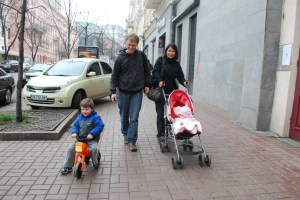
Our family walking in downtown Kyiv in November 2010:

DSC_1378

I was in town for a pastors conference with Calvary Chapel and we found Kyiv to be a beautiful, cosmopolitan European capital.

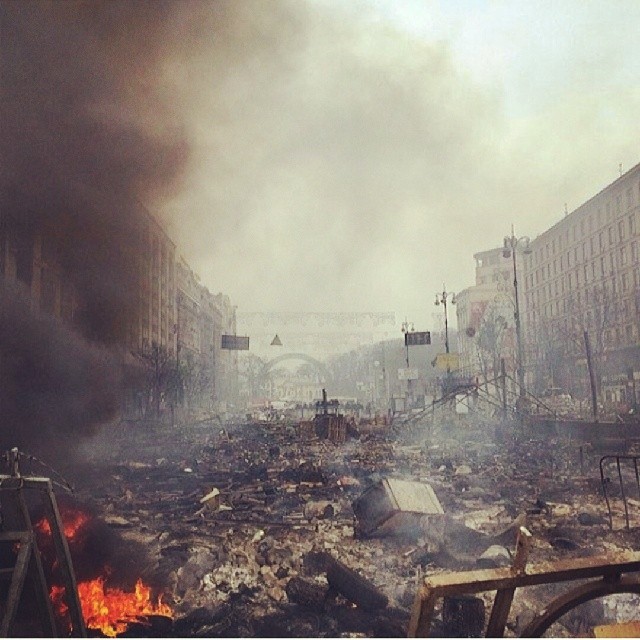
Here’s what Khreshchatyk street looks like today after months of anti-government protests, which recently turned violent:

 1959855_10203073030967423_1411475053_n

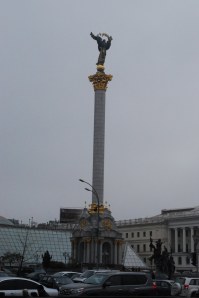
Here’s a photo I took of Independence Square, AKA Maidan, in 2010:

DSC_1376

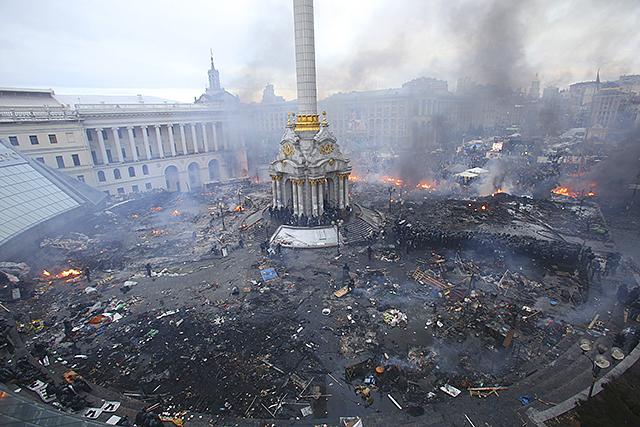
Here’s the scene today:

IndependenceSquareKiev021914_640

You can follow the news of what is going on in Ukraine here: the BBC is running live updates as things unfold.

Please pray for the people of Ukraine. They have suffered greatly from corruption since the end of the Soviet Union. Ultimately, the greatest hope for these people, as for all people, is found in Jesus Christ, and in His Kingdom of righteousness.

“Blessed are those who hunger and thirst for righteousness, for they shall be satisfied.” (Matthew 5:6, ESV)

How Effective was Government Persecution of Orthodox Churches in Russia During the Communist Period?

I have been toying with the idea of posting some of the articles I’ve written for seminary up on this blog for people to read and discuss. A few friends mentioned they would be interested in this one in particular. The following is an article I wrote for a class on Twentieth-Century Church History. Feel free to chime in and leave a comment below. (Just a heads-up that it’s written in UK English; those aren’t misspellings!)

The twentieth century, along with being a time of great technological development, was a period of some of the most intense persecution of Christianity the world has ever seen. Multiple sources have estimated that more Christians were killed for their faith in the twentieth century than in all other centuries combined. Much of this persecution happened under the rule of communist regimes in Eastern Europe and Asia. Not least among the persecuted churches was the Orthodox church in Russia. However, the Orthodox church did not cease to exist, and now enjoys a constitutionally privileged position in Russia. Tertullian famously wrote, ‘the blood of Christians is seed’; the implication being that persecution, rather than causing the extermination of Christianity, actually causes it to become stronger and to spread. Was this the case in regard to Orthodox Christianity in Russia during the communist period, or did the persecution ultimately reach its objective?

First of all, we must consider what the objectives of the government persecution were. As the largest and most influential religious organisation in Russia, the persecution of the Orthodox church by the Soviet government was both ideologically and politically motivated. Ideologically, one of the ultimate objectives of Marxism was the elimination of all religion. Politically, the Orthodox church had been very closely tied to the ruling houses of Imperial Russia, and thus, in the minds of the communists, was part of the old system which they were trying to overthrow. The fact that during the Russian civil war many prominent Orthodox supporters fought on the side of the ‘Whites’ certainly contributed to the persecution of the church once the ‘Reds’ eventually triumphed. Although all religions and Christian groups suffered persecution during the communist period, the Orthodox church was often treated uniquely; there were times when non-Orthodox were allowed greater freedom in the hope that their growth would weaken the Orthodox church, and there were times when the government sought to work through the Orthodox church as it did through its puppet regimes, to influence people or gain popular support for its agendas.

Some historical context is helpful for understanding the place of the Orthodox church in Russia prior to the communists coming to power. The official christianisation of the Russian people is recognised as having taken place in 988, when Vladimir I led the citizens of Kyiv to the Dnieper river for baptism. One of the factors in Vladimir pronouncing Christianity to be the official national religion was that he believed it would be a means of unifying his divided people by giving them a common sense of identity. Vladimir aligned his people with Constantinople, the ‘second Rome.’ Vassily III was the first Russian ruler to take the title of ‘tsar’, which comes from the Latin ‘caesar’. In 1589, the Patriarchate of Moscow was established; the Patriarch of Constantinople recognised Russia as the political but not ecclesiastical successor to Constantinople, and the tsar was acknowledged as successor to the Byzantine Emperors, but Moscow was not acknowledged as the ‘third Rome’, though its form of Christendom and church-state relations followed that model. Russian history after this point was marked by a struggle for authority between church and state; at some points church leaders claimed supreme authority, while at others the church was reduced to a department of the state and the clergy as state servants. At the beginning of the eighteenth century, Peter the Great suppressed the Moscow Patriarchate in favour of a synod which ran the church as a department of the state, limiting its freedom. Thus, in Russia there was a tradition of autocracy reaching back several centuries, in which the Orthodox church, while enjoying considerable privileges, was subjected to the state. When the communist regime made the churches answerable to a government department, this was nothing new to the Orthodox church. The traditional patterns of church-state relationship in Russia meant that the Orthodox church was surprisingly able to adapt to life under communism, where they found themselves once again in a struggle with the state for authority and once again subjugated to the state. In some ways the situation the Orthodox church found itself in under communism was one they were well-prepared to cope with because it was more familiar to them than, for example, Western-style pluralistic democracy would have been.

The Orthodox church suffered great losses during the communist period, but they also received some surprising benefits. After the Bolsheviks took power, a prolonged period of repression began, rising steadily throughout the 1920’s and 1930’s. The Orthodox church was virtually ‘decapitated’; between 1918 and 1926, over 100 bishops were executed and thrown in prison, along with tens of thousands of priests—85,000 clergy were put to death in 1937 alone. Stalin, a dropout from an Orthodox seminary, continued Lenin’s policy of persecution. During the first decades of Soviet control, the number of functioning Orthodox churches was reduced from around 55,000 to about 500, and the number of monasteries was reduced from 1,025 to 0. The Orthodox church, at least on the surface, ceased to exist; it was forced underground, with believers being led by clergy who took up ordinary occupations to mask their religious activity and to support themselves. We are only left to wonder if the Orthodox church in Russia would have survived at all had this level of persecution continued, because in 1943, Stalin introduced a reversal in policy and allowed the Orthodox church a limited amount of freedom in exchange for their support of the war effort. Such changes in policy happened a number of times during the communist period, with bursts of persecution and moments of reprieve, but it was always generally suppressive, and it was clear that the view of the future held by the communist powers was one which did not include religious groups of any kind, much less the Orthodox church. However, the Soviets were not opposed to using the church in the short term as a mechanism for influencing and controlling people in their empire, as Stalin had in 1943. Furthermore, it was easier to control centralised institutions than underground bodies. Thus, from 1940 the Uniate churches of Ukraine and Central Europe were forcibly united with the Russian Orthodox church and the jurisdiction of the Moscow Patriarchate was extended after 1945 to include Orthodox churches in Bulgaria and Romania as they came under Soviet political domination. The Russian Orthodox church had a history of attempting to extend its influence, and ironically, it was the Soviet regime who helped them to do so during the communist period.

The way the communist government of the Soviet Union approached the Orthodox church in Russia differed from policy of the communist government in China towards Christianity. The main reason for this is because communist social thought did not have to undo Christian cultural influence in China as it did in Russia, which had been shaped by centuries of Christian allegiance. In China the Christian community had always been a minority; it was smaller, less influential, and closely associated with foreign influence. Russia, on the other hand, had experienced centuries of Christendom, in which the Orthodox church, far from being considered a foreign entity, was part of the historical and national identity of Russia and the Russian people. This is precisely what Soviet policy sought to undo, as well as the reason why this was as incredibly difficult task, which they never fully succeeded to accomplish. It seems that this was ultimately accepted by the Soviet government, who in 1988, at the millennium of the christianising of Russia, not only allowed, but even participated in the commemoration by minting a gold coin. In the newfound liberty after the end of communism, the Orthodox church rushed in to fill the void in national identity left by the collapse of the Soviet Union. Symbols and paraphernalia of Orthodox worship began to reappear and the remains of Tsar Nicholas II and his family were disinterred and reburied in an Orthodox cathedral in Saint Petersburg. In 1997 a new law in Russia put the Orthodox church in a constitutionally privileged position and limited the freedom of other religious groups. Orthodox priests have been seen blessing Russian army recruits going off to war in breakaway provinces. It would seem that these are signs of a return to Christendom and the failure of the decades-long Soviet policy of persecution.

Statistics, however, suggest that the government persecution of the Orthodox church was not without effect. It is estimated that by 2000 there were around 80 million self-identified Orthodox Christians in Russia—about half the population. The other believers of all religions made up roughly 15 million, leaving approximately 65 million Russians professedly without any religious belief—an astonishingly high proportion compared with countries outside the former communist lands. Of that 80 million, somewhere between 3-15 million actually attend church even once a year. This disparity between practice and professed identity has led some to suggest that Russia is in fact one of the most secularised societies in the world.

Since the breakup of the Soviet Union, one of the greatest challenges that Orthodoxy has faced is how to cope with Western-style pluralistic democracy. The collapse of the Soviet state, while allowing the church far greater freedom than it had had at any time since 1917-1918, came at the expense of its ability to influence many of the churches once under the Soviet sway. One of the great legacies of communism has been internal church division. The reappearance of the Uniate churches and the formation of the Ukrainian Orthodox Church as well as schismatic Orthodox churches in Russia, Ukraine and abroad have significantly weakened the Moscow Patriarchate. Whereas the Orthodox church in Russia, for many centuries under tsarist rule and then still under communist rule was one, unified, ‘national’ church—Orthodoxy in Russia and its former areas of influence is now splintered and divided. Thus, it seems that the vision of a renewed Christendom is something which can never again exist in the same way it did during Russia’s imperial period. The legacy of the communist era is that it forced Russia out of Christendom in an irreversible way.

How effective was the government persecution of the Orthodox church in Russia during the communist period? On the one hand, in the wake of the communist era, an astonishingly high number of Russians profess no religious belief and the once-united Orthodox church is now splintered, divided and weakened. In this sense, the persecution was effective. On the other hand though, it failed to accomplish its ultimate objectives of destroying the church and its role in society. Although there is evidence that church attendance was in decline during this period, it was also in decline in the West; state persecution did not make much difference. In fact, in some ways, Soviet policy helped to strengthen the church by keeping it united and by increasing its sphere of influence. Considering the rapid decline of Christianity in Western Europe—and even more recently in countries like Poland, which remained extremely loyal to the Roman Catholic Church throughout the communist period, but has seen decline in that area since it has become more of a Western-style democratic society—one is left to wonder what would have happened if the communist authorities would have not persecuted the Orthodox church, but had treated it as irrelevant and quietly excluded it from public life, as the democracies of Western Europe did as they transitioned out of Christendom. If the Soviets would have done that, I expect that Orthodox faith in Russia would have gone the way of Lutheranism in Sweden and Anglicanism in England—and maybe it is now, but the transition would have been, I believe, quicker and easier. Forbidden fruit is always sweeter; persecution only strengthens the resolve of the faithful. The real way to kill a religion is not through persecution, but by making it appear irrelevant and making its adherents complacent and uninterested in it.

Bibliography

  • Ferguson, S.B., D.F. Wright and J.I. Packer, eds, New Dictionary of Theology (Leicester: Inter-Varsity Press, 1988)
  • Grass, T., THY305 Twentieth-Century Church History (Cheltenham: University of Gloucestershire, 2013)
  • Graves, D., “Tertullian’s Defence”, Christian History Institute, <https://www.christianhistoryinstitute.org/study/module/tertullian/> [accessed 06/12/13]
  • Jackson, E. and T. Grass, THY206 The Early Church to the Enlightenment, ed. by J. McKeown (Cheltenham: University of Gloucestershire, 2011)
  • Morris, J. N., The Church in the Modern Age (London: I.B. Tauris, 2006)
  • Noll, M.A., Turning Points: Decisive Moments in the History of Christianity, 2nd edn (Grand Rapids, Michigan: Baker Academic, 1997)
  • Norris, F.W., Christianity: A Short Global History (Oxford: Oneworld, 2002)
  • Pell, G., “Persecution of Christians is still rife today”, The Telegraph, 24 August, 2013 <http://www.dailytelegraph.com.au/news/opinion/persecution-of-christians-is-still-rife-today/story-fni0cwl5-1226703406943> [accessed 06/12/13]
  • Vos, H.F., Exploring Church History, Nelson’s Christian Cornerstone Series (Nashville, Tennessee: Thomas Nelson Publishers, 1994)
  • Walters, P.M., ‘Russian Orthodox Theology’ in New Dictionary of Theology, ed. by S.B. Ferguson, D.F. Wright and J.I. Packer (Leicester: Inter-Varsity Press, 1988), pp. 599-605

A Message from Ukraine

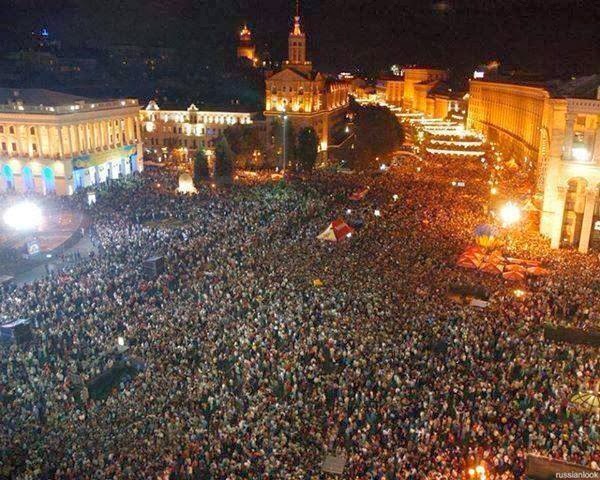
Maybe you have heard about what’s happening in Ukraine – where upwards of 25,000 people have taken to the streets in anti-government protests. 

Image

A friend of mine who is a pastor in Ukraine spoke at our church here in Longmont a few months ago (click here to watch that video), and today I asked him to write a brief synopsis on what is going on in Ukraine and how we can be praying for them. Here is what he wrote:

“And if one member suffers, all the members suffer with it…” 1 Cor. 12:26

You may have seen in the news recently that Ukraine, a former Soviet republic sandwiched between Russia and the European Union, is in the middle of massive street protests.  These protests were originally in reaction to the president breaking his promise to sign an association agreement with the EU.  People were angry and began to protest on the main square of the capital, Kiev.  After a few days on Nov. 30th, the president tried to end the protest with a massive show of violence, sending out special forces and riot police to beat peaceful protesters with batons.  They struck in the middle of the night when the fewest number of protesters were there to resist.  They beat both men and women indiscriminately and savagely, though the protesters posed no threat.  The president hoped that he would be able to put a stop to the people calling him to accountability for his broken promises.  He was wrong.  The reaction was the opposite and the next day many more people joined the protest.  This became no longer primarily a question of economics or which countries to build alliances with, but an outcry against human rights abuses, violence and oppression.  
Last night the president sent in troops and police again to try to clear the main square, though with more restraint as far as violence goes.  They attack began around 1:30am local time, again when there were less protesters to resist.  Many believers across Ukraine began praying.  We called each other, sent texts, waking one another up to stand before our mighty God and Savior and ask for Him to intervene.  It looked like this was the end of the protest and there was a thin line of protesters holding back a flood of riot police.  But then little by little people flocked to the square from all over Kiev in the middle of the night.  Soon the numbers were even.  Then the protesters were the majority.  By a miracle of the grace of God and in response to the prayers of His people, the protesters endured through the night and are still there.  The morning found a renewed protest and masses flocked to rebuild the barricades the police and special forces had torn down during the night.  
But the conflict is not over.  Tonight promises to be an important and difficult night on Independence Square in Kiev.  The protesters are more organized now, talking about organizing shifts for the night watch, but even then it will not be easy.  Also, the temperatures dipped down to almost 5F during the night last night.  Many of our brothers and sisters in Christ, including many pastors, are on the main square and will spend the night there ministering to the people and praying for God’s protection and peace and that His justice would triumph.  Near the beginning of the protests, some pastors set up an inter-denominational prayer tent on the square and people are coming to pray and even receiving Christ during this difficult time!  
The Word of God calls us to stand in unity and solidarity with both our brothers and sisters in Christ and with the oppressed and weak.  In this case, there is great overlap in those two categories.  I would beg you to stand together with the church in Ukraine before God and intercede at this pivotal moment in the nation’s history.  

Please pray for the following points:
1. Not against any party or person per se, but for the nation of Ukraine, that God would pour out His blessing and mercy on this people.

2. That God, who is not a God of disorder, but of peace (1 Cor 14:33) would establish His peace, order and justice in this land.

3. That God, who hates the hands that shed innocent blood (Pr. 6:17) would protect the people from violence and bloodshed, regardless of political affiliation.

4. That God would bless those currently in power by bringing them to repentance and the knowledge of Him and that they would rule in submission to God and turn from their wickedness, that we might live quietly and peaceably. (2 Tim. 2:2)

5. That the people would not be cursed in turning their hope to yet another man or political party in this time of trouble, but would be blessed by putting their hope in the Lord. (Jer. 17:5-7)

6. That the true enemy of man, Satan, who desires to steal, kill and destroy, would be cast down and that his plots would not prevail. (Eph. 6:12)

7. That, as our Lord Himself taught us to pray, the kingdom of God would come and His will be done on earth as in heaven. (Mt. 6:10)

Thank you for standing together as one body with your brothers and sisters in Ukraine.  God bless you and God bless the people of Ukraine!