Longmont Baby Abductor Will Not Be Charged With Murder

I was talking to a friend in Romania the other day and he said it feels like he is always seeing Longmont in the news.

It’s true. Longmont has made national (and apparently international) headlines a lot in the past few years, and not for good reasons: catastrophic floods, carjackings involving kids, and most recently a fetal abduction in which a woman who was 7 months pregnant responded to a Craigslist ad for free baby clothes was beaten, stabbed and had her baby cut from her womb and kidnapped.

For what it’s worth – crime rates in Longmont have actually decreased in the last year, as opposed to Boulder, which has higher crime rates which haven’t decreased, but this kind of stuff, although not characteristic of this fine town, gets a lot of publicity – as it should.

The suspect’s arraignment will be today at 1:30, but the Times-Call reported that the DA has already stated that murder will not be among the charges brought against this woman, the reason being that Colorado law does not count the death of an unborn child as murder, unless the child lived outside of the womb for some time. The issue in this case is that it’s not possible to prove that the child lived outside of the womb, and if so, for how long – so Colorado’s wording of the law will not allow a murder charge in this case.

People in Longmont were protesting this and picketing on Main Street last week when it was first announced. The charges expected to be brought against the suspect are: suspicion of attempted first-degree murder, first-degree assault and child abuse knowingly and recklessly resulting in death.

The problem with those charges are that even all together they will not lead to as strong of a sentence as if murder or manslaughter had been part of it. Since the mother survived, and there is no proof that the baby lived outside of the womb, Colorado law has no way to charge her with anything stronger.

What do you think?  Is this justice?

The sad part of this is that if this attack had not happened, this baby would have lived. The baby’s life was clearly taken by this attack. I find it hard to accept that we have no way to prosecute that.

Should Christians Try to Improve Society?

Tomorrow morning I’ll be teaching on Jesus’ salt and light metaphors from the Sermon on the Mount, as part of our CounterCulture series at White Fields.

I found this quote in a book by John Stott, about the social responsibility of Christians as part of our identity as the salt of the Earth. Since salt has a healing and preserving effect, the idea is that Christians should have a healing and preserving effect on society.

There are some who would say, What’s the point in trying to make society better?  If Jesus could come back any minute, and this life is short anyway, then shouldn’t all our efforts be towards saving people out of this world, rather than “polishing a turd”, to put it crassly?

However, it seems to me that it is an inherent part of the calling of a Christian to make the world a better place, if for no other reason than to “let your light shine before others so that they may see your good works and glorify your Father who is in Heaven.” (Matthew 5:16)

Here is that John Stott quote:

Too often evangelical Christians have interpreted their social responsibility in terms only of helping the casualties of a sick society, and have done nothing to change the structures which cause the casualties. Just as doctors are concerned not only with the treatment of patients but also with preventive medicine and public health, so we should concern ourselves with what might be called preventive social medicine and higher standards of moral hygiene. However small our part may be, we cannot opt out of seeking to create better social structures, which guarantee justice in legislation and law enforcement, the freedom and dignity of the individual, civil rights for minorities and the abolition of social and racial discrimination. We should neither despise these things nor avoid our responsibility for them. They are part of God’s purpose for his people. Whenever Christians are conscientious citizens, they are acting like salt in the community.

As Sir Frederick Catherwood put it:‘To try to improve society is not worldliness but love. To wash your hands of society is not love but worldliness.’

Stott goes on to say that SALT is not all that the world needs. The world also needs LIGHT – the truth of God, ultimately found in the Gospel.

Crossing Jordan

A reader of this blog requested that I write a post about the symbolic significance of the Jordan River crossing in Joshua chapter 3.

This week I began teaching Bible class at Longmont Christian High School. This class is doing an overview of the Old Testament, and I picked up where the previous teacher had left off: in the Book of Joshua.

One of the concepts I shared with the students as we’ve been studying Johsua is Biblical Typeology, or how certain characters, events or places in the Old Testament function as types of New Tesament truths.

In 1 Corinthians 10, Paul writes this: For I do not want you to be unaware, brothers, that our fathers were all under the cloud, and all passed through the sea, and all were baptized into Moses in the cloud and in the sea, and all ate the same spiritual food, and all drank the same spiritual drink. For they drank from the spiritual Rock that followed them, and the Rock was Christ. Nevertheless, with most of them God was not pleased, for they were overthrown in the wilderness. Now these things took place as examples for us, that we might not desire evil as they did. (‭1 Corinthians‬ ‭10‬:‭1-6‬ ESV)

What Paul is talking about here are how the Old Testament stories are both historically true, and yet were also so masterfully crafted by God that He, in His divine providence, embedded them with symbolic meaning, that is only realized by us now as being a pattern or type or foreshadowing of New Testament truths, i.e. Christ and the Christian life.

For example, in Luke 24, we read how after Jesus resurrected from the dead, he gave the best Bible study ever given: he took his disciples through the Olt Testament, showing them how everything actually pointed to him.

And beginning with Moses and all the Prophets, he interpreted to them in all the Scriptures the things concerning himself.

Then he said to them, “These are my words that I spoke to you while I was still with you, that everything written about me in the Law of Moses and the Prophets and the Psalms must be fulfilled.” Then he opened their minds to understand the Scriptures, (‭Luke‬ ‭24‬:‭27, 44-45‬ ESV)

In other words, reading the Bible is a lot like watching the movie “The Sixth Sense”. If you’ve seen the movie, it’s about a boy who sees dead people. The boy starts meeting with a psychologist, played by Bruce Willis, who talks him through what’s going on, but at the end of the movie you realize something that changes everything: the psychologist is dead too – he’s been dead all along. And then, when you realize that, you can never watch the movie the same way again. In fact, you feel compelled to watch the whole movie all over again, because this time you see the whole thing in a completely different way: you realize that no one ever looks at the psychologist – people look right past him, because they don’t see him.

That’s how it is with reading the Bible too! Once you know the end of the story – that it was all building up to Jesus Christ, and you come to understand the Gospel, you can never read it in the same way again! This is what happened to the Apostle Paul! As soon as he came to see that Jesus was the Messiah, he could never read the scriptures the same way ever again (see Acts 13:13-41).

The whole Old Testament is full of such types of Christ and of the New Life in Christ. For example: Melchizedek (Genesis 14). Hebrews 7 says that Jesus is a high priest in the order of Melchizedek. What does that mean? It means that Melchizedek was an Olt Testament type of Christ. The name Melchizedek means: King of Righteousness. He was king of Salem, which means peace, and he gave Abraham bread and wine and Abraham gave him a tithe.

The Exodus narrative is another example of Biblical Typeology. Think about it:

  • The people of Israel are in bondage in Egypt, just as we in our natural condition are in bondage to sin, vanity and futility.
  • The people of Israel cry out to God to set the free, and so God saves them by the blood of the Passover lamb; if anyone is covered by the blood of the lamb, their house is passed over by tha angel of death. In the same way, if we are covered by the blood of the true and ultimate Passover lamb, Jesus Christ, we will be saved from the judgment of God.
  • After saving them by the blood of the lamb, God led the people of Israel out of bondage in Egypt. They were separated from Egypt (which is commonly considered a type of “the world”) through the Red Sea, which Paul tells us in 1 Corinthians 10 is a type or picture of baptism.
  • After they cross through the Red Sea, the next thing that happens is that God leads them to the Mountain of God, where they came out and God gives them His Word. In the same way, once we are saved and set free, God gives us His Word and instructs us in His ways.
  • After that, they are to enter the Promised Land, which they fail to do because of their lack of faith, out of fear of the obstacles. There has been debate as to what the Promised Land would be a type of. Many old songs refer to it as a type of Heaven. However, I disagree. The Promised Land is a place where there are battles to be wages, there are enemy forces. There are victories to be won, but defeats are also suffered. There are obstacles and difficulties in the Promised Land, but there is the primise of victory if the people will obey God by faith and take hold of everything He will give them if they assertively take hold of it. For this reason, many, including myself, would say that the Promised Lamd is rather a picture or type of the Victorious Christian life that God promises to those who are in Christ (see Ephesians 1). Some would also refer to this as the Spirit-Filled Life.
  • Because the Israelites were unwilling to enter the Promised Land, they ended up wandering in the wilderness, going in circles and getting nowhere for 40 years, until they died, having lived lives of aimless wandering, not taking hold of what God would have given them and wanted to give them, because they allowed fear to hold them back from engaging in mission God gave them. Yet, they were saved by the blood of the lamb, baptized in the Red Sea and had received the word of God. This is clearly a type of the Christian life as it is lived by some.
  • That brings us to the issue of the Jordan River crossing in Joshua 3. What is this a type of? Well, it is the entrance into the Promised Land, a step which must be taken by faith. Just as the Red Sea crossing is a type of baptism, the Jordan crossing would seem to also picture baptism: a second baptism: the baptism of the Holy Spirit.

Once you’ve read the book and seen Jesus, you can never read the book the same way again!

 

Big Shoes

Starting today, I am now teaching Bible class at Longmont Christian High School.

I took over for Don Monteath, a great godly man who taught history and Bible for many years at LCS; he taught our son for the years that he went to school there. Mr. Monteath didn't only teach the kids, he also loved them very much and they knew it. Mr. Monteath didn't teach at the school because he needed to, he taught there because he loved the kids and he loved teaching.


Don Monteath passed away in December. I attended his memorial, and it was packed. There was an open mic and the memorial went on and on with former students, family members and friends sharing their memories.

I heard it said recently that what the church needs most is more great men and women of God, who serve God and take part in His mission simply because they are Christians and that is what Jesus called all of His followers to be about until His return.

I consider it a privilege to get to teach these students the Bible, and to fill Mr. Monteath's shoes in this role.


Redemption: Jesus’ Family Tree

advent2014HERO


In the Gospel of Matthew, the Christmas Story doesn’t begin with a baby born in Bethlehem and placed in a manger. When Matthew wants to tell us the story of Jesus, he takes us back hundreds, even thousands of years, to look at the family line from which God chose to bring the Redeemer into the world. Matthew starts by giving us a genealogy — which gets skipped over by many people, because it reads like a Hebrew phone book!
But, if you look closely, you’ll find that Jesus’ family tree contains a lot of knots: people we have read about in the Old Testament, whose stories were full of scandal and intrigue…and sin. Yet, these people each represent a story of redemption, in which God blessed a mess and brought beauty from ashes and salvation from brokenness. Ultimately, it was from this group of people that God brought The Savior, The Redeemer, Jesus Christ into the world.
In Matthew 1:21, we read this glorious proclamation: “Mary will bear a son and you shall call his name Jesus, for he will save his people from their sins.”  
Jesus came to save you from your sins. That is what Christmas is all about.
I invite you to join us at White Fields Church in Longmont every Sunday in December and on Christmas Eve for “Redemption: An Advent Series” – in which we will be looking at the knots in Jesus’ family tree, and how God redeems.


Does Forgiveness Simply Mean Suppressing Your Feelings?

In reading through some material for a class I’m taking on Christian ethics, I ran across an interesting discussion of the ethic of forgiveness, related to Jesus as Priest (part of that being that one role of priests in the Old Testament is that they were mediators of forgiveness between God and humans).

Here is the quote from Esther Reed in the book “The Genesis of Ethics”:

Christian ethics has much to share with – as well as to learn from – the survivors of sexual abuse and domestic violence. A problem for both is that forgiveness is too often confused with passive acceptance of wrong, or the suppression of hurt and anger.

The supposed virtue of self-control, and the ideal of self-sacrifice or martyrdom, can lead women to believe that in accepting abuse and exploitation they are doing what Christianity, especially in its support for family values, requires. For neither, however, does forgiveness properly equate with sweeping wrong aside. Rather, it has regard for the specifics of a person’s situation and never trivializes any suffering endured. Anything less is what Bonhoeffer calls ‘cheap grace’, because there is no recognition of guilt and no call for genuine repentance.

I recently spoke about this very thing at White Fields Church – on the oft-missunderstood topic of ‘turning the other cheek’ and what that means, because it has often been taken to mean allowing people to walk all over you or permitting people to abuse you. I don’t believe that’s what it means – and I explained that in detail in a study titled “Loving Your Enemies” – the audio of which can be found here.

Opinion Article in Longmont Times-Call Advocates that Fertilized Eggs are Human

I was surprised to see today that the Longmont Times-Call posted an opinion article by a Longmont resident on the topic of when an unborn child becomes a true person – since this is a controversial topic which is very much at the heart of debates over abortion and human rights.

I was even more surprised when I realized that the article was advocating for seeing fertilized eggs as fully human – not what I had expected to find when I saw the title of the article.

The author, Brad Jolly, is writing in response to atheist doctor Richard Juday, who believes that humanness develops over time.

Check out the article – I found it surprisingly refreshing, especially that it appeared here in the local paper: http://www.timescall.com/columnists/opinion-local/ci_26964706/brad-jolly-fertilized-human-eggs-are-human

Thank you Longmont Times-Call for representing a broad spectrum of viewpoints!

When God Says “No”

One of the things we’ve been doing at White Fields Church is giving people the opportunity to text or tweet us questions during the sermon.

Yesterday morning I taught 2 Samuel ch 7, which is the time when David had a desire to build a house for the Lord, but God said “No!”  That has some interesting implications, because what David wanted to do was a good thing, and it was a biblical thing – yet God said “no”.

This question was texted in during that sermon:

This morning in the sermon, you discussed having a desire to be a missionary, pastor, etc. If we have that desire in our hearts, didn’t God put that there? So why would He close The door if He put that desire there?

That is a great question!  The first question is a particularly important one: Did God put that desire there?  I believe that as we get closer to the heart of God – delighting ourselves in the Lord, as David said (Psalm 37:4) – that our desires are changed and become more aligned with His desires. 

In the story we studied yesterday in 2 Samuel 7: David had a desire. It was a good, noble desire – it was even a Biblical desire. Did God put that desire there? Maybe! Or maybe not. We don’t know for sure. There is a way in which we could argue that God did put that desire in David’s heart – but that David’s role in fulfilling that was not to be directly involved in the building of the temple, but indirectly – as we saw, how David got the ball rolling with the building of the temple and had all of the items made which would be used in the temple.

Let me share an example from my own life: I gave my life to the Lord when I was 16, and almost immediately I developed a desire to minister to the people of the former Soviet Union, specifically Ukraine, where my family had immigrated from. When I was 18, I was invited to go on a ministry trip to Budapest, Hungary – to a conference for Calvary Chapel churches from Hungary and Ukraine. It was the Ukrainian part which I was interested in, and I went there with the hope that I could connect with some ministries in Ukraine. I was able to do that, but interestingly all of the “doors of opportunity” for me to serve in Ukraine seemed closed, however there was an incredible open door and an invitation for me to serve in Debrecen, Hungary – the pastor there told me he had been praying for someone exactly like me to come and work with them. I had no real desire to go to Hungary, my desire was to serve the Lord in Ukraine – but I prayed about it and came to the conviction that this is what God had for me at that point, and after serving there for a little while I could move to Ukraine, where I really desired to be. I committed to go to Debrecen, Hungary for 8 months. During those 8 months, I prayed for Ukraine constantly, I even tried to go to Ukraine to work with some of the people I had met the year before at the conference in Budapest, but once again all the doors of opportunity were closed!  My feeling was: God, why did you give me this desire to serve you in Ukraine, and then close all the doors before me?!  Yet, in the meantime, I had become very proficient in Hungarian and was involved in some very exciting and fruitful ministry in Hungary. I came to see that perhaps God had given me that desire to serve Him in Ukraine in order to get me to pray and to get me to Hungary – which hadn’t even been on my radar, but which ended up being the “land of blessing” for me, where I met my future wife, where I became a pastor, where my 3 kids were born, where I was involved in years of fruitful and wonderful ministry. Was it God who put that desire to serve Him in Ukraine in my heart? I’m not sure. But He certainly used that desire in my life to lead me to where He wanted me to be.

My desire to serve the Lord in Ukraine never went away; I still have it. But I have come to rest in believing that God gave me that desire not in order to move me to Ukraine, but so that I would carry the people of that country on my heart and pray for them, and support what God is doing through other people there – which is exactly what I strive to do! This desire to serve the Lord in Ukraine led me to start taking teams from our church in Eger up to a Hungarian-speaking region of Ukraine, where we would do evangelism and support ministries in that region. I also had the opportunity to take extended trips to Ukraine and teach in a Bible school there. Who knows what God has for the future, but I very much can relate to David – who, although he was not allowed to be directly involved in the building of the temple, found a way to still be involved in it in a signifiant and meaningful way, indirectly.

So, to the question: If you have a desire to be a pastor, missionary, etc. – did God put it there? If so, why would he then shut the door?    I think that 2 Samuel 7 shows us that even if God is the one who put that noble desire in your heart to serve the Lord in a particular way, perhaps the fulfillment of that desire is not found in you fulfilling the role you specifically have in mind – perhaps the fulfillment of that desire will come in a way that is completely from God, and has a greater impact, even in your own life, than you could have ever imagined.

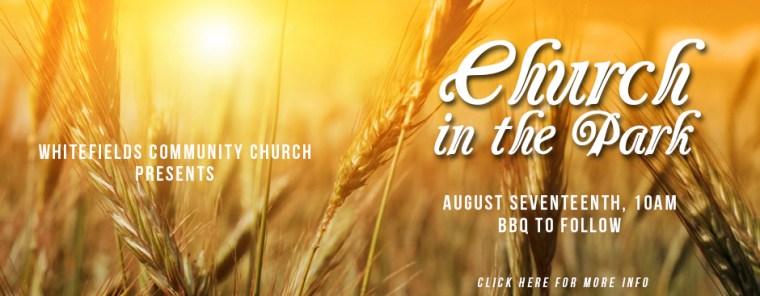
Church in the Park – upcoming event in Longmont’s Roosevelt Park

CHURCHINTHEPARK

White Fields Community Church will be hosting Church in the Park on August 17th in Longmont’s Roosevelt Park (700 Longs Peak Avenue).

This outdoor service will be held under the shade of the trees in the South-East corner of the park, right in front of the St Vrain Memorial building.

We will be joined by guest Pastor Pete Nelson, who will be sharing the Word with us.  Hope you will join us!

English Camp in Hungary

This July I was in Hungary for just under 2 weeks, leading a team from White Fields Community Church in Longmont to serve at the English Camp outreach hosted by Golgota Eger.

My wife and I started this camp when we were living in Eger and looking for a way to effectively reach young people with the Gospel. This was the 9th English Camp in the hills outside of Eger – and over the years, we have seen God do such great things through it and so much great fruit come out of it.

For the past several years, the camp has been at full capacity of what we can fit at this location, and the amount of kids we can reasonably handle and minister to well – around 130.

Here is are 2 short videos which highlight the long-term impact that this outreach is having on youth in this part of Hungary: