
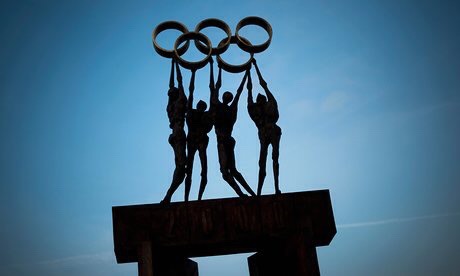
The IOC on Religion: Nothing New Under the Sun


One of the things we do at White Fields Church every week is invite people to text or tweet questions during the sermon and then I respond to them on our members’ website called The City. I really enjoy this aspect of it, and I think that such engagement aides in the learning process.

For the past several weeks I have been teaching through Paul’s letter to the Colossians, and what I have found most interesting about it is that the core message of the book is something which is incredibly relevant to our day, which is the uniqueness of the Christian gospel as it relates to every other religion and philosophy in the world.

When you look into the culture of the Roman Empire, interestingly what you find is a society which was very similar to modern Western society in many ways. It was a pluralistic society, a multi-cultural, multi-ethnic society, in which there was freedom of religion – and yet… the prevailing notion was that in order for there to be peace in a mixed society, no one should say that their tradition or religion was any better or more true than anyone else’s – only that it was different. Furthermore, a person’s religion or tradition was considered to be something they were born into rather than something they had a responsibility to choose for themselves, and therefore it was considered taboo, rude and even wrong to try to “convert” someone to another religion than that which they were born into or brought up in.

Now, if that doesn’t sound familiar to our day and age, then you should check your pulse.

I discussed this in more detail this past Sunday. If you’re interested, check out the audio of that message here.

In response to that teaching, a member of our church texted in:

The unifying/melting pot of religions that Paul is warning the Colossians about in today’s passage is the same message delivered by the president of the IOC at the opening of the Olympic Games. It’s clear that making exclusive claims about right or wrong in regard to religion is frowned upon internationally.

I unfortunately missed the opening ceremony of the Rio Olympics, and have not been able to find a way to watch the whole thing online – if anyone knows a way, please let me know!

Although I am not surprised by this, I am surprised by the naivety in thinking which it represents. For educated people to say that no one should make exclusive claims is to ignore the fact that EVERYONE makes exclusive claims, including the people who say that you should not make exclusive claims. For example, if you say that it is wrong to say that something is wrong, you are doing the same thing which you are claiming should not be done. I only wonder if this overlooking of the obvious is sincere/naive in nature, or it is it a willful ignorance for the sake of pragmatism; in this case that everyone would just get along. Either way, to make such a claim reveals a sort of patronizing disregard for the validity of the claims of any and all religious beliefs, which is itself a form of judgment about them… Oh the irony…

Don’t fall for this underdeveloped, recycled logic. We can absolutely live in a free society where honest and open dialogue of the validity of certain ideas, traditions, practices and beliefs exists.


The Impact on Kids of Dad’s Faith and Church Attendance

Dream Lake landscape  Rocky Mountain National Park

According to LifeWay Research Group, Fathers Day is the holiday with the single lowest average church attendance – statistically lower than Labor Day, Memorial Day and even the Fourth of July.

This is interesting, especially when you consider that Mothers Day tends to be the day with the third highest church service attendance, after Easter and Christmas.

So, Mothers Day is one of the most highly attended Sundays of the year, and Fathers Day is one of the lowest. What does this tell us?

Scott McConnell, director of LifeWay Research, gives this assessment:

“Clearly, mothers want to be present for the affirmation that is typically offered in most churches, but families also are present knowing their attendance will honor their mother.

The attendance difference between Mothers Day and Fathers Day is telling,” said McConnell. “Either churches are less effective in affirming fathers, or families believe Christian fathers don’t value their participation in worship services.”

Surely there are other factors involved, including travel and the time of year. On Mothers Day school is still in session, on Fathers Day it isn’t – so families travel to visit relatives, or go on vacation.

But all these factors and statistics aside, here’s what’s really striking: when you see the research on the impact of a dad’s faith and practice on their families.

According to data collected by Promise Keepers and Baptist Press, if a father does not go to church, even if his wife does, only 1 child in 50 will become a regular worshiper. If a father does go regularly, regardless of what the mother does, between two-thirds and three-quarters of their children will attend church as adults. If a father attends church irregularly, between half and two-thirds of their kids will attend church with some regularity as adults.

If a mother does not go to church, but a father does, a minimum of two-thirds of their children will end up attending church. In contrast, if a father does not go to church, but the mother does, on average two-thirds of their children will not attend church. 

Another study, focused on Sunday School, found similar results on the impact of fathers:

  • When both parents attend Bible study in addition to the Sunday service, 72% of their children attend Sunday school when grown.
  • When only the father attends Sunday school, 55% of the children attend when grown.
  • When only the mother attends Sunday school, 15% of the children attend when grown.
  • When neither parent attends Sunday school, only 6% of the children attend when grown.

Another survey found that if a child is the first person in a household to become a Christian, there is a 3.5% probability everyone else in the household will follow. If the mother is the first to become a Christian, there is a 17% probability everyone else in the household will follow. However, when the father is first, there is a 93% probability everyone else in the household will follow. 

Here’s the point of all these statistics: Dad’s impact on the kids’ faith and practice is HUGE.

Dads, let me encourage you with these words which Moses spoke by the inspiration of the Holy Spirit to the dads of the new generation in Deuteronomy:

And these words that I command you today shall be on your heart. You shall teach them diligently to your children, and shall talk of them when you sit in your house, and when you walk by the way, and when you lie down, and when you rise. You shall bind them as a sign on your hand, and they shall be as frontlets between your eyes. You shall write them on the doorposts of your house and on your gates. (Deuteronomy 6:6-9)

Playing Harps in Heaven? Don’t be Ridiculous

I have been reading CS Lewis’ Mere Christianity along with the men’s group at White Fields Church. I first read the book 18 years ago, and reading it again has been like reading it for the first time.

I came across this quote in the book, which I thought was excellent, in regard to the Christian belief in Heaven:

There is no need to be worried by facetious people who try to make the Christian hope of ‘Heaven’ ridiculous by saying they do not want ‘to spend eternity playing harps’.

The answer to such people is that if they cannot understand books written for grown-ups, they should not talk about them.

All the scriptural imagery (harps, crowns, gold, etc.) is, of course, a merely symbolical attempt to express the inexpressible. Musical instruments are mentioned because for many people (not all) music is the thing known in the present life which most strongly suggests ecstasy and infinity. Crowns are mentioned to suggest the fact that those who are united with God in eternity share His splendour and power and joy. Gold is mentioned to suggest the timelessness of Heaven (gold does not rust) and the preciousness of it. People who take these symbols literally might as well think that when Christ told us to be like doves, He meant that we were to lay eggs.

Lewis, C. S. Mere Christianity (p. 137).

I love his line about if you can’t understand a book written for grown-ups, then you shouldn’t be talking about it!

He says in another place in the book:

Very often a silly procedure is adopted by people who [oppose] Christianity. Such people put up a version of Christianity suitable for a child of six and make that the object of their attack.

When you try to explain the Christian doctrine as it is really held by an instructed adult, they then complain that you are making their heads turn round and that it is all too complicated.

It is no good asking for a simple religion. After all, real thing are not simple.

Lewis, C. S. Mere Christianity (p. 41).

I have found this to be true – not only in regard to discussions about Christianity, but in many debates about many things. People put up a caricature of the other person’s views and then proceed to destroy them. This is sometimes called a “straw man argument”.

It is important that we should not allow people to do that with Christian beliefs, and also that we should not do the same with other people’s beliefs. This is sometimes called “Presuppositional Apologetics” – the idea that you should try to frame the views of your “opponent” in such a way, that they would say, “I couldn’t have put it better myself.”

As Timothy Keller put it recently:


Was Paul Suicidal?

Recently at White Fields I have been teaching through Paul’s Letter to the Philippians in a study titled, The Pursuit of Happiness.

This past Sunday I taught on Paul’s famous saying: “For me to live is Christ and to die is gain” – and I explained how the gospel gives new meaning to our lives and it redefines what death means for us. Audio of that message can be found here.

In that sermon, I didn’t get to what Paul says after that famous phrase. Here’s the rest:

For to me to live is Christ, and to die is gain. If I am to live in the flesh, that means fruitful labor for me. Yet which I shall choose I cannot tell. I am hard pressed between the two. My desire is to depart and be with Christ, for that is far better. But to remain in the flesh is more necessary on your account. Convinced of this, I know that I will remain and continue with you all, for your progress and joy in the faith, so that in me you may have ample cause to glory in Christ Jesus, because of my coming to you again. (Philippians 1:21-26)

A reader of this blog sent me a message this week about this passage:

I have always wondered if Paul was experiencing a period of depression when he wrote this epistle. What he says in verse 1:22, “yet what I shall choose I cannot tell” even makes me consider that he was in some ways considering “suicide”. I know that sounds preposterous, and I’m not suggesting that he actually thought of killing himself but rather maybe purposely doing something that would result in his death. In todays world it might be called “suicide-by-cop”. It seems as he continues through the remainder of the chapter that he convinces himself that it is better to remain for the benefit of others. It could be that he was just experiencing a time when his death seemed imminent and he was preparing the readers for that eventuality, but I think that he was experiencing a great amount of stress during this time. As always, he was able, through the Spirit, to overcome his stress and turn it into a beautiful, encouraging letter. I believe it probable that all men of great faith experience times of doubt or fear brought on by the enemy.

That’s an interesting thought. Certainly Paul was facing dire circumstances, and I fully agree with the final sentence, but I wouldn’t go so far as to agree that Paul might have been having suicidal thoughts – even to the degree of doing something that might provoke someone else to kill him.

To me, the tone of the letter is one of triumph in the face of harsh circumstances, even death.

I believe that what’s going through Paul’s mind as he writes those words is that he wants to explain something important to the Philippians: That although as Christians, the ultimate hope of the Gospel is the hope of eternal life in paradise with God, that should never minimize the purpose that God has for our lives here on Earth.

This seems to have been a problem amongst some of the early Christians. 2 Thessalonians was written, in part, to let the Christians know that Jesus had not yet returned, that the Parausia, the Second Coming, was still to come – but that as we await Jesus’ imminent return, we should not be inactive;  we should still work hard. That’s why he says:

If anyone is not willing to work, let him not eat. For we hear that some among you walk in idleness, not busy at work, but busybodies. Now such persons we command and encourage in the Lord Jesus Christ to do their work quietly and to earn their own living. (2 Thessalonians 3:10-12)

The context of that, is that the Thessalonians were eagerly expecting the return of Jesus any day – as all early Christians did, and as it seems that Jesus intended all Christians to do, which is the reason for his vagueness about when his return will take place.

The point is this: We should not have a Christianity in which we encourage people to just believe in Jesus and then hang on and wait for death! I think Paul wanted to Philippians to understand that: that Christianity isn’t only about going to heaven when you die, it’s about living this life for Christ – as much as, and as long as possible.

It’s not only that because of the Gospel, DEATH IS GAIN – but also: because of the Gospel, TO LIVE IS CHRIST!

Another reason why I think Paul was not discouraged when he wrote to the Philippians is because he closes the letter by saying:

Greet every saint in Christ Jesus. The brothers who are with me greet you. All the saints greet you, especially those of Caesar’s household. (Philippians 4:21-22)

What this means is that members of Caesar’s household, including the Praetorian Guard (members of which were chained to Paul 24 hrs a day in 6 hr shifts), were becoming Christians through his being there in jail. I think Paul was feeling particularly encouraged after facing years of discouragement prior to this. Finally he was starting to see some fruit and the purpose for which God must have allowed this series of terrible difficulties and injustices happen to him. Many of us may never get to see that in our difficulties, but when we do it helps to encourage us that God is indeed in control and using all of the frayed strands to create a beautiful tapestry.


O Little Town of Bethlehem: What are the Odds?

A reader of this blog contacted me this week asking if I could write a few words about Micah 5:2

But you, O Bethlehem Ephrathah,
who are too little to be among the clans of Judah,
from you shall come forth for me
one who is to be ruler in Israel,
whose coming forth is from of old,
from ancient days.

Bethlehem = “House of Bread” – it is a small town only a few kilometers outside of Jerusalem. It was also the ancestral home of King David.

The older, pre-Jewish name of Bethlehem was Ephrathah, which is used on several occasions to speak of it in the Bible.

Micah’s prophecy is about the impending destruction of Samaria and Judea, including Jerusalem for their sins and refusal to repent of them and turn their hearts back to God. As a result, destruction would come upon them from other nations and they would be carried off in exile.

However, the final word of this prophetic message is one of hope and restoration, the message that God has not abandoned his people, but is wholly committed to them, and at a time when they have repented, he will fulfill his promises to them.

What promises were these? In particular it was the promise of a ruler, a King in the line of David, who would establish a Kingdom which would have no end; a kingdom of peace and justice and righteousness which would last forever.

That’s a pretty steep promise! Is it just meant as hyperbole, or was it meant to be taken as a literal promise? How could any king rule forever?

When you begin to take the different promises about this king together, the picture comes together of a King who is more than just a man, but who is actually divine in nature. Notice how Micah says that “his coming forth is from old, from ancient days” – this is saying that one is going to be born, who has existed from eternity past. This is speaking of divinity being born into the world to establish an everlasting kingdom. This is speaking of the incarnation: God coming to us, born in human flesh.

And where would this happen? In Bethlehem. A village of no consequence, only famous as the ancestral home of Israel’s greatest king – and significantly, a king who was promised by God that one of his descendants would establish an everlasting kingdom.

Micah 5:2 is one of 300+ prophecies found in the Hebrew Bible (what Christians call the Old Testament) about the Messiah, which speak of who he would be, what he would do, and how his coming would take place. 300+ – fulfilled by one person! What are the odds?

Peter Stoner, in Science Speaks (Moody Press) attempts to show how coincidence is ruled out by the science of probability. Stoner says that by using the modern calculation of probability in reference to eight prophecies, “we find that the chance that any man might have lived down to the present time and fulfilled all eight prophecies is 1 in 1017.” That would be 1 in 100,000,000,000,000,000.  In order to help us comprehend this staggering probability, Stoner illustrates it by supposing that “we take 1017silver dollars and lay them on the face of Texas. They will cover all of the state two feet deep.

“Now mark one of these silver dollars and stir the whole mass thoroughly, all over the state. Blindfold a man and tell him that he can travel as far as he wishes, but he must pick up one silver dollar and say that this is the right one. What chance would he have of getting the right one? Just the same chance that the prophets would have had of writing these eight prophecies and having them all come true in any one man.”

Stoner considers 48 prophecies and says, “we find the chance that any one man fulfilled all 48 prophecies to be 1 in 10157. The estimated number of electrons in the universe is around 1079. It should be quite evident that Jesus did not fulfill the prophecies by accident.”

Advent Meditations: 10 – Christmas Joy

christmas-joy-516x260

And the angel said to them, “Fear not, for behold, I bring you good news of great joy that will be for all the people. For unto you is born this day in the city of David a Savior, who is Christ the Lord. – Luke 2:10-11

What is the joy of this season?    Is it Tradition?  Family?  Giving and receiving?

The thing about each of these, is that the joy of these things is something very temporal and easily lost.

If the joy of Christmas is family, then what about those who have no family?  Does this season hold no joy for them?

If the joy of Christmas is tradition, then what is there for those who have suffered loss of loved ones – or even of financial resources?  For them, Christmas will be pure pain.
If the joy of Christmas is tied to traditions: decorating a house, eating certain foods, doing certain things – then if those things are no longer possible, because you had to give up the house, or because a family member passed away, or any other reason, then Christmas will not be a time of joy, but of pain and heartache.

If the joy of Christmas is in giving and receiving, then once again, what about those who have nothing to give and/or no one to receive from?  If the joy of Christmas is in giving and receiving, then Christmas brings loneliness and shame rather than joy.

These things are what are commonly held by many people to be the joys of Christmas, but let me tell you: these should not be – they cannot be – the wellspring of joy that Christmas brings, because it is only a matter of time, before all of these things run dry…and make Christmas a time of pain and bitter longing rather than life-giving joy.

What is the true joy of Christmas?  It is this: A Savior is born to you, who is Christ the Lord.

One of the verses in the Bible that I find most moving is Matthew 1:21:

She will bear a son, and you shall call his name Jesus, for he will save his people from their sins – Matthew 1:21

This is the joy of Christmas: that though you were lost, God pursued you and found you!   That though you were without hope, God came near to you to give you hope that extends beyond the grave!  That though you were destined for darkness and death, God broke into time and space to bring you light and life!

That is a joy that doesn’t disappear when financial resources dry up!  That is a joy that doesn’t grow dimmer as loved ones pass away – but rather grows all the more vibrant and beautiful!

May this be the joy of Christmas for you!

And may we not teach our children, whether in word or in deed, to find the joy of Christmas primarily in tradition or in giving or receiving, or even in family – but in the hope of the Gospel of Jesus Christ.


Promises and Proverbs

Take the few minutes to listen to this audio from John Piper. He’s addressing something that I think a lot of people are confused about.

The issue is: what constitutes a “promise” in the Bible, and what constitutes a “proverb”?

The issue in question is that of Proverbs 22:6, which says: “Train up a child in the way he should go; even when he is old he will not depart from it.”

Many people consider this a “PROMISE” from God – that if you raise you kids up right, they will be good people who do right things. In particular, many Christians come to this verse in the hope that if they raise up their children to walk with God, then their children are guaranteed to grow up to share their faith – and if that doesn’t happen, then it is “user error”, i.e. the parents didn’t do a good enough job raising their kids up in the right way.

The problem is, there are plenty of kids who come from great, loving, Christian families, who don’t follow their parents’ faith nor their moral/ethical values.  What are we to make of this?

John Piper answers the question well – concerning the nature of proverbs versus the nature of promises, and how we should understand this verse.

Why do Christians Worship on Sunday?

Have you ever wondered why Christians worship on Sunday?

Recently I have been taking a seminary class on the history of Christian worship, and I came across some interesting information the other day about the history of Christian worship on Sundays.

The most common assumption is that Christians worship on Sunday because that is the day that Jesus rose from the dead. And that is correct. But there is more to it than that.

For the early Christians, Sunday become known as “the Lord’s Day” – references to which are made in the New Testament. However, it is worth noting that in the places Christians lived in those early centuries, including the Roman Empire, Sunday was a work day. So it became common for Christians to gather early on Sunday mornings, before work, to share in communion, teaching and worship – communion being seen as an essential element of the gathering, one which they would never consider neglecting (an important factor when considering what we do on Sunday mornings in churches today).

It was only in the time of Emperor Constantine, that Sunday became a day of rest, when Constantine (before his “conversion” to Christianity) declared that the “venerable day of the Sun” should be a day of rest for all people in the empire. Interestingly, in Germanic languages, including English, we have retained some of the pagan names for the days of the week, from Roman times: Sunday (Sun), Monday (Moon), Saturday (Saturn). However, in romance languages, the name of Sunday reflects the Christian understanding of “the Lord’s Day”, e.g. “Domenica” in Italian.

Another common assumption is that the Christians chose Sunday as the day of worship because it was the day on which Jesus rose from the dead, and it was their alternative Sabbath – their new “day of rest”.

The true story is actually even more interesting. Early Christians considered it of great significance that Jesus rose on a Sunday, and they carried this understanding and significance into their practice of worshiping on Sundays.  The Jewish understanding of the week is that each day corresponds to a day of Creation, and the reason they rest on Saturday is because it is the Seventh Day, the day on which God rested from His labor, and instructed us to do the same. Sunday, in the Jewish mind, is the first day of the week and corresponds to the first day of creation, the day on which God brought light out of the darkness. For the Jews, there was an understanding of the week as a closed circuit, if you will.

In Jewish apocalyptic writing, there is a book called the Book of Enoch, in which a concept is introduced called “The Eighth Day”. The Eighth Day is the day of the Messiah – when the Messiah comes and He inaugurates a NEW DAY – the Eighth Day – the first day of a NEW CREATION.

Early Christian fathers wrote about this concept of the Eighth Day several times in the early centuries, and they considered Sunday worship as representing this idea of the Eighth Day – that Jesus Christ rose from the dead on a Sunday – the day after the Seventh Day – and by his resurrection he inaugurated the Eighth Day, and now we worship on the Eighth Day – the day of new creation, as Jesus in His resurrection was the first-born of the new creation (1 Cor 15). This is the day on which Jesus broke us out of the closed circuit that we have been living in of the first creation, and inaugurated a new day – the Eighth Day – the day of the new creation.


Evangelicals’ Favorite Heresies

Christianity Today posted this article about surveys done of evangelical Christians, which revealed how many American evangelicals hold views condemned as heretical by some of the most important councils of the early church.

Here’s the article:

New Poll Finds Evangelicals’ Favorite Heresies: Survey finds many American evangelicals hold unorthodox views on the Trinity, salvation, and other doctrines.

It’s worth reading. Here are a few of the poll results:

The concluding statements were also very insightful and worth taking note of:

Beth Felker Jones, professor of theology at Wheaton College, said, “Orthodoxy is life-giving, and God’s people need access to it.” Participants who gave unorthdox answers are not heretics, but probably lacked quality resources, she said. “Church leaders need to be able to teach the truth of the faith clearly and accurately, and we need to be able to show people why this matters for our lives.”

For Nichols, one way forward in understanding God and ourselves is to consult the historic church. “While slightly over half see value in church history, [nearly] 70 percent have no place for creeds in their personal discipleship,” he said. For Nichols, the church’s knowledge of its past will determine its future. Knowing heresies and how they were overcome, he says, will help the church stay on the right track theologically.

Thoughts?

Where Two or More are Gathered… But Why?

You have probably heard the verse before: “For where two or three are gathered in my name, there am I among them.” 

These words, spoken by Jesus, and recorded for us in Matthew 18:20, are often used with good intention in many settings to refer to the way that God’s presence is specially manifested in the gathering of believers.

But here’s the thing: Most people who quote that verse, although not incorrect in what they are stating, are taking those words of Jesus out of context.

Do you know what the context was in which Jesus said that famous statement?

Wait for it…

CHURCH DISCIPLINE!

Here’s the entire context:

“If your brother sins against you, go and tell him his fault, between you and him alone. If he listens to you, you have gained your brother. But if he does not listen, take one or two others along with you, that every charge may be established by the evidence of two or three witnesses. If he refuses to listen to them, tell it to the church. And if he refuses to listen even to the church, let him be to you as a Gentile and a tax collector. Truly, I say to you, whatever you bind on earth shall be bound in heaven, and whatever you loose on earth shall be loosed in heaven. Again I say to you, if two of you agree on earth about anything they ask, it will be done for them by my Father in heaven. For where two or three are gathered in my name, there am I among them.” (Matthew 18:15-20)

The full context of what Jesus was saying is about addressing Christians in the church who are in sin. He urges Christians to lovingly confront each other if they are in sin, for the purposes of repentance, reconciliation and restoration. This loving confrontation is to be done in the smallest circle possible, because it is not meant to shame a person or embarrass them, but to lovingly confront them because sin by nature is destructive and detrimental, not only to the person who sins, but it has an overflow affect to those around them. Sin never happens in vacuum.

If that person won’t listen to the one who lovingly confronts them, then other objective Christian brothers or sisters are to be brought along, to talk to that person and pray for them to have a change of heart and turn back to the Lord.

It is in this regard, that God says: know that I will with you when you gather together to do this, as a word of reassurance and encouragement to those seeking to do the difficult job of confronting someone in love and urging them towards repentance.

Eric Bargerhuff sums it up well:

Essentially, Jesus is teaching that interpersonal sin and conflict should not be ignored or dismissed, because Christians in general should be committed to maintaining healthy, wholesome, and fully reconciled relationships. After all, this is ultimately why Christ died, so that we first could be reconciled with God and second, reconciled to one another. So we must guard and protect our relationships from sin, especially those relationships between believers.

Jesus is saying that whenever the church is pursuing and is involved in a reconciliation process with someone who has refused to repent, they can rest assured that God’s blessing is with them in their efforts. In other words, as the church renders judicial decisions on matters of right and wrong that are based on the truth of God’s Word, they should be confident that they are doing the right thing and that Christ himself is right there with them, spiritually present in their midst.

From: The Most Misused Verses in the Bible