Recently, in light of the October 7 attack in Israel by Hamas terrorists, many people have been curious how to think about these events from a biblical perspective, as well as how they should pray, and if there are any ways that they can help.
How to Pray
These are just a few of the many ways to pray:
Pray for the peace of Jerusalem (Psalm 122:6)
Pray for the victims of the terrorist attacks, the injured, those taken hostage, the families of those killed or held captive, and those who live in fear of attack or injury
Pray for the innocent civilians who are being impacted by the conflict
Pray for justice to prevail
Pray for the safety of Jewish people around the world who are being targeted, as anti-semitism has seen a sharp rise
Pray for the many Christians in the West Bank and the estimated 800-1000 Christians living in Gaza
How to Think About These Events from a Biblical Perspective
I shared my views on this in this recent video:
How to Help
For those looking for a good Christian ministry to support in Israel, Netivah Ministries was recommended by a pastor friend who says that he knows this group personally and recommends the good work they are doing. Here is a recent update and video from them:
Dear Friends! It has been a month since the horrific Saturday on the 7 of October, and many of you have been asking how we are coping, praying for our safety and contributing to the work we are doing here. THANK YOU SO MUCH! We are blessed, encouraged and strengthened by all your support. We also know that during these days the most important thing is to be a light and a voice of hope in these dark times, encouraging our loved ones that are on the front line, those that have been displaced, and sharing the hope to our people that are hurting and confused. Four of our NETIVAH team have been called up and the rest of us are working to be effective and supportive for the Body of Yeshua, for the displaced families and for our young men and women in the service.
Thank you for your Prayers, Concern and Support during these days. Yours in Yeshua,
In this episode, Dr. Ryken and I discuss the role of beauty in theology. Dr. Ryken points out that Beauty is not a topic that is often discussed in theological circles, but it should be, both as a lens through which we view theological topics such as forgiveness, or atonement, or justice, and even as an attribute of God and the end result of God’s work of redemption in our lives and in the world.
Dr. Philip Ryken is the President of Wheaton College in Wheaton, Illinois. He has a Doctorate in Philosophy from Oxford University, and he is the author of over 50 books. His latest book is called Beauty is Your Destiny: How the Promise of Splendor Changes Everything.
In this episode, Dr. Ryken and I discuss the role of beauty in theology. Dr. Ryken points out that Beauty is not a topic that is often discussed in theological circles, but it should be, both as a lens through which we view theological topics such as forgiveness, or atonement, or justice, and even as an attribute of God and the end result of God’s work of redemption in our lives and in the world.
Jeremy Treat is the Pastor for Preaching and Vision at Reality LA, a church in Los Angeles, California. He is also an Adjunct Professor of theology at BIOLA University, and he has his PhD from Wheaton College.
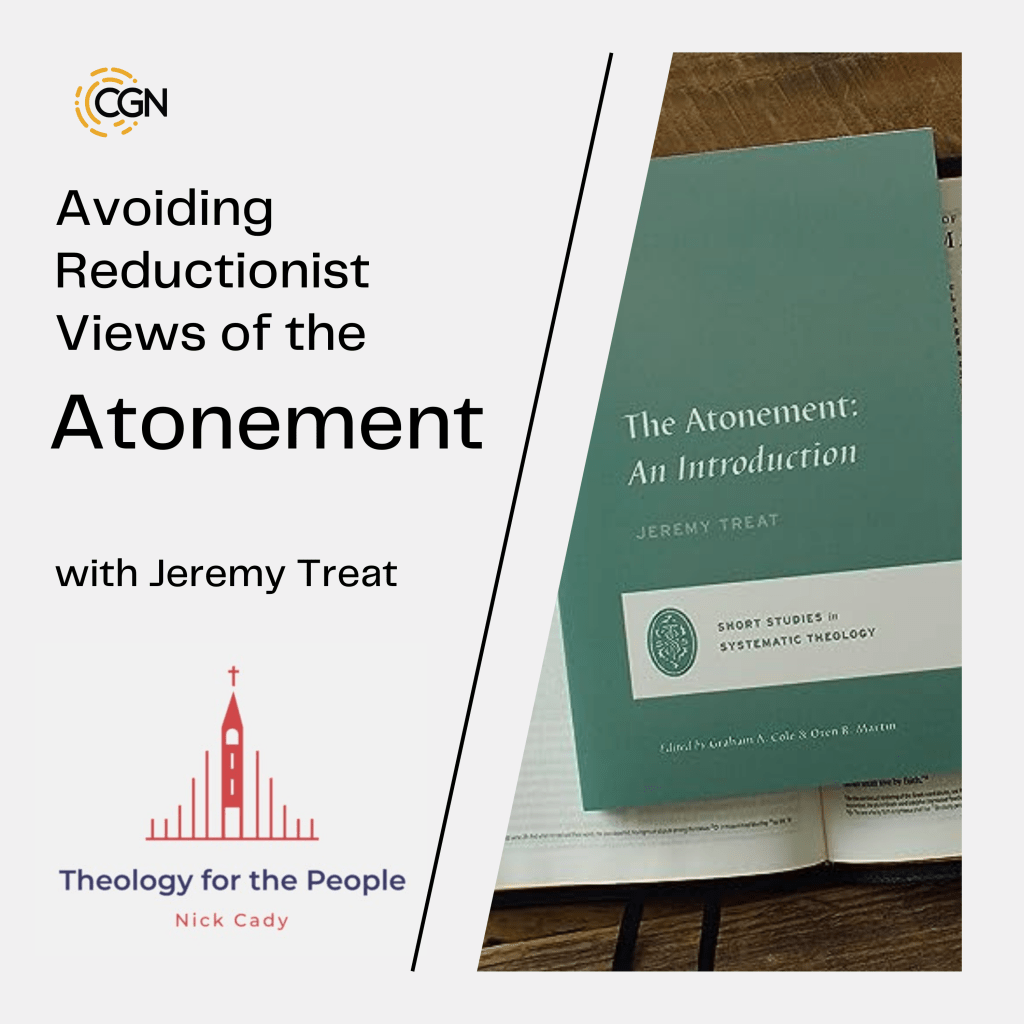
On this episode of the Theology for the People podcast, I spoke with Jeremy about the doctrine of the Atonement, including what it means, and why it is so central to Christianity.
We also discuss some common errors that people commit when thinking about the atonement, and how many of these errors are due to a view of the atonement which is reductionistic. Further, we talk about the practical implications of those different reductionist views.
Jeremy believes that the best narrative in which to understand the atoning work of Jesus is that of the Kingdom of God, in light of the entire story that the Bible tells.
Jeremy Treat is the Pastor for preaching and vision at Reality LA, a church in Los Angeles, California. He is also an Adjunct Professor of theology at BIOLA University, and he has his PhD from Wheaton College.
Jeremy is the author of several books. His latest book is The Atonement: an Introduction, published by Crossway Publishing as part of their series of Short Studies in Systematic Theology.
In this episode, Jeremy speaks with Nick Cady about the doctrine of the Atonement, including what it means, and why it is so central to Christianity.
They also discuss some common errors that people commit when thinking about the atonement, and how many of these errors are due to a view of the atonement which is reductionistic. Further, they talk about the practical implications of those different reductionist views.
Jeremy believes that the best narrative in which to understand the atoning work of Jesus is that of the Kingdom of God, in light of the entire story that the Bible tells.
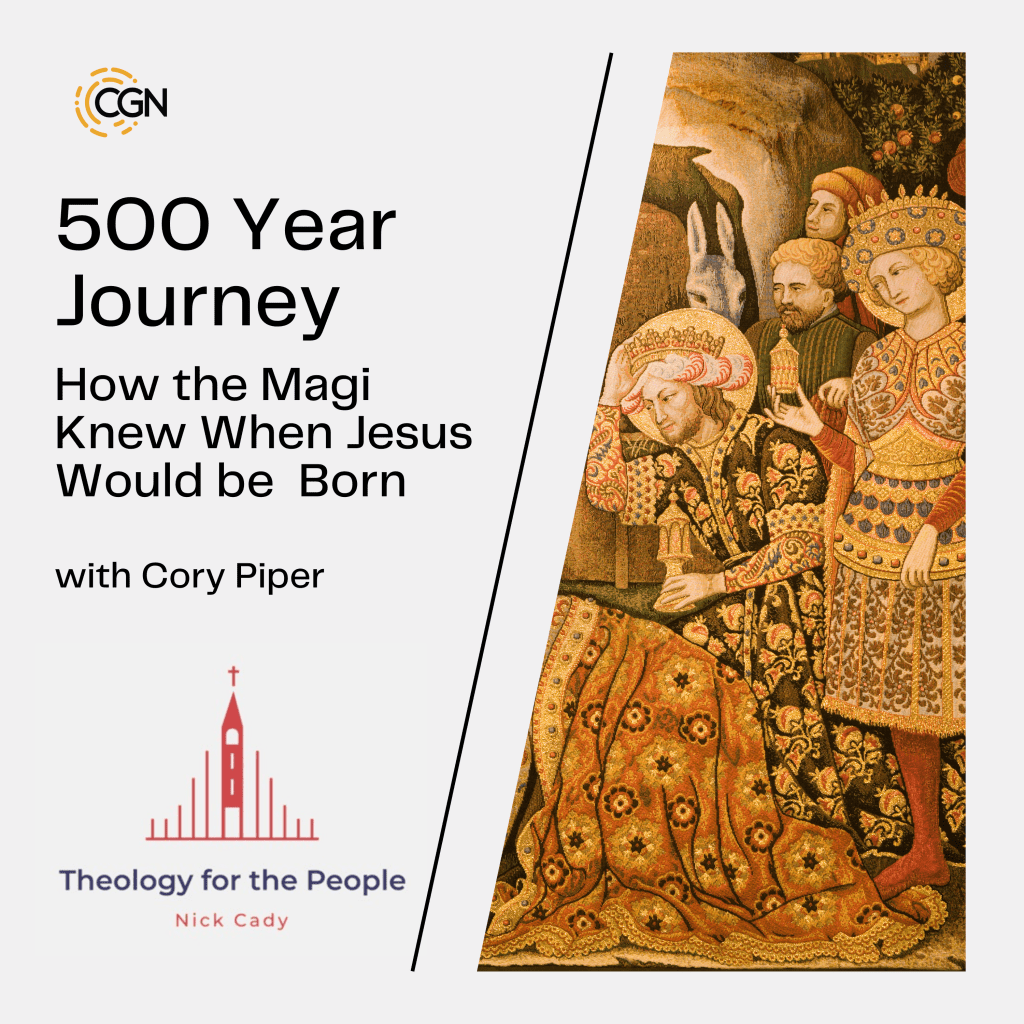
We discuss who the Magi were and why they came to Jerusalem at the exact time they did, when Jesus was born, and how it ties into the book of Daniel and other Old Testament passages.
Additionally, we talk about the history of why the church has celebrated the birth of Jesus on December 25, and whether that has any ties to paganism or not.
500 Year Journey: How the Magi Knew When Jesus Would be Born – with Cory Piper –
Theology for the People
Cory Piper is a teacher who specializes in the Old Testament, theology, and history. He recently wrote a book called 500 Year Journey: How the Magi Knew When Jesus Would be Born
We discuss who the Magi were and why they came to Jerusalem at the exact time they did, when Jesus was born, and how it ties into the book of Daniel and other Old Testament passages.
Additionally, we talk about the history of why the church has celebrated the birth of Jesus on December 25, and whether that has any ties to paganism or not.
Visit the Theology for the People website at nickcady.org
In this episode of the Theology for the People podcast, Nick Cady and Jason Cralley respond to the best arguments for Biblical Unitarianism, which is the a non-Trinitarian interpretation of biblical texts about who God, Jesus, and the Holy Spirit are.
In doing this, we look at the history of Arianism and Trinitarian formulations of who God is, including a discussion about Constantine and the First Council of Nicaea, and the Nicene Creed.
Further, we look into the arguments put forth regarding certain Biblical passages that Unitarians point to as evidence of God’s non-trinitarian, or unitarian nature, and give a defense for trinitarian beliefs.
Below, you can find a link to the video mentioned in the episode about Bad Trinitarian Analogies.
What is Biblical Unitarianism? – Considering the Best Arguments For and Against It –
Theology for the People
In this episode, Nick Cady and Jason Cralley respond to the best arguments for Biblical Unitarianism, the a non-Trinitarian interpretation of biblical texts about who God, Jesus, and the Holy Spirit are.
In doing this, they look at the history of Arianism and Trinitarian formulations of who God is, including a discussion about Constantine and the First Council of Nicaea, and the Nicene Creed.
Further, they look into the arguments put forth regarding certain Biblical passages that Unitarians point to as evidence of God's non-trinitarian, or unitarian nature, and give a defense for trinitarian beliefs.
Make sure to visit the Theology for the People website at nickcady.org
In recent years it has become increasingly popular for people who grew up in Christianity to go through a process of “deconstruction” in which they seek to examine and question the origins of their beliefs.
Deconstruction isn’t always a bad thing, but the deconstruction movement, powered by social media, largely targets younger people and encourages them to cast off their Christiaan beliefs.
This episode of the Theology for the People podcast is the recording of a workshop which Nick Cady and Aaron Salvato co-lead at the 2023 Calvary Global Network International Conference on the Topic of Doubt and Deconstruction.
We start out by defining deconstructionism and examining its philosophical roots, then we look at the impact of this movement and some of the common themes in its claims. Finally, we discuss a Biblical response to doubt and deconstruction and give some helpful tips for addressing the questions that those who are deconstructing may have.
In recent years it has become increasingly popular for people who grew up in Christianity to go through a process of “deconstruction” in which they seek to examine and question the origins of their beliefs.
Deconstruction isn’t always a bad thing, but the deconstruction movement, powered by social media, largely targets younger people and encourages them to cast off their Christiaan beliefs.
This episode of Theology for the People is the recording of a workshop which Nick Cady and Aaron Salvato co-lead at the 2023 Calvary Global Network International Conference on the Topic of Doubt and Deconstruction.
We start out by defining deconstructionism and examining its philosophical roots, then we look at the impact of this movement and some of the common themes in its claims. Finally, we discuss a Biblical response to doubt and deconstruction and give some helpful tips for addressing the questions that those who are deconstructing may have.
Check out more from Aaron Salvato on the Good Lion Podcast.
My book, The God I Won't Believe In: Facing Nine Common Barriers to Embracing Christianity, can be found here.
Visit the Theology for the People blog at nickcady.org
Please kindly explain John chapter 10 verses 17 and 18.
Here’s what those verses say:
For this reason the Father loves me, because I lay down my life that I may take it up again. No one takes it from me, but I lay it down of my own accord. I have authority to lay it down, and I have authority to take it up again. This charge I have received from my Father.”
John 10:17-18
Context: The Good Shepherd Discourse
In John 10:1-18, Jesus gives the Good Shepherd Discourse, which he spoke in response to the events that took place in John 9 and the actions of the “bad shepherds” of Israel: the religious leaders who had excommunicated a family because they refused to deny that Jesus had healed their son who had been blind from birth.
In response to the actions and attitudes of the “bad shepherds,” Jesus describes himself as the Good Shepherd.
Fulfillment of Messianic Prophecies
In Ezekiel 34:23 and 37:24, Ezekiel (writing hundreds of years after the death of King David), predicted a future day when “David” would rule over the people of Israel as their single shepherd.
Rather than having many shepherds (spiritual leaders), who were often bad, God was going to raise up a single shepherd, from the line of David. This was certainly a reference to the promise God made to David in 2 Samuel 8, called the Davidic Covenant, in which God promised that the Messiah would come from David’s family line.
Consider this passage from Jeremiah 23, which is clearly speaking of Jesus as the future, coming “Good Shepherd.”
“Woe to the shepherds who destroy and scatter the sheep of my pasture!” declares the LORD. Therefore thus says the LORD, the God of Israel, concerning the shepherds who care for my people: “You have scattered my flock and have driven them away, and you have not attended to them. Behold, I will attend to you for your evil deeds, declares the LORD. Then I will gather the remnant of my flock out of all the countries where I have driven them, and I will bring them back to their fold, and they shall be fruitful and multiply. I will set shepherds over them who will care for them, and they shall fear no more, nor be dismayed, neither shall any be missing, declares the LORD. “Behold, the days are coming, declares the LORD, when I will raise up for David a righteous Branch, and he shall reign as king and deal wisely, and shall execute justice and righteousness in the land. In his days Judah will be saved, and Israel will dwell securely. And this is the name by which he will be called: The LORD is our righteousness.’
Jeremiah 23:1-6
So, that’s the context for what Jesus says in John 10:17-18.
The Good Shepherd Lays Down His Life for the Sheep
In this section, in verses 11 and 15, Jesus says that, as the Good Shepherd, one of the things which differentiates him from the bad shepherds – or really from all other shepherds, is that he will lay down his life for the sheep, which he explains is motivated by his love for them.
But in verses 17-18, Jesus shows that another motivation for laying down his life, is that he is doing it in obedience to the Father.
The Connection Between Love and Keeping God’s Commands
Verse 17 should not be understood to mean that Jesus earns the Father’s love by laying down his life, rather that there is a relationship of mutual love between the Father and the Son. Jesus’s obedience to the Father’s authority and commands is a reflection of his love for the Father.
In John 14:15, Jesus told his disciples: “If you love me, you will keep my commandments.” And in John 15:10, Jesus explains that “abiding” in his love looks like, in practice: keeping his commands, just as he keeps the Fathers commands and thereby abides in the Father’s love:
Abide in my love.If you keep my commandments, you will abide in my love, just as I have kept my Father’s commandments and abide in his love.
John 15:9b-10
Clearly there is a connection between love and keeping God’s commands. Jesus expressed his love for the Father by doing what the Father had called him to do, and there was a relationship of mutual love between them, which manifested itself in Jesus being willing and glad to submit to the Father’s authority.
Laying Down His Life, Only to Take It Up Again
In verses 17 and 18, Jesus explains that the plan of the Father, by which he would save his people from their sins (cf. Matthew 1:21) was not only that he would lay down his life, but that he would take it up again, i.e. resurrect from the dead.
This is one of the few places in the New Testament where Jesus’ resurrection is attributed as an action of Jesus himself. In most other places, God the Father is described as raising Jesus from the dead. This is important because it is one more example of the fact that the Bible teaches that Jesus is God: because Jesus does the works that are attributed to God alone, e.g. the creation of the world.
On a human level, Jesus’ life was taken from him by the actions of evil men. And yet, as we see in verse 18, those events were not outside of Jesus’ control. Jesus was not as a victim of circumstance, but the one who was in control of his destiny. Later on, during his trial, before he was crucified, Pontius Pilate said to Jesus, “Don’t you realize I have power either to free you or to crucify you?” (John 19:10). Jesus replied, “‘”You would have no power over me if it were not given to you from above” (John 19:11). These incidents show that Jesus was in control of his own destiny.
A good example of this two-fold understanding of why Jesus died is found in Acts 2:23, where Peter says to the crowd gathered on the day of Pentecost:
this Jesus, delivered up according to the definite plan and foreknowledge of God, you crucified and killed by the hands of lawless men.
Acts 2:23
In this verse we see both the human responsibility and the plan of God which were at work in the death of Jesus. Jesus laid down his life willingly; he certainly could have walked away from the Garden of Gethsemane on the night when he was arrested. He didn’t have to come to Jerusalem at all, actually – and many people urged him not to! But Jesus went, knowing what awaited him, intent on laying down his life BOTH as an act of loving obedience to the Father who sent him, and as an act of loving redemption for those whom he came to save.
Ask a Question or Suggest a Topic
If you have a question or would like to suggest a topic for me to address here on the blog, click here: Ask a Question or Suggest a Topic
We talk about how the Beatitudes are meant to be understood, and how people have misread them throughout history. Further, we also discuss what the eschatological nature of the Beatitudes, and what they mean for practical areas of life, such as lament, power, and politics.
In this discussion, we talk about different interpretations of the Beatitudes, from Martyn Lloyd-Jones to Robert Schuller, to the church fathers. We also talk about Nietzsche, Constantine, and the question of whether Christianity creates emasculated men under the heading of “meekness,” and what it looks like to live out the ethic of Jesus in our modern world.
Chris Castaldo is the Lead Pastor of New Covenant Church in Naperville, Illinois. He has a PhD from London School of Theology, where he studied under Dr. Tony Lane; the same professor who was my mentor for my Masters dissertation.
Chris Castaldo is the Lead Pastor of New Covenant Church in Naperville, Illinois. In this episode we discuss his recent book The Upside Down Kingdom: Wisdom for Life from the Beatitudes. We talk about how the Beatitudes are meant to be understood, and how people have misread them throughout history. Further, we also discuss what the eschatological nature of the Beatitudes, and what they mean for practical areas of life, such as lament, power, and politics.
Chris has a PhD from London School of Theology, and he is a fellow at the Center for Pastor Theologians. He has authored and contributed to several books including: Talking with Catholics about the Gospel: A Guide for Evangelicals.
You can find more about Chris and read his writings at chriscastaldo.com.
On this episode of the Theology for the People Podcast, I am joined by Jason Cralley, Executive Pastor at White Fields Community Church, and we respond to questions from listeners on a variety of topics, including how Christians should respond to Pride Month, whether humans will have the ability to sin in the age to come, how to serve God faithfully in an unsatisfying job, and how to respond to different situations in dating and marriage.
AMA #1: Ask Me Anything – Pride Month, Sin in the New Jerusalem, Work, Marriage, and more –
Theology for the People
In this episode, Nick Cady and Jason Cralley respond to questions on various topics, including how Christians should respond to Pride Month, whether humans will have the ability to sin in the age to come, how to serve God faithfully in an unsatisfying job, and how to respond to different situations in dating and marriage.
To submit your questions for future Ask Me Anything Episodes, visit nickcady.org.
Have we over-emphasized the value of rest and Sabbath to the neglect of the biblical teaching on diligence and hard work?
On this episode of the Theology for the People Podcast, I am joined by Tyler Fuss and Mike Neglia to discuss what the Bible has to say about the importance of diligence, the danger of sluggardliness, and how to know the difference between hard work and over-work.
Tyler is a member of White Fields Community Church; he studied theology at Denver Seminary and is now a business owner in Colorado. Mike is the lead pastor of Calvary Cork in Cork, Ireland and a student at Western Seminary. Mike also leads Expositors Collective, an initiative which seeks to raise up the next generation of expository Bible teachers, and he hosts the Expositors Collective Podcast.
With All Your Might: Exploring Biblical Teaching about Diligence, Hard Work, Sabbath, and Sloth –
Theology for the People
Have we over-emphasized the value of rest and Sabbath to the neglect of the biblical teaching on diligence and hard work?
On this episode, Nick Cady is joined by Tyler Fuss and Mike Neglia to discuss what the Bible has to say about the importance of diligence, the danger of sluggardliness, and how to know the difference between hard work and over-work.
Tyler studied theology at Denver Seminary and is now a business owner in Colorado. Mike is the lead pastor of Calvary Cork in Cork, Ireland and a student at Western Seminary. Mike also leads Expositors Collective, an initiative which seeks to raise up the next generation of expository Bible teachers, and he hosts the Expositors Collective Podcast.
Resources mentioned in this episode:
Zeal Without Burnout (Book)
Don't Waste Your Life (Book)
You Have One Life, Don't Waste It (John Piper YouTube video)
Overcoming Apathy and Slothfulness – Uche Anzior (Podcast Episode)