Kobe Bryant holds an NBA record. Do you know which one? Most missed shots. Of any player. Ever.
When Kobe set this record in the 2013 season with his 15,296th missed shot, guess whose record he broke… Michael Jordan. Until 2013, Michael Jordan had been the NBA player with the most missed shots ever.
Yet, Kobe and Michael are also 2 of only 5 players to ever score over 30,000 points in their NBA careers.
The other players? Kareem Abdul Jabar, Karl Malone and Wilt Chamberlain. Consequently, Karl Malone and Kareem Abdul Jabar also hold the number 4 and 5 spots for most shots ever missed.
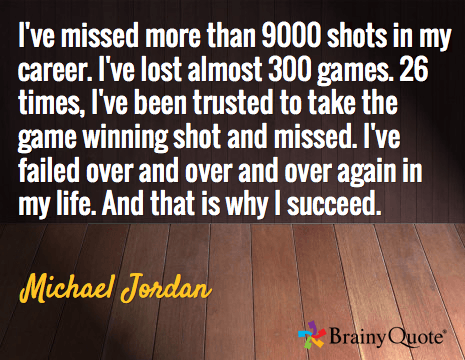
Long before he went on to reach the 15,000 missed shots mark, Michael Jordan said this in an interview:
Proverbs 14:4 says “Where there are no oxen, the manger is clean,but abundant crops come by the strength of the ox.”
Nobody likes messes. Messes are messy. If you want to completely avoid messes, then here’s an easy way: never have an ox. If you have an ox, you will always have messes to clean up. BUT – if you have an ox, then you will also have increase and profit and great things. BUT you will also inevitably have messes.
There is a sure-fire way to never fail: don’t try anything. Play it safe. Don’t take risks, don’t take chances. Don’t get invested in anything. Don’t wade out into the deep water – just splash around in the shallows.
If you do that – you will never fail. You will never have to deal with messes. There will never be anything to clean up. BUT, you will never reap the benefits which only come to those who dare to take a shot.
I think sometimes it can be easy for Christians to forget what Romans 1:19-20 says: “For what can be known about God is plain to [all people], because God has shown it to them. For his invisible attributes, namely, his eternal power and divine nature, have been clearly perceived, ever since the creation of the world, in the things that have been made.”
What that means is that all people are grappling with ideas and questions about God. Christians can be quick to discount what people “outside the fold” think or say about God – but the truth is that sometimes they have some pretty astute and profound things to say, even though they may have no commitment to Jesus. On the other hand, I am sometimes frustrated with the trite nature and shallow lyrics of some “Christian” music.
The are some “secular” songs out there which put some “Christian songs” to shame, because they reflect a deeper, more sincere, more REAL engagement with questions about the person and character of God.
Here are a few examples for you. If you have any others to suggest, leave me a comment below!
First: Regina Spektor
Second: Dashboard Confessional. Listen especially to the middle of this one, where Chris Carrabba is asking God to help him with the sin he wants to be set free from and talks about his struggles with unbelief.
Evangelism, proselytizing, seeking to convert people to our faith – these are things which are inherent to Christianity if one is to take the words of Jesus as true and relevant.
However, some – even some Christians – feel that this is presumptuous; that Christians should just do their thing and let other people be drawn to it if they will – but not actively attempt to convert others to their faith.
I found this quote to give a helpful perspective:
A major aspect of the Great Commission is the emphasis that Jesus places upon his authority. This is vitally important, because unless Jesus has such authority how can he give such a command? This is a kingly command which assumes that he is Lord over all peoples. If Jesus is not the King, his Commission is presumptuous and without foundation. If he is King, then the whole of life ought to be subject to his royal authority. The fact that God is King is the heart of the Gospel message.
The authority of the missionary lies therefore in the very person of Christ. If Jesus is the King of God’s Kingdom then the missionary has the right, even the duty, to go to all people. If he is not King, then the missionary has no right to seek to take his religious ideas to others. Is Jesus Lord? This is the vital question.
– D. Burnett, “God's Mission: Healing the Nations”
Last Sunday I preached on 1 Samuel 12, which is the speech that Samuel gives to the nation at the re-coronation of Saul.
There is a very intriguing statement in this section, which I didn’t address in the sermon, but I think is worthy of consideration.
And Samuel said to the people, “The Lord is witness, who appointed Moses and Aaron and brought your fathers up out of the land of Egypt. Now therefore stand still that I may plead with you before the Lord concerning all the righteous deeds of the Lord that he performed for you and for your fathers. When Jacob went into Egypt, and the Egyptians oppressed them, then your fathers cried out to the Lord and the Lord sent Moses and Aaron, who brought your fathers out of Egypt and made them dwell in this place. But they forgot the Lord their God. And he sold them into the hand of Sisera, commander of the army of Hazor, and into the hand of the Philistines, and into the hand of the king of Moab. And they fought against them. And they cried out to the Lord and said, ‘We have sinned, because we have forsaken the Lord and have served the Baals and the Ashtaroth. But now deliver us out of the hand of our enemies, that we may serve you.’ And the Lord sent Jerubbaal and Barak and Jephthah and Samuel and delivered you out of the hand of your enemies on every side, and you lived in safety. (1 Samuel 12:6-11, ESV)
Samuel says: Let me tell you of all the righteous deeds of the Lord that he performed for you. Then he tells them that God “sold them into the hand of Sisera,” a Philistine general.
Notice – he didn’t ‘allow them to fall into the hand of Sisera’ – it wasn’t a passive allowance, but an active SELLING! He SOLD them into the hand of Sisera – and THIS, of all things, is given as an example of one of the righteous acts of the Lord, which he performed on behalf of the people of Israel because of his love and care for them!
This is a little bit different picture of God than what we usually get in the “moralistic therapeutic deism” which is passed for Christianity these days in many places – where God exists to be your friend, make your problems go away and make your wishes come true. When bad things happen, usually we are told that God passively allows these things to happen to you, so that you can grow through them.
But isn’t that a bit trite and simplistic? Not to mention – that viewpoint has no capacity to deal with real evil – or even with scriptures such as the one mentioned above. The vision of God given here is of a God who is willing to sell you into the hand of Sisera if that’s what it takes to get you to turn back to Him! To God, in this story, it was obviously more important to Him that the people of Israel turn back to Him and pursue Him than that they be comfortable and problem-free.
What about you? Is it possible that the difficulties in your life have not just been passively “allowed” by God, but actively sent by God into your life for the purpose of moving you in a certain direction or getting you to a certain place, either physically or spiritually?
Could it be that God has sold you into the hand of Sisera in order to do a work in your heart, because He loves you?
I believe in miracles because I have one walking around in my house. Here’s our story:
In January of 2010, my wife Rosemary was in her final month of pregnancy with our second child, a girl whom we had decided to name Felicia, which means “happy”. It has been a pretty smooth pregnancy, with one exception: in the last trimester she experienced intense itchiness in her skin, like it was on fire. It was so unbearable that she was unable to sleep and sometimes resorted to standing outside in the cold to numb her skin. We now know that this was caused by a condition called cholestasis, in which the liver stops functioning, and isn’t cleaning the blood. This condition went undiagnosed, and led to what happened next.
Rosemary went into labor naturally, and was quietly getting ready to go to the hospital, but at one point her contractions suddenly went from being 9 minutes apart to being 2 minutes apart. She had a sense that something was wrong with the baby, so she told me that we needed to leave immediately, and left our 2 year old son with our neighbors and we rushed to the hospital.
We arrived at Markhót Ferenc Megyei Kórház, the hospital in Eger, Hungary which was about a 10 minute car ride from our home, just a minute or two after 8 o’clock that morning. The nurses took Rosemary into the room to measure her vital signs, while I waited outside in the hallway. At this point I assumed that everything was fine, and that I would be welcomed into the birthing room shortly, as I had been with our first child who was born in that same hospital. I started emailing my parents on my phone, letting them know that the baby was on her way.
Only a few minutes later, the door to the birthing ward was flung open, not by a nurse inviting me in as I had expected, but by the doctor, who came running into the hallway, nervously yelling to others down the hall to come immediately. He then turned to me and said, “There’s a problem with the baby”, and disappeared back behind the door of the birthing unit.
Over the next few minutes, 20 or so doctors and nurses ran past me into the room where my wife was. I didn’t know anything, and when I asked the nurses what was going on, they told me they couldn’t tell me anything — only the doctor was allowed to do that, but they privately said that it was bad and the baby may not survive. At one point a nurse ran into the birthing ward carrying a plastic tube of some kind, and a few minutes later 3 nurses ran out holding a little body wrapped in towels, while one of them pumped frantically on that same plastic device as they transported her to another area of the hospital. After about an hour of nervously waiting for any news, I saw our doctor, who knew I was a pastor, and as he ran past me in the hall, simply said: “Pray!”.
Three hours passed as I waited for the doctor to call me in and tell me what had happened. I was called into the office of Dr. Kovács Krisztina, the head of the neonatal department. She explained that when they had first called Rosemary in for examination, they were not able to find the baby’s heartbeat, and they had to do an emergency caesarian. She explained that they didn’t know why, but that our daughter had gone without oxygen for quite a long period of time. At this point I asked the question which had been on my mind for hours: “Is my baby alive?” “Yes, she’s alive, but there is a good chance she will not live through the next 24 hours. And if she does, then you can be sure that she will have life-long serious disabilities, because she went so long without oxygen, that she has suffered serious brain damage.” Her APGAR score was a 1, the lowest score possible. She was not breathing at all, and the only reason she got an APGAR of 1 was because she did have a faint heartbeat.
Dr. Kovács explained to me that there is only one treatment for babies in this condition, but it is very experimental, and so I would need to sign a consent form. The treatment involved putting the newborn baby into a morphine induced coma and then subjecting them to hypothermia to try to salvage what was left of their brain and other vital organs which had started to die due to the lack of oxygen. I signed the papers, and then was taken into a room, where Felicia—whose body was completely grey and lifeless except for the fact that a respirator violently caused her chest to rise and fall—was in an incubator, and she was wheeled in to where Rosemary was. Rosemary had been put under during the emergency surgery and was just coming to—and they made her reach in the incubator and touch Felicia. Basically, they were making sure she got the chance to meet her baby and say goodbye.
Right after that, Felicia was wheeled outside, where she was taken by a special ambulance from the Peter Cerny foundation, which helps babies get to the Semmelweis university hospital neonatal intensive care unit in Budapest. Semmelweis is the best equipped hospital in the country for neonatal ICU, but they have limited space—room for 10 or so babies at a time, so they only take the worst of the worst. When Felicia arrived, we were told that she was in the worst condition of any of the babies in that unit.
I went home and packed up my son to go to Budapest to be with Felicia—and I quickly wrote a blog post asking people to pray for a miracle. I would continue writing posts about Felicia, which were then shared on social media and sent around the world. Thousands upon thousands of people began praying for Felicia’s healing from every corner of the globe, and messages began filling my inbox from places like India and Africa, from people I had never met, telling me they were praying for God to heal our little girl for His glory.
For the next 2 weeks, Felicia was unconscious. She had wires and tubes sicking out of every part of her little body and she was on a respirator, because she was not able to breathe on her own. During that time the doctors conducted a blood test and found an enzyme in her blood that indicated brain damage. A normal level of this enzyme would be 25 count – Felicia’s level was 1500 count; very disheartening news. The doctors told us to prepare for the worst. They were unsure if she would ever wake up from the coma, and even if she did, it was unsure if she would ever breathe on her own, not to mention whether her nervous system or vital organs would function properly. Not only had she gone without oxygen, but she had inhaled meconium, which filled her lungs and throat, which had developed into pneumonia. She had also inhaled meconium, which had then infected her digestive tract. We were told there was a good chance she would be in a vegetative state for her whole life.
In the NICU during the coma
All we could do was pray. And so we asked everyone we possibly could to pray for her – churches around Hungary and throughout the world began praying for her. People I had never met began approaching me and telling me, “I’ve been praying for your daughter!” Our church in Eger came together to support our family; the community of Calvary Chapels in Hungary rallied around us, praying for us and encouraging us constantly.
After 7 days of being in the coma, Felicia woke up. Rosemary got to see her that day for the first time, but it was bittersweet. Although Felicia was alive and awake, she showed signs of being handicapped. Her eyes were crossed, she could not focus on anything, she could not swallow, and did not move. We left that night with a sense of heaviness, but once again wrote a blog post asking people to pray for Felicia to be fully healed.
The next day we walked into the ICU to find a different baby in Felicia’s bed; it was her, but she was so different than the night before, that we hardly recognized her! That night, her condition had changed completely. She made eye contact, was moving, had started swallowing milk and making noises!
After another week in that unit, Felicia was transferred to intermediate care, and then to Developmental Neurology at a different hospital in Budapest. She had suffered brain damage; even though seemed to be doing better, she was still very sick; she basically had no reflexes. Rosemary spent a week in the Developmental Neurology department being trained by doctors to do reflex therapy with Felicia at home in order to create new pathways in her brain, taking advantage of the abundance of stem cells that babies have. During this time we continued to pray for her healing.
For 8 months, we spent 6 hours a day doing therapy with Felicia. At times we had people come live with us to help cook and clean, so we would be free to care for our little girl. At one of our regular visits to the neurology department, after 8 months of therapy, we were told that Felicia was healed. She now had all the normal reflexes that a baby her age should have; reflexes being a key indicator of healthy brain function.
All the doctors and the nurses who witnessed Felicia’s recovery told us that it was a true miracle—that they had never seen a baby who was in that bad of a condition – the worst in the entire country when she arrived – get better, and not just get better, but to the point of having no symptoms! Felicia had 5 different doctors who treated her, and each of them told us that surely God must have healed her.
On Felicia’s first birthday we had a party. To this 1 year old girl’s party, people came from all over Hungary and even from the United States. Most notably, the head doctor of the Neonatal Intensive Care Unit at Semmelweis, who had personally attended to Felicia during her time there, Dr. Szabó Miklós, as well as Dr. Kovács Krisztina came to the party, and Dr. Szabó spoke, and told everyone that as a doctor, he can attest to them, that Felicia’s healing was a genuine miracle. He said that he never accepts invitations from the families of his former patients, but he drove up to Eger from Budapest for Felicia, because her story was so special and remarkable to him.
God healed Felicia. When Felicia was 18 months old, we were told that she would no longer need a neurologist. She was given a completely clean bill of health!
In 1 Chronicles 16, David says:
[8] Oh give thanks to the LORD; call upon his name; make known his deeds among the peoples!
[9] Sing to him, sing praises to him; tell of all his wondrous works!
[10] Glory in his holy name; let the hearts of those who seek the LORD rejoice!
[11] Seek the LORD and his strength; seek his presence continually!
[12] Remember the wondrous works that he has done, his miracles and the judgments he uttered,
[23] Sing to the LORD, all the earth! Tell of his salvation from day to day.
[24] Declare his glory among the nations, his marvelous works among all the peoples!
[25a] For great is the LORD, and greatly to be praised,
[28] Ascribe to the LORD, O families of the peoples, ascribe to the LORD glory and strength!
[29] Ascribe to the LORD the glory due his name;
[31] Let the heavens be glad, and let the earth rejoice, and let them say among the nations, “The LORD reigns!”
Again and again in this song of David – he says “tell” of his wondrous works. Remember the miracles he has done, and bring glory to God by declaring those things to the nations, so that all will see that He indeed is Lord of heaven and Earth!
Today Felicia turned 4 years old, and she is completely healthy in every way! She is a true miracle.
We will never forget, and we will continue to faithfully tell our story for His glory.
This article gives all the details about what Phil Robertson, an outspoken Christian, said to GQ magazine regarding his opinions about homosexuality. Those opinions got him indefinitely suspended from the hit A&E show “Duck Dynasty”.
For the past several years pastors in North America and Western Europe have been wondering when the time will come when teaching biblical passages which label homosexual activity as sin will be constituted as “hate speech” and be punishable by law. I’ve heard that such laws are already in place in France and Canada. It is a slippery slope we are on. One of the reasons why the founding fathers of the United States wanted the separation of church and state was to protect the integrity of the church from government involvement. This isn’t quite that bad, A&E is a private company dealing with an employee, but as a pastor, I can’t help but see this as a sign of what is to come.
One of the first changes we made to the bulletins at White Fields when we redesigned them last year, was to get rid of a chunk of text which said: “Please turn off cell phones and pagers during service”. First of all: pagers are only found in museums, so I don’t think we’ll have a big problem with those being on in service, and second: I don’t want people to turn off their phones in church. That’s right – you read that correctly. I don’t want them answering phone calls or sending texts – but I’d say that our technology culture has developed enough of an etiquette by now, that that goes without saying for most people.
Christianity Today published an article last week about a Barna poll which had shown how millennials use technology in their faith life. The title of the article was: “Watch Out, Pastors: Millennials are Fact-Checking Your Sermons”. First, let me say, that I think we make too much of a big deal over the term “Millennial” – to the point that we seem like we are studying a wild animal rather than dealing with individuals. The reality is, that it isn’t only young people who are connected; nowadays, everyone is connected. Some of the most tech-savvy people I know are in their 60’s. This week SNL’s Weekend Update reported on how Facebook’s stock share prices dropped because of a report that less and less teenagers are using the site. ‘”Really? I think Facebook is great” said moms.’ That’s right – moms are all over Facebook, and every other kind of social media. Because being connected to the internet is the new way to be human. And this isn’t just the case in the United States – reports show that the most connected countries in the world are outside of the United States – places like the Philippines. My experiences is that Hungarians are way more connected to Facebook than Americans. The internet, in many ways, serves as a great equalizer.
Being connected to the internet is the new way to be human.
And that brings us back to the point of the internet and church. The article I mentioned above warned pastors against fibbing, because some of the young people in their congregations might be on their phones fact-checking you as you speak. Here’s what I think: If you are fibbing or exaggerating, then you deserve to be found out! How dare anyone stand up and speak in God’s name and use half-truths and lies or non-credible information to bolster a point they are trying to make? That is an utter lack of respect for God and for the people you minister to. If you are going to teach something, then it better be true!
Pastors: If you are fibbing or exaggerating in your sermons, you deserve to be found out!
For example: earlier today, my cousin, who recently declared himself an outspoken atheist, jumped into a conversation I was having about something my son said about Jesus’ crucifixion, to ask if there are any non-Christian credible sources from antiquity that spoke of Jesus as a historical figure and a man who performed miracles. I was able to immediately send him an article which contained a collection of those writings, which he obviously assumed did not exist. Here’s the point: I am not afraid of the truth – because if what I believe is not true, then I don’t want to believe it! And if what I believe is true, then I don’t need to be afraid of people investigating its veracity.
So here’s what I say: I WANT you to use your phone during my sermon! Don’t be texting people, don’t be surfing the web – be engaging and connecting with what we’re studying. I WANT you to be posting to Facebook during my sermons; I WANT you to be tweeting – as long as you are posting and tweeting as a form of engagement. I love it when I come home from church on a Sunday afternoon, and I see that members of our church were tweeting out or Facebooking quotes from my sermon during the message! That means that the words of my sermon will have a greater reach than they would have otherwise, because they get sent out to hundreds of thousands of people on those social networks.
For over two years now, I have preached from a tablet rather than printed out notes. At White Fields I don’t have a pulpit – I have a mic stand with an iKlip on it. On my iPad I have about 10 versions of the Bible available at my fingertips, and I read from them as I teach. For this reason, for quite a while, I didn’t bring a Bible with me up to the “pulpit” – since I would read the scriptures off of my iPad. Recently though, I did take an old-school paper Bible up with me and read from it, and I got comments right away about how people were happy to see that. So, ever since, I’ve started doing that again. I’ve also started carrying a paper Bible with me to counseling and discipleship meetings, whereas I previously only took my iPad and read scriptures from it. The reason I’ve made this change is because I realize the incredible symbolic value of the Bible as a book. Everyone carries an iPad or a smart phone, but not everyone carries a Bible. When I read my Bible in a coffee shop, people know what I’m reading – whereas they don’t when I read from an iPad.
What about you? Do you read the Bible on your phone or tablet at church? Do you engage with the sermon while it’s being preached?
The danger of it of course is that if someone lacks self-control, they could easily be distracted from the sermon rather than engage with it on their device.
What do you think? How do we leverage getting greater engagement via smart phones and tablets without people getting distracted by them? Is it possible? Leave me a comment below about your experience.
Today is October 31st. That means that today, all across America, neighborhood children are going to come knocking at your door to try to coerce you into giving them candy by threatening retribution if you don’t comply. We call it Halloween, and yes, in its modern form, it’s innocent enough. In fact, as I wrote in this post earlier this week, Halloween is a great opportunity for Christians to think missionally, as it is the only day of the year when most of your neighbors will come knocking on your door.
However, October 31st is a much more historical and significant day in the history of the world. Before anyone considered dressing up as a superhero or a robot, October 31st was celebrated for a different reason: It is the day when in 1517, Martin Luther nailed his 95 Theses to the door of the All Saints Church (ironically on the eve of All Saints Day) in Wittenburg, Germany. This event is generally regarded as the catalyst of the Protestant Reformation, thus – for centuries before Americans came along and capitalized on Halloween and commercialized it, October 31st was celebrated amongst Protestant Christians as Reformation Day.
These days, Reformation Day is still a big deal in Germany and other parts of Europe, but in America it is only celebrated by a handful of Lutherans, Reformed Christians and other protestants – albeit, most of them celebrate it as a Halloween alternative, and still get dressed up and hand out candy to kids. If you really want to make a splash at one of these events, here’s a tip: dress up as Martin Luther. You’ll probably be the only one (no you won’t; I was being facetious). If you really want to wow all your Lutheran friends at the Reformation Day party, then you should actually dress up like Johann Tetzel – you will be the hit of the party (not really). By the way – I’m allowed to make Lutheran jokes; I went to Lutheran school growing up – Missouri Synod baby. That’s right.
Anyway, obscure Lutheran references aside – I am thankful for the work of the reformers. Men like Luther and Calvin, and Hus and Wycliff before them. I’m thankful that we have been given the freedom to read the Bible for ourselves, in our own languages – and consider for ourselves what God says to us in the scriptures. I am thankful for the return to Biblical theology that these men worked for.
I used to speak at an annual Reformation Day gathering in Hungary, and what was always said at those meetings was that we must remember that the reformation of the church is never over; it is a continual need, that we come and examine every practice and every doctrine according to the Word of God, even in our protestant churches. The Word of God must always remain our standard and our guide in all things.
I hope you have a great October 31st, and remember today that the fact you can have a Bible in your own language, that you can read any time you want, and have God speak to you personally through it – that’s not something to be taken for granted! The teaching of grace that you (hopefully) hear in church – that’s not something to be taken for granted. These things were fought for – and we reap the benefits. Keep that in mind while you eat “fun size” candy bars for the next several weeks, and give thanks to God for what happened on October 31st, 1517.
This week a Gallup poll came out which showed that for the first time, a majority of Americans favor legalizing marijuana. In fact, in the past year, the support for marijuana legalization surged from 48% to 58% of those polled. Here in Colorado, we live in a state that has had medical marijuana legal for years and which voted last November to legalize its recreational use as well. Not to mention that here in Boulder County, whether it’s legal or not, people in this area have been smoking a lot of pot for a long time and will continue to do so. A friend of mine who just moved to BoCo wrote this about how prevalent marijuana use is just in his daily commute. Just the other day I was talking to someone about Lyons High School (thinking ahead for our kids); they said it’s a good school – but that it’s known for the kids there smoking a ton of weed.
Marijuana is here to stay. It’s already been legalized in this state, and will soon be regulated. Interestingly enough though, I have heard almost NOTHING from Christian leaders on this topic. I have, however, heard a lot of people talking about it – including Christians, saying things like: If marijuana becomes legal and readily available in the same way that alcohol is, then is there anything wrong with trying it out? If you can buy it in a shop and it becomes socially acceptable, then is there any reason to not occasionally indulge?
Up until now, pastors have been telling people they shouldn’t smoke pot because it’s illegal, and the Bible instructs us to honor the laws of the land we live in (Romans 13). But now – guess what: game changer! Marijuana is no longer illegal! Drinking alcohol in moderation is more or less acceptable in most Christian circles these days – so if marijuana gets put in the same legal category, then is it okay to treat it the same way?
These are real questions that people – including Christians – are considering. If Christian leaders aren’t talking about what people are actually thinking about and talking about, then we have become irrelevant and are not engaging people and bringing God’s word to bear on the time and place we live in, as we are called to do.
So, what should be the Christian response to the legalization of marijuana?
What does the Bible say?
The Bible doesn’t say anything about marijuana – just like it doesn’t say anything about tobacco or chemical weapons or genetically modified food. But there are principles the Bible lays down which apply.
The “don’t do it because it’s illegal” argument is soon to be off the table, so what should our position be towards recreational marijuana use? The Bible doesn’t say anything about marijuana in particular, but it does speak about mind-altering drugs – in Greek: farmakeia – which were used recreationally rather than medicinally.
Also, the Bible tells us not to be drunk, but to be filled with the Holy Spirit – i.e.: Don’t be under the influence of substances, but be under the influence of God’s Spirit.
The differences between marijuana and alcohol
More and more people are speaking up about how much safer marijuana is than alcohol. You never hear about people committing violent acts because they are stoned. Marijuana has also not been shown to cause long-term brain damage as alcohol has.
But the difference between marijuana and alcohol are that you can drink alcohol without getting intoxicated. It’s possible to drink wine (like Jesus did) or beer with a meal to enjoy the flavor without getting drunk. No one smokes marijuana just for the flavor – the very point of smoking it is mood alteration.
Will marijuana legalization change anything?
It’s clear by now that adults are going to smoke marijuana whether it is legal or not – which is why more and more people are saying, ‘why not tax it and regulate it then?’. It has been estimated that up to $40 million dollars in tax revenue could come in from recreational marijuana sales in Colorado, which would be earmarked for schools. Regulating marijuana, they point out, could also kill at least part of the black market for it, which inevitably leads to violent crime.
Certainly marijuana use would increase once it’s legalized – as people who were once worried about doing something illegal would no longer have to worry about that. Also, and this is a concern for me – it would make it more accessible to kids, because they would no longer need to find a dealer, they will just have to find a friend with an older brother who is willing to buy it for them – just like with alcohol and tobacco.
I smoked pot when I was a teenager, before I gave my life to the Lord when I was 16. I have family members who smoke pot regularly, and I don’t want my kids to smoke pot. I don’t want them to check out or get intoxicated to cope with life or to have fun – whether with alcohol or marijuana or any other substance.
Legislating morality and the real issue
There are plenty of things the Bible instructs us not to do that are legal in our society, such as adultery, fornication, drunkenness, sorcery, etc. Christian maturity means being able to discern and choose for yourself, from a heart-felt response to God’s grace rather than needing to have someone hold your hand and dictate to you what to do.
There are plenty of ways to harm yourself which are completely legal. You can go buy some glue and sniff it and get high – legally. There are also ways to harm yourself, however, which are illegal, such as chemical food additives, cocaine, certain medications, meth, etc. which we consider detrimental to society and harmful to people, which we have banned and we don’t give people legal avenues to indulge in.
For us as Christians, the point is clear: marijuana is intoxicating. We should not be intoxicated or controlled by substances, but by the Holy Spirit. It’s pretty cut and dry.
For society in general, it’s a question of whether or not it would be helpful or harmful to have more intoxicated people everywhere and to make a mind-altering drug more accessible to children than it already is.




 Theology for the People