Do you remember that Seinfeld episode where they talked about why we say “God bless you” when someone sneezes? One of them – I can't remember if it was Elain or Jerry – suggested was that instead we should say, “You're so good looking!”, because that would really make people feel better.
I saw this display at Sprouts in Longmont today:
Ga Ble Shu: You know, for when you're not really into God, but you feel like you should say something when people sneeze.
What do you think? Harmless advertising gimmick or a sign of the spiritual climate?
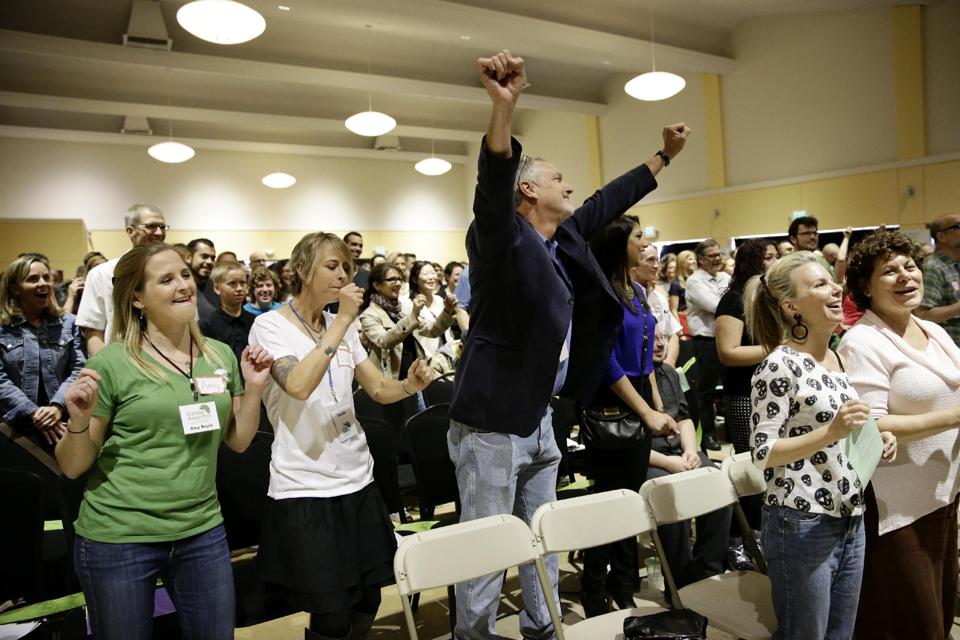
Recently a new movement has been getting a lot of publicity. Dubbed “atheist mega-churches” – the movement is being spearheaded by two British comedians. They call their meetings “sunday assemblies,” and they have all of the look and feel of a contemporary Christian church service, without one key factor: God.
Co-founders, Sanderson Jones and Pippa Evans have stated that their goal is to export the original concept, first started in London, around the world. They are currently on tour visiting 40 major cities; right now they are in the US, going from New York to Los Angeles, trying to establish Sunday Assemblies and propagating their message of humanist community gatherings.
At these Sunday assemblies, they do everything that your average Christian church does: they sing songs, they drink tea and coffee and chat in the lobby, they raise money for humanitarian causes – they take offerings, and they have a sermon each week! In an interview, Sanderson Jones answered the obvious question of what they preach on if they don’t have the Bible or another “sacred text”. His answer was astounding and something that should cause Christians everywhere some serious consideration. He said that ‘preaching without God isn’t hard at all – after all, most preaching in churches these days is basically tips and strategies about how to be a kinder, more balanced, well-rounded person; we embrace that whole heartedly, and we don’t believe we need God to do that.’
‘preaching without God isn’t hard at all – after all, most preaching in churches these days is basically tips and strategies about how to be a kinder, more balanced, well-rounded person; we embrace that whole heartedly, and we don’t believe we need God to do that.’
Here are my thoughts on these “atheist mega-churches”:
1. Mega-churches? Hardly.
Although they have been dubbed “mega-churches” by the media, if you look at the pictures, you will notice that if this were a Christian church, it would not be qualify as a “mega-church”. Furthermore, let’s not forget that the gatherings getting the most press are the ones in which Jones and Evans are present and leading the meetings – two British celebrities, who have been getting a lot of press attention lately for these Sunday Assemblies. This is a special event, not a church – not a committed community of people, and certainly not a mega-church. Even the original Sunday Assembly is not all that big. I understand that “mega-church” pops out on a page – but let’s make sure we’re not blowing this all out of proportion.
2. Novelty = Media Hype
“Atheist Mega-church” is a novelty of a phrase that grabs people’s attention. Perfect for the media. Is there much substance to it? Will we see this as a growing movement for years to come? I don’t think so. I don’t believe it is sustainable. In fact, if it hadn’t been started by two celebrities, I don’t think it would have ever gotten off the ground. I see this fizzling out in the weeks, months and years to come as media hype wears off and moves on to the next amusing story. The reason why “Christian music and movies” are never as good as the original is simply this: they are not original – they are trying to copy someone else’s idea and put a Christian twist on it. It is often second-rate as a result. This smacks of the same thing, only more so.
3. A Very Important Critique
The quote from Sanderson Jones above is a VERY important critique for Christians, and particularly church leaders. Because here’s the deal: ANYBODY can “do church”! And Sanderson is right – you don’t need God to just get together, drink some bad coffee, sing a few songs and hear an inspiring talk about 10 ways to have your best life now. YOU DON’T NEED GOD FOR THAT! He’s right!
ALL that we have as Christians is the Gospel of Jesus Christ. If we get away from that, then we have become nothing more than a community gathering – in which it doesn’t matter if God is there or not.
Recently I had someone come to our church, and they told me that they had been attending another church previously, but came to realize that the sermons that were being preached could have easily been speeches given at a high school graduation or by a politician. God’s name was mentioned, but if it hadn’t been, it wouldn’t have changed the substance of the message. In other words: it didn’t matter if God was there or not. They were giving tips and strategies for how to be a kinder, more-balanced, well-rounded person – and the fact is, that you don’t need God to do that.
The Gospel of Jesus Christ and the Word of God are what we have as Christians. They are what we should major on, and never neglect in an effort to give practical advice. The Gospel is life-changing and transforming, and we must crank it up rather than water it down. Only then will people really be transformed.
What do you think of these atheist mega-churches and my estimation of them? Are they just a flash in the pan, or are they here to stay? And what does this mean for Christianity and society in general?
Have you ever heard the term “Christendom”? I have often heard it used to refer to the “invisible community of Christians everywhere” – kind of along the lines of the term “blogosphere”.
While that use of Christendom isn’t wrong – it isn’t the historical use of the word either. Historically, Christendom referred to the “Christian nations.” It was a way of dividing up the globe, into “Christendom” and “heathendom”.
In the book he includes two lists: the first is a list characterizing Constantinian Christianity and culture, and the second characterizes the shift away from it. They are particularly interesting in regard to thinking of the United States or the United Kingdom (or any country for that matter) in our modern era as a “Christian nation.” Whether or not our founders were God-fearing people, or whether we have a history of movements of God in our country – we need to assess the reality of the modern situation. Sweden, for example, like a number of other European countries, is still technically a Christian nation, whilst practically they shifted away from Christendom long ago.
The other thing you realize from these lists is that maybe Christendom wasn’t actually as great as people think it was. One of the great downfalls of a “Christian nation” is that you give people a false sense of security in their salvation – simply because they were born into a “Christian” culture or society. At least in a pluralistic society (which is what we are in – but was also the situation Paul the Apostle and the Christians in the Book of Acts were in!) people realize the immediate and pressing need for them to make a choice to follow Jesus, and the radical implications that come with it!
Rather than bemoaning the end of Christendom, I believe that Christians are faced with a great new opportunity in pluralistic society – the opportunity to bring to bear on all people the challenges of the Gospel and the call to follow Jesus Christ, because being a Christian is no longer a “given”.
Here are those lists:
Characteristics of the shift to Christendom:
The adoption of Christianity as the official religion of city, state, or empire.
Movement of the church from the margins to the center of society.
The creation and progressive development of a Christian culture or civilization.
The assumption that all citizens (except Jews) were Christian by birth.
The development of a “sacral society,” corpus Christianum, where there was no freedom of religion and political power was divinely authenticated.
The definition of “orthodoxy” as the belief all shared, determined by powerful church leaders with state support.
Imposition, by legislation and custom, of a supposedly Christian morality on the entire society (though normally Old Testament morality was applied).
Infant baptism as the symbol of obligatory incorporation into Christian society.
The defense of Christianity by legal sanctions to restrain heresy, immorality, and schism.
A hierarchical ecclesiastical system based on a diocesan and parish arrangement, analogous to the state hierarchy and buttressed by state support.
A generic distinction between clergy and laity, and relegation of laity to a largely passive role.
Two-tier ethics, with higher standards of discipleship (“evangelical counsels”) expected of clergy and those in religious orders.
Sunday as an official holiday and obligatory church attendance, with penalties for non-compliance.
The requirement of oaths of allegiance and oaths in law court to encourage truth telling.
The construction of massive and ornate church buildings and the formation of huge congregations.
Increased wealth of the church and obligatory tithes to fund the system.
Division of the globe in “Christendom” and “heathendom” and wars waged in the name of Christ and the church.
Use of political and military force to impose Christianity, regardless of personal conviction.
Reliance on the Old Testament, rather than the New, to justify these changes.
Characteristics of the shift into post-Christendom:
The Christian story and churches have moved from the center to the margins.
Christians are now a minority.
Christians therefore no longer feel at home in the dominant culture.
Christians no longer enjoy automatic privileges but find themselves as one community among many in a plural society.
The church no longer exercises control over society but instead Christians can exercise influence only through faithful witness to the Christian story and its implications.
The emphasis is now no longer on maintaining the status quo but on mission in an contested environment.
Churches can no longer operate mainly in institutional mode, but must learn to operate once again as part of a movement.
What do you think? Are there any Christian nations these days? Do we really want to be one?
Jesus didn’t live in a Christian nation, neither did Paul. And I don’t think they thought our goal as Christians was to establish them either.


 Theology for the People