When Misinterpreting the Bible Leads to Tragedy

On Saturday, an apartment fire in NYC claimed the lives of 7 children. When you find out why it happened, you realize just how dangerous it can be to misinterpret the Bible…

Recently at White Fields church I have been teaching on Jesus’ Sermon on the Mount. This past Sunday I taught Matthew 5:17-30, where Jesus refutes the misinterpretation of the Law of Moses by the Pharisees.

The Pharisees made 2 basic errors in regard to their interpretations of the Law of Moses. On the one hand, they would add rules to the Law of Moses, to make sure they didn’t accidentally break any of the commandments. On the other hand though, they created a system of loopholes to circumvent the very rules which they themselves added to the Law of Moses. The purpose of this was so that they could claim that they had “technically” kept the Law, while still making sure they had ways to do all the things they felt the need to do.

Modern day Judaism has had to deal with technological innovations, such as electricity and motor vehicles, which has greatly complicated the question of what constitutes “labor” on the Sabbath. In broad terms, they have landed on the definition that the breaking or building of anything constitutes “work”. So, practically, they have determined that it is not permissibly to drive a car, since combustion happens in an engine, nor are they allowed to turn on or off electricity, because it breaks an electrical current.

To circumvent this rule, especially in cold places, modern ultra-orthodox Jews, have tended to turn on a hot plate or an oven the night on Friday afternoon, before the start of the Sabbath, and that way they can heat food and keep their residences warm without technically doing “work”.

During my sermon this past Sunday, I mentioned a news story about an apartment fire in Jerusalem in an orthodox neighborhood, where – because people considered it not forbidden to use a phone on the Sabbath – the fire spread to 2 surrounding buildings before fire fighters were alerted and got to the scene to put it out.

Right after church, someone told me about the tragic events which had happened for very similar reasons the night before in New York City, in which an orthodox Jewish family had left a hot plate on in the kitchen, a common practice for those who adhere to the “Talmudic fence” which Pharisaical Judaism put around the Law of Moses; when the hotplate malfunctioned and caused a fire in the middle of the night in the apartment which left  7 children dead and the mother and oldest child in critical condition.

This is a tragic example of how misinterpreting the Bible can lead to tragedy…

One of the saddest parts of the news report was the final line:

“We believe that being buried in Israel is important because all of your sins are then absolved,” [Rabbi Alon Edri] said.

These Jews, who take the Law and the Prophets (Old Testament) seriously, understand that the fundamental need of the human soul is for our sins to be dealt with and wiped away. The problem is that they have no way of obtaining this, especially since for almost 2000 years now they have had no temple in which to make the sacrifices of atonement prescribed by the Law of Moses. The idea that being buried in Israel will absolve one’s sins is not found in the Bible; it is something they have created to deal with the problem that they deeply feel and see: that they need their sins to be forgiven, yet they have no way of having their sins atoned for. They have done something similar with Yom Kippur (the Day of Atonement), on which, according to the Law of Moses, a sacrifice was to be made to atone for the sins of the nation – but instead of doing that, modern Judaism has settled for telling people to make “sacrifices of contrition” (read: feeling really bad about yourself and your sin) in order to make atonement. However, this, according to the Law itself, is not enough, for we know that “life is in the blood” and “there is no atonement of sin apart from the shedding of blood.”

Oh that they might come to see that Jesus came to fulfill all of the Law and the Prophets! That He is the atoning sacrifice which God provided for them.

We pray for this family, for the community and for the mother and daughter still in critical condition, that God would comfort them and that they would come to know the righteousness that God has provided for them apart from the Law, since “by the works of the Law, no one will be justified”.

Brett Felton: US Veteran Fighting ISIS and Defending Christians in Iraq

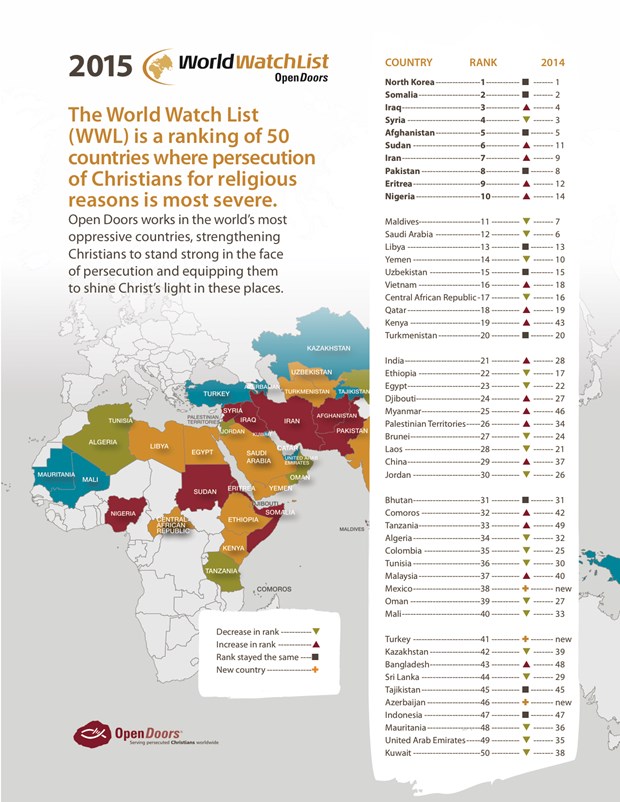
60 Minutes aired a report this past weekend on the Christians of Northern Iraq, and how they are being persecuted by ISIS. It is terrible and tragic, and something the whole world needs to hear about. Take a few minutes to read this report. This is an event of historic proportions: books and churches which have existed since the early days of Christianity are being destroyed. A Christian community is being eradicated.

If we think back on the actions of Hitler in Europe and reflect on what Christians should have done, we must open our eyes to realize that something similar is happening in our day in the Middle East to Christians. What will the world do? What can be done?

One American Christian, Brett Felton, came to the conclusion that the right thing for him to do, as a former US soldier who fought in Iraq, was to return there to help the Iraqi Christians defend themselves. 60 Minutes posted this video report about him. Check it out.

Brett is over there, not hunting ISIS, but training the Iraqi Christians on how to defend themselves if and when ISIS attacks, and he is standing beside them to fight if and when that day comes.

What do you think about a Christian taking up arms to fight against ISIS?

ISIS is clearly doing something very evil – something that should not be tolerated from any group of people, no matter who they are persecuting.

Considering the circumstances, and the fact that ISIS is functioning as a military group, terrorizing largely unarmed, untrained civilians, I think that what Brett Felton is doing is praiseworthy – putting his life on the line to help civilians protect their families and their ancient civilization from an evil assailant.

Should Christians Try to Improve Society?

Tomorrow morning I’ll be teaching on Jesus’ salt and light metaphors from the Sermon on the Mount, as part of our CounterCulture series at White Fields.

I found this quote in a book by John Stott, about the social responsibility of Christians as part of our identity as the salt of the Earth. Since salt has a healing and preserving effect, the idea is that Christians should have a healing and preserving effect on society.

There are some who would say, What’s the point in trying to make society better?  If Jesus could come back any minute, and this life is short anyway, then shouldn’t all our efforts be towards saving people out of this world, rather than “polishing a turd”, to put it crassly?

However, it seems to me that it is an inherent part of the calling of a Christian to make the world a better place, if for no other reason than to “let your light shine before others so that they may see your good works and glorify your Father who is in Heaven.” (Matthew 5:16)

Here is that John Stott quote:

Too often evangelical Christians have interpreted their social responsibility in terms only of helping the casualties of a sick society, and have done nothing to change the structures which cause the casualties. Just as doctors are concerned not only with the treatment of patients but also with preventive medicine and public health, so we should concern ourselves with what might be called preventive social medicine and higher standards of moral hygiene. However small our part may be, we cannot opt out of seeking to create better social structures, which guarantee justice in legislation and law enforcement, the freedom and dignity of the individual, civil rights for minorities and the abolition of social and racial discrimination. We should neither despise these things nor avoid our responsibility for them. They are part of God’s purpose for his people. Whenever Christians are conscientious citizens, they are acting like salt in the community.

As Sir Frederick Catherwood put it:‘To try to improve society is not worldliness but love. To wash your hands of society is not love but worldliness.’

Stott goes on to say that SALT is not all that the world needs. The world also needs LIGHT – the truth of God, ultimately found in the Gospel.

The Longmont Pastor on the Radio!

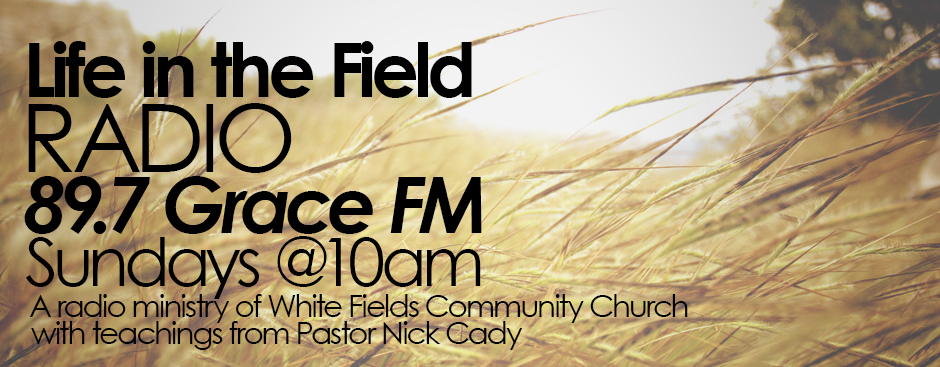
Life in the FieldAs of this past Sunday (March 8), those of you on Colorado’s Front Range can now hear me on the radio every Sunday morning on GraceFM (89.7 for Denver, Boulder, Fort Collins areas & 101.7 in Colorado Springs) from 10:00-10:30 AM.

Our church service at White Fields starts at 10:00 AM – as do many other churches. So why this time slot? Because our aim is to reach people who are not in church!

The program is titled Life in the Field, because our desire is to bring the Gospel message of Jesus Christ into people’s lives, so that they can live out God’s mission in his mission field – hence: Life in the Field.

In addition to our weekly broadcasts, we’re also archiving all of our episodes on SoundCloud (click here for our SoundCloud account), so you can listen to them at your connivence on any device.


Family Christian Stores Files For Bankruptcy

America’s largest Christian retailer, Family Christian Stores, has filed for chapter 11 bankruptcy protection.

This doesn’t mean that they are closing down; they are doing this in order to save their company. They are going to restructure and try to stay in business.

Perhaps most interesting though, is that while Family Christian Stores is floundering, Lifeway Christian Bookstores is expanding.

What’s the difference between these two?  In short, I would put it this way: Lifeway has higher standards about what they sell and how they do business.

Earlier this year, when it came out that a certain big name pastor/author had committed rampant plagiarism, Lifeway immediately dropped his books from their shelves. Family Christian Stores, on the other hand specializes in cheesy Christian paraphernalia and selling whatever sells. I remember going into one of their stores once and being surprised to see a particular book on their shelves. My wife asked the manager why they sold that book – his response was very telling: he said he was ashamed to have that book on their shelves too, but corporate said that they had to, because they are first and foremost a business and people buy that product.

It would seem to me that the reason Family Christian Stores is struggling whereas Lifeway is flourishing must somehow be attributed to the fact that Christians actually have higher standards and are more discerning as to where they spend their money and what values they want their retailers to represent than Family Christians Stores gave them credit for.


The Eschatological Significance of the Christian Sunday

Following up on a previous post on why Christians worship on Sunday and the correlation between the Jewish Sabbath and the Christian Sunday, I recently read something I found interesting.

While many people assume that Christianity just took the Jewish idea of Sabbath and moved it to Sunday, it turns out the reason for the Christian Sunday is deeply eschatological.

Check it out:

Jewish Sabbath

  • End (Saturday)
  • Rest from Creation
  • Happens after creation, within time: retrospective
  • Keeping of obligations
  • Preservation

Christian Sunday

  • Beginning (Sunday)
  • Commencement of the New Creation
  • Speaks to the aim of new creation: eternity = future-oriented
  • Celebrates that the obligations have been met by God through Christ
  • Resurrection

Christianity was not just a rebranding of Jewish practices, but an eschatological fulfillment of them.

The Christian Sunday is more than a day of rest for Christians, it is a day of new creation. In it, we remember not only to rest from our labor, but we are reminded that with the resurrection of Jesus, we stand at the dawn of eternity – and that one day soon, the Son will break over the horizon and usher in the New Day. In the death and resurrection of Jesus Christ we have witnessed the death of death and the birth of “the life that is truly life”.

When I Don’t Feel Like Going to Church

The story of told of the man whose wife came in to wake him up on a Sunday morning:

It’s time to get up honey, you need to get ready for church!  You’re going to be late!

I don’t want to go to church today!  It’s boring and the people there are all jerks and nobody is nice to me.  

But honey, you have to go to church!  You’re the pastor!

Now, just to be clear: I LOVE going to church!  And not just because I’m the pastor.  But I do know that some people sometimes struggle for various reasons with not feeling like they want to go to church.

I would encourage you with the words of Paul’s letter to the Galatians: That going to church, being in fellowship, joining in prayer, singing songs of praise and worship to God, partaking in Communion, hearing the Scriptures read aloud and expounded upon, hearing the Gospel message proclaimed and applied to real-life scenarios – these things are tantamount to “sowing to the Spirit”.

Paul says in Galatians 6:

Do not be deceived: God is not mocked, for whatever one sows, that will he also reap. For the one who sows to his own flesh will from the flesh reap corruption, but the one who sows to the Spirit will from the Spirit reap eternal life. And let us not grow weary of doing good, for in due season we will reap, if we do not give up. (Gal 6:7-9)

When you don’t feel like going to church, I encourage you to make the choice to sow to the Spirit – take that hour and a half out of your Sunday morning to sow to the Spirit and you will, in due season, reap a harvest of joy and life and righteousness.

Frontier Church and Beyond

I do my seminary studies in England, and I always find it interesting to read about American culture, politics, etc. from a British perspective.

This semester I’m taking a class on History of Christian Worship, and one part of this describes the development of different ways of “shaping Christian time” in worship.

Here’s an excerpt from my reading about the “Frontier Church model”:

Frontier or Revivalist Groups

This term is used by White to designate a type of Protestant worship widely recognised in North America which spread to the UK. As already indicated, it is a nineteenth-century form of the Service of the Word in which worship became simply equated with evangelism. Its roots were Puritan, Reformed and Methodist, and it was born out of a prevailing spirit of its Victorian times – didactic, stripped-down commonsensical. To meet the challenge of how to mediate Christian faith to the scattered and independent people moving west across the North American continent, evangelists developed a pragmatic, free-style, anti-tradition form. This kind of worship had one purpose and that was to make converts.

The service had a three-part form:

  • 􏰂the warm-up or preliminaries – easy-to-sing emotional hymns;
  • 􏰂 the Word – the sermon, preparing for;
  • 􏰂 the harvest – altar call, an emotional appeal for conversion.

Frontier-type worship is evident in evangelistic ‘crusades’ and in many independent church services and Pentecostal meetings.

Sound familiar?  This gives interesting perspective to the “common” way of doing church in America today.  I know that this is the MO of many mega-churches. However, the question is begged: where is the discipleship? I know of large churches which have no strategy for discipleship beyond their Sunday morning preaching times, which are focused on proclamation of the Gospel with a focus on evangelism.

On the other side of the spectrum, I was speaking this weekend with friends in Canada who told me that the services in their church are focused wholly on the people of God and are not at all evangelistic (something they regretted to admit).

This seems to be one of the big questions: Who and what is the church service designed for? Discipling believers, or preaching to unbelievers for conversion?  But what if everyone is converted already?  Do you just keep preaching the same invitation to receive salvation to the already saved, because there just might be 1 or 2 unsaved people?  Or is it then always an invitation to “re-committ”?  Where does the instruction of believers come in?  Is that really “church”?  BUT – if you never preach and invite people to respond to the call of the Gospel to commit themselves to following Jesus, then what happens when new people come? Is your service simply not for them?

Clearly every church is trying to find this balance. I find that teaching through the Bible systematically, like we do at White Fields, is one of the most effective ways of both instructing believers and giving calls to action and to repentance. I also believe that having Christian instruction outside of the Sunday morning gatherings is an important way of doing this too. One of the things I’d like to start at White Fields is something along this line, because after all, we are called to not only make converts unto Jesus Christ, but disciples of Jesus Christ, teaching them to observe all that He commanded us (Matthew 28:20).