
Last night I went to an event where author Eric Metaxas was speaking about his new book, a biography of Martin Luther. It was held at a church in Greenwood Village, and after speaking for about an hour about Luther and the writing of the book, he answered questions and then signed books.

During the Q&A time, Metaxas said a few things which I thought were particularly powerful. The question was one about how Christians should always be reforming the church. Eric responded by saying that: yes, the Reformation must always continue, but in his opinion, oftentimes the church is too critical of the church. That Christians spend a lot of time deriding Christians and bemoaning the church, when in fact we should find an immense amount of joy in being the people of God who are called to take the message of God’s grace and love into the world. This is something we should revel in!
He went on to say that he grew up in the secular culture, and that for him – he saw the church as a living connection to God. When you’re drowning and someone throws you a rope, he said, it may be an imperfect rope, but it is a rope nonetheless, and rather than focusing on its flaws, you are thankful for the rope!
Metaxas went on to point out that the cultural elites in our day all speak the same language of secular humanism, and they together have collectively agreed that Christianity is old fashioned, obsolete and passé – and too often, we as Christians bow down to that and say: ‘Yeah, you’re right,’ and we shrink back into the shadows or retreat into an insular Christian sub-culture. Instead, we should stand in confidence as the people of God, with the truth of God, and use all avenues available to us to bring God’s truth and the message of the gospel into our society.
Eric has done this very well with his radio program and his books, which are published by a mainstream publisher (Viking Books) and several of which have made the New York Times bestseller list. He has a unique perspective on the church, having become a Christian later in life, studying at Yale and living in New York City, none of which are generally considered particularly friendly towards Christianity. He has been a good steward of the gifts that God has given him and has become an important and influential voice in our society, heralding the gospel as he can.
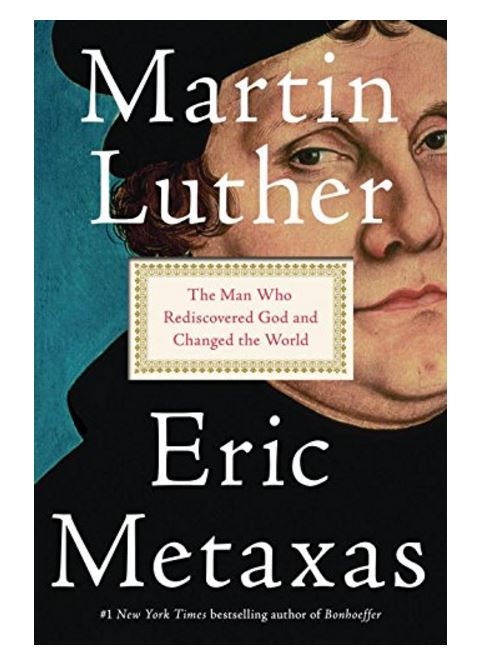 Metaxas begins his book with a story, which I had never heard before: How in 1934, an African American pastor from Georgia got on a boat to make the trip of a lifetime; he sailed across the Atlantic Ocean, through the gates of Gibraltar, across the Mediterranean Sea, to Israel. After this pilgrimage to the Holy Land, he traveled to Berlin to attend an international conference of Baptist pastors. While in Germany, this man, Michael King, became so impressed with what he learned about the Reformer, Martin Luther, that he decided to do something dramatic: he decided to change his name to Martin Luther King. This man’s son, also named Michael, was five years old at the time, and although close relatives would continue to call him Mike for the rest of his life, his father also changed his name, and he became known to the world as Martin Luther King Jr.
 Theology for the People