
Why Go to Church If You Already Know It All? Here’s Why:

Hebrews 10:24-25 tells Christians to not neglect gathering together, but to seek all the more how we can stir each other up to love and good works.
I just taught that passage last Sunday (audio of that message here), and in my preparation I discovered that the phrase “stir up” essentially means to pester or annoy someone, to not leave them alone. I’m thankful for people who do that in my life.

A friend of mine had been politely pestering me to read James K.A. Smith’s “Desiring the Kingdom” for about a year before I finally picked up a copy and started reading it earlier this month. I’m glad I did.
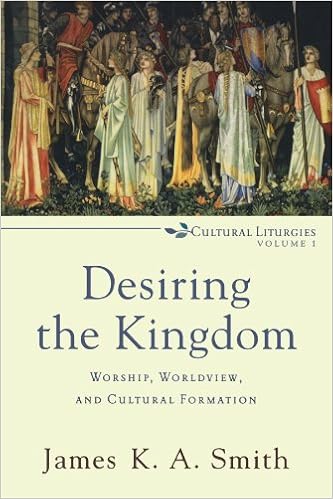
Smith’s basic premise is that all of us are constantly being shaped by “liturgies,” including (and primarily) “cultural liturgies.”

Liturgies, as he uses the term, are not confined or restricted to the order of service in a church worship service. Liturgies are, according to Smith’s use of the word, “rituals of ultimate concern that are formative of our identity—they both reflect what matters to us and shape what matters to us.” Liturgies, wherever they may be found, serve to shape us by forming affections within us.

Smith points out that such liturgies can be found throughout our culture, in places like malls, stadiums and universities, to name a few.

As Christians, it is important that we intentionally submit ourselves to the kinds of liturgies which will shape us into the kind of people we believe we ought to become, and which shape our affections in the right direction.

He points out that our nature as humans is such that we are not so much shaped by our worldviews as our worldviews are shaped by our practices, experiences and affections. Therefore, knowing this, it is important that we submit ourselves continually to the right kinds of “liturgies”.

Liturgies, he explains, “inculcate particular visions of ‘the good life’ through affective, precognitive means, and do so in a way that trumps other ritual formations. In short, they are the rituals that grab hold of our hearts and want nothing less than our love.”

Malls, stadiums and universities are filled with “rhythms, rituals, and spaces which are loaded with meaning; and more specifically, they are loaded with a particular vision, a unique ‘understanding’ of what it means to be a happy, fulfilled, and flourishing person; in short, implicit in these liturgies is an understanding of what it means to be really human.”

It is important therefore, that we recognize the “religious” nature of cultural practices and institutions, and understand that they are not neutral and that participation in them shapes us in very real ways. We should be aware of this fact, and also decide what “liturgies” we want to participate in, in order to shape our affections in the right directions.

He states that this makes it all the more important that Christians focus on creating and practicing our own uniquely Christian liturgies – formative practices which shape us and develop our affections in a particular direction. Christian liturgies include church attendance and participation, reading the Bible and listening to sermons in weekly church services, praying and singing with others, taking communion, being part of a community group, etc. His goal in this is to help us “see the importance and centrality of Christian worship in ways that we perhaps haven’t heretofore.”

I think this is a very important realization: that the reason to participate in church is not only to learn things, but to take part in practices which shape our minds and hearts towards God and His ways. This is why you need church even if you already know “everything” 🙂

There are other reasons as well:

Statistics show that church attendance has a radical impact on families and on the success and health of marriages.

Catechesis Today

Catechesis is an education in the faith of children, young people and adults which includes especially the teaching of Christian doctrine imparted, generally speaking, in an organic and systematic way, with a view to initiating the hearers into the fullness of Christian life.”

A few years ago, Christianity Today published some statistics about the lack of knowledge of basic Christian doctrine amongst evangelicals. See: ‘Evangelicals’ Favorite Heresies’.

This data was very eye-opening for me, and solidified my decision to introduce a Christian education program at White Fields which we now call School of Ministrybut which we eventually plan to build into something bigger that will reach beyond our church.

One of the reasons for the lack of knowledge of basic Christian doctrines among evangelicals is that although many evangelical churches have a strong focus on Bible-teaching, oftentimes that teaching is focused on personal application rather than explicit doctrinal instruction and core doctrines are assumed rather than explicitly taught.

It could be argued that if you teach expositionally through the Bible, then all major doctrines will eventually be addressed and taught and a systematic theology will naturally develop. I believe this is true, and it is why I take an expositional and verse-by-verse approach in teaching the Bible in our church. However, I do think that along with an expositional approach to biblical theology, a systematic approach is also important. A systematic approach is when you say, What does the Bible teach about ________?  If we’re honest, everyone has a functional systematic theology, although it may change or develop over time, and we employ that systematic theology whenever we approach the Bible expositionally.

For these reasons, we’ve started a foundations class at White Fields. I originally assumed that this class would be attended mostly by new believers and youth, but I’ve been surprised at the amount of interest from people who have been Christians and have been attending church for years, who feel like they need this instruction on the core Christian doctrines.

On a personal level, one thing we’ve started doing in our home with our kids is going through the New City Catechism.

I can already anticipate the question: “Catechism? Isn’t that a Catholic thing?” The answer is: No. The word catechism means “to teach orally”, and “throughout the history of the church, Christians have used catechisms—collections of questions and answers designed for memorization and recitation—to teach others the core doctrines of the faith. The New City Catechism is a modern-day resource aimed at reintroducing this ancient method of teaching to Christians today.”1


There are some great things about the New City Catechism that make it helpful:

  1. It has a free app for iPhone, iPad and Android, as well as a printed version which can be purchased
  2. It has 52 questions, designed to be memorized at one per week
  3. It has a children’s mode, which includes simplified answers and songs to help them learn what is being taught

Our kids enjoy doing it. We do it at the dinner table, and then throughout the week we’ll practice together. I would recommend it as a great tool for individuals and families. If nothing less, it is a way to get yourself or your family focused on, talking about and thinking about Biblical doctrine throughout the week.

Martin Luther King Jr.’s Letter to Pastors

55 years ago, Martin Luther King Jr. wrote a letter to fellow pastors from a jail cell in Birmingham, where he sat because of a non-violence “sit-in” protest. He wrote the letter mostly on pieces of toilet paper and scraps of newspaper.

Here are some excerpts of that message which every Christian would do well to read today.

“Though I was initially disappointed at being categorized as an extremist, as I continued to think about the matter I gradually gained a measure of satisfaction from the label. Was not Jesus an extremist for love: “Love your enemies, bless them that curse you, do good to them that hate you, and pray for them which despitefully use you, and persecute you.” Was not Amos an extremist for justice: “Let justice roll down like waters and righteousness like an ever flowing stream.” Was not Paul an extremist for the Christian gospel: “I bear in my body the marks of the Lord Jesus.” Was not Martin Luther an extremist: “Here I stand; I cannot do otherwise, so help me God.” And John Bunyan: “I will stay in jail to the end of my days before I make a butchery of my conscience.” And Abraham Lincoln: “This nation cannot survive half slave and half free.” And Thomas Jefferson: “We hold these truths to be self evident, that all men are created equal . . .” So the question is not whether we will be extremists, but what kind of extremists we will be. Will we be extremists for hate or for love? Will we be extremists for the preservation of injustice or for the extension of justice? In that dramatic scene on Calvary’s hill three men were crucified. We must never forget that all three were crucified for the same crime–the crime of extremism. Two were extremists for immorality, and thus fell below their environment. The other, Jesus Christ, was an extremist for love, truth and goodness, and thereby rose above his environment. Perhaps the South, the nation and the world are in dire need of creative extremists.

I have heard numerous southern religious leaders admonish their worshipers to comply with a desegregation decision because it is the law, but I have longed to hear white ministers declare: “Follow this decree because integration is morally right and because the Negro is your brother.” In the midst of blatant injustices inflicted upon the Negro, I have watched white churchmen stand on the sideline and mouth pious irrelevancies and sanctimonious trivialities. In the midst of a mighty struggle to rid our nation of racial and economic injustice, I have heard many ministers say: “Those are social issues, with which the gospel has no real concern.” And I have watched many churches commit themselves to a completely other worldly religion which makes a strange, un-Biblical distinction between body and soul, between the sacred and the secular.

I have wept over the laxity of the church. But be assured that my tears have been tears of love. There can be no deep disappointment where there is not deep love. Yes, I love the church.

There was a time when the church was very powerful–in the time when the early Christians rejoiced at being deemed worthy to suffer for what they believed. In those days the church was not merely a thermometer that recorded the ideas and principles of popular opinion; it was a thermostat that transformed the mores of society. Whenever the early Christians entered a town, the people in power became disturbed and immediately sought to convict the Christians for being “disturbers of the peace” and “outside agitators.”‘ But the Christians pressed on, in the conviction that they were “a colony of heaven,” called to obey God rather than man. Small in number, they were big in commitment. They were too God-intoxicated to be “astronomically intimidated.” By their effort and example they brought an end to such ancient evils as infanticide and gladiatorial contests. Things are different now. So often the contemporary church is a weak, ineffectual voice with an uncertain sound. So often it is an archdefender of the status quo. Far from being disturbed by the presence of the church, the power structure of the average community is consoled by the church’s silent–and often even vocal–sanction of things as they are.

But the judgment of God is upon the church as never before. If today’s church does not recapture the sacrificial spirit of the early church, it will lose its authenticity, forfeit the loyalty of millions, and be dismissed as an irrelevant social club with no meaning for the twentieth century.

I hope this letter finds you strong in the faith. I also hope that circumstances will soon make it possible for me to meet each of you, not as an integrationist or a civil-rights leader but as a fellow clergyman and a Christian brother.”

For the full text of Martin Luther King Jr.’s “Letter from a Birmingham Jail,” click here.

The Positives in the Negatives

but God shows his love for us in that while we were still sinners, Christ died for us.
Romans 5:8 ESV

Sin. The blood of Jesus. The wrath of God. Judgement. Aren’t these just negative, primitive, obscene and off-putting terms? Isn’t what we need in our modern world a much more palatable, positive type of religion which avoids these ideas and instead focuses on affirmation?

Imagine for a moment that you are standing on a busy street with a friend, and that friend says to you: “Let me show you how much I love you,” and then throws themselves in front of an oncoming bus, and dies.

You would probably think: “What in the world did he do that for?! What a tragic and pointless waste of a life!”

But now imagine that that bus was headed straight for you, but your friend acted to save you from certain death at the risk, no – at the cost of their own life. You would say: “Truly, that person loved me.”

Unless you understand the depth of the problem, you will never understand the extent of God’s love for you. That is why we can’t do away with terms and concepts like blood, judgment, wrath and sin.

Blood, for example, has both very negative and a very positive connotations – and both are important for understanding the central message of Christianity.

On the one hand, blood speaks of brokenness and guilt. If you have blood spurting out of your body, then something is broken, perhaps even mortally so. We use phrases like “blood on your hands” and “blood on your head” to refer to guilt.

And yet, blood also has positive connotations: “Life is in the blood” the Bible says. If you don’t have blood in you, you don’t have life. Every baby who is born comes into the world with the shedding of blood. Blood which is shed voluntarily for the sake of another is a heroic act of self-giving. It is through the shedding of Jesus’ blood that he causes us to be born again to new life.

I do not set aside the grace of God; for if righteousness comes through the law, then Christ died in vain. (Galatians 2:21 NKJV)

What the verse above is saying is that if it were possible for a person to earn salvation by being good enough, then we could save ourselves, and if we can save ourselves, then Jesus Christ died in vain.

If we could save ourselves, Christ’s death was pointless, meaningless and tragic – like a person who throws themselves in front of a bus for no reason. But if we understand the depth of the problem from which Jesus saved us, then Christ’s death will mean everything to us, it will be an overwhelmingly positive act which affirms God’s love for us. It will change the way we think about God and ourselves, and it will change the way we live from that day forward and how we relate to others. Understanding what God saved us from fills us with 1) humility, so we don’t consider ourselves better than anyone or look down on anyone, and 2) confidence, that God truly loves me and is for me.

It is within these “negative” concepts that we find the overwhelmingly positive message of the gospel – a message which is infinitely more positive than any mere patronizing platitudes. If it is positivity and affirmation you desire, then it isn’t a circumvention of sin, wrath, judgement and blood that you need, but a b-line to the cross of Calvary, where these were in full force and God’s love was displayed in giving Himself to save all who would receive His gift by faith.

Is Christianity Just Another Form of Self-Seeking?

I received this question from a reader recently:
What would you say to someone who claims that “all people watch out for themselves first, even Christians come to their faith in order to selfishly serve themselves and to secure a positive afterlife.”?
I would respond to this claim by pointing out that the Christian ethic is acutely opposed to selfishness. This is exemplified by our God who self-sacrificially gave himself for us; forfeiting glory in exchange for shame, dishonor, discomfort, and death in order to save us. We are then encouraged throughout the New Testament to follow that example in how we relate to others: to lay down our lives for the sake of God’s mission, which is to rescue people out of darkness and death. Christians are encouraged to not seek our own good first, but to sacrifice for the good of others.
A great scripture on this is Philippians 2:3-8:
Do nothing from selfish ambition or conceit, but in humility count others more significant than yourselves. Let each of you look not only to his own interests, but also to the interests of others. Have this mind among yourselves, which is yours in Christ Jesus, who, though he was in the form of God, did not count equality with God a thing to be grasped, but emptied himself, by taking the form of a servant, being born in the likeness of men. And being found in human form, he humbled himself by becoming obedient to the point of death, even death on a cross.
When it comes to salvation, it is too simplistic to claim that Christianity is only about obtaining a “get out of hell free card.” Jesus said in John 17:3 that the essence of eternal life is knowing God; this means that for Christians, salvation is more than just being saved in the afterlife, it is being saved in the here and now, essentially giving up your life here on Earth for God’s plans and purposes, and this life of salvation continues on beyond death – which is what humans were originally created for to begin with, but which was ruined by sin (and the curse of sin, which is death).
This person would not be wrong in saying that many people turn to Christianity for purely selfish reasons. This is nothing new. A lot of people look to God as useful to them, but when you understand the Gospel, that changes: you begin to no longer see God as useful, you begin to see Him as beautiful, and that becomes your motivation in worshiping and serving him.
Do you see God primarily as useful or as beautiful?
Just because some people “do it wrong” doesn’t mean that the flaw is with Christianity. In fact, Jesus himself criticized such people harshly – particularly the Pharisees, who sought to use religion for selfish gain rather than giving up their lives to serve God and serve others. Jesus said that anyone who tries to hold onto their life will lose it, but only the person who gives up their life for the sake of the gospel will find it. The gospel he is referring to is the mission of God to rescue people – thus what he’s describing is a life of sacrificial love and service to others, which helps work out God’s plan for their life (that they would know God and be rescued from sin and death both now and for eternity).
One last thing: this person seems to be making a common assumption: that selflessness is the highest virtue. Consider this quote from CS Lewis on this topic:
If you asked twenty good men today what they thought the highest of the virtues, nineteen of them would reply, Unselfishness.  But if you had asked almost any of the great Christians of old, he would have replied, Love.  You see what has happened?  A negative term has been substituted for a positive, and this is of more than philological importance.  The negative idea of Unselfishness carries with it the suggestion not primarily of securing good things for others, but of going without them ourselves, as if our abstinence and not their happiness was the important point.  I do not thik this is the Christian virtue of Love.  The New Testament has lots to say about self-denial, but not about self-denial as an end in itself.  We are told to deny ourselves and to take up our crosses in order that we may follow Christ; and nearly every description of what we shall ultimately find if we do so contains an appeal to desire.  If there lurks in most modern minds the notion that to desire our own good and earnestly to hope for the enjoyment of it is a bad thing, I submit that this notion has crept in from Kant and the Stoics and is no part of the Christian faith.  Indeed, if we consider the unblushing promises of reward and the staggering nature of the rewards promised in the Gospels, it would seem that Our Lord finds our desires not too strong, but too weak.  We are half-hearted creatures, fooling about with drink and sex and ambition when infinite joy is offered us, like an ignorant child who wants to go on making mud pies in a slum because he cannot imagine what is meant by an offer of a holiday at the sea.  We are far too easily pleased.
– CS Lewis, The Weight of Glory 
For more on this, check out this article from the CS Lewis foundation, which goes into more depth on the topic of ethics and virtues.

Vocation and Calling According to the Reformers

One question I am sometimes asked is how a person can know what their “calling” in life is. The Reformers had a lot to say on this topic, which is helpful for us in how we think about “calling” in our lives.

The words “occupation,” “job” and “vocation” are used more or less interchangeably by people today. “Vocational training,” for example, refers to training specific to a particular line of work. However, for the Reformers, the word “vocation” had a distinct meaning.

The word vocation comes from the Latin word vocare, literally: calling.

For the Reformers, to speak of work as vocation, reflected their view that “secular” work is actually a calling from God to do his work in the world and to serve your neighbor.
This was in contrast to the view which was held by the medieval Roman Catholic Church, which made a strong distinction between sacred and secular realms of life, the sacred realm being reserved for things directly related to the church and its work, and the secular realm being that of all non church-related activity. This view, however, is still very common – and the language of “secular” vs “sacred” is still very prominent. Think about all the times you have heard people talk about “secular music” as opposed to “Christian music”, or if you have heard people talk about “secular jobs” as opposed to “ministry jobs.”

To this, Luther wrote:

“What seem to be secular works are actually the praise of God and represent an obedience which is well-pleasing to him.” Housework may have “no obvious appearance of holiness, yet those household chores are to be more valued than all the works of monks and nuns.” (From Luther’s commentary on Genesis)

To the person struggling to find their calling, Luther would say, “How is it possible that you are not called? Are you a husband or a wife? Are you a mother or a father or a child or an employee?” (See Colossians 3:17-24)

The Reformers would have pushed back against the concept of “finding your calling.” Your calling, they would have said, is not something mysterious or difficult to discern. It is the current circumstances of your life. If you are a mother, then your calling is to be a mother. If you are an office worker, then it is to be an office worker. There is a freedom to change what you do, but whatever you do, you are to view it as a calling from God to serve him by serving your neighbor in that context.

What transforms a job into a calling is faith. By faith we see our daily activities as tasks given to us by God to be done for his glory and for the benefit of others.

One bit of feedback I received via social media was from a person who works in a convenience store, and who questioned how selling cigarettes, beer and junk food could possibly be service to God or others. While I’m sure that there is some redeeming value in working in a convenience store, this brings up a great point: if you do not believe that what you are doing is honoring to God or contributing to the flourishing of others, or is actually detrimental to others, then the right thing to do might be to find another job.

This teaching should not be taken to mean that you must not leave your job if, for example, the working climate or culture is unhealthy, or if you would simply like to pursue another career. It simply means that you should view whatever you do as a way to glorify God and do his work in the world by serving others.

For more on this topic see: “We Who Cut Mere Stones…”