Advent Meditations: 6 – Giving Gifts to God

gift-04

When it comes to Christmas, there is a joy that comes with giving and receiving. As children we tend to revel more in the receiving than the giving, and as we grow into maturity, we learn that as Jesus said: It is more blessed to give than to receive (Acts 20:35).

Where does the tradition of Christmas gifts come from?

Yesterday was December 6, on which, in some parts of the world, the Feast Day of Saint Nicholas is celebrated. Nicholas was a Christian man, who was famous for his generosity to the poor and needy. Read more about him here. Yet, it was not first from Nicholas of Myra (St. Nick) that the tradition of giving Christmas gifts derives.

Some have suggested that the tradition comes from the fact that on Christmas, God gave us the greatest gift possible: Himself, the Redeemer, come to save us from our sins.

you shall call his name Jesus, for he will save his people from their sins – Matthew 1:21

Thanks be to God for His indescribable gift! – 2 Corinthians 9:15

Yet, it seems that the tradition of giving Christmas gifts comes from the “wise men” from the east who came to Jesus and presented the child king with three gifts: gold, frankincense and myrrh.   I’ll talk about the significance of these in my next post, but for now, I’d like to focus on this: the tradition of giving gifts goes back to people who came to give gifts to Jesus.

It would be presumptuous to think that God needs our gifts. Furthermore, the message of the Gospel is that our relationship with God is based on what He has done for us (grace), not on what we do for him.

So then, what is the place of giving gifts to God?

When you give gifts to God, whether of your finances, your time or something else, you are saying: “I have come to you not for what you can give me, but for the sake of you yourself.The joy that I seek is not the hope of you giving me things, but the joy of knowing you, and I seek to enjoy you even more by giving up things which have value to me, to express my love, devotion, thankfulness and commitment to finding my joy all the more in you and not in these things.”

As you give gifts this Christmas season, remember to give to God – not to earn his favor, but to train your heart and express with your life that He alone can satisfy your heart, not any material things.

 

Advent Meditations: 4 – Set Free

manger-cross-3

Since therefore the children share in flesh and blood, he himself likewise partook of the same things, that through death he might destroy the one who has the power of death, that is, the devil, and deliver all those who through fear of death were subject to lifelong slavery. – Hebrews 2:14-15

Last night I was at the hospital with the family and close friends of a woman who was passing on from this life. She was a wonderful wife, mother and friend, and she will be dearly missed.

But although she has passed from this life, she is not dead – she is alive and we will see her again.

That is the hope of the Gospel, and she and her husband believe and embrace the Gospel.

The verse above sums up the significance of Christmas more succinctly and clearly than almost any other passage in the Bible: because we, God’s children, are flesh and blood, HE took on flesh and blood, that through his death, he might destroy death and the devil and set us free from bondage to the fear of death.

The reason Jesus was born was so he could die. God became a man, because as God he could not die, but as a man he could. Therefore, he had to become human. Good Friday is the reason for Christmas.

Because of his death, we are set free from the power of death, and therefore we can be free of the fear of death. Our ultimate security has an immediate affect on our lives. The happy ending takes away the slavery to fear in the here and now.

When you no longer fear the last and greatest enemy: death, then you are truly free to live a bold, courageous life of pursuing things that really matter and giving of yourself radically in a way that makes a difference in the lives of others and the world, because you have nothing to lose.

Live in that freedom today.

Advent Meditations: 3 – Paradoxes and Promises

In an article for Christianity Today, Michael Horton began with a captivating introduction:

“It was confusing to grow up singing both ‘This World is Not My Home’ and ‘This is My Father’s World.’ Those hymns embody two common and seemingly contradictory Christian views of the world.” One sees this world as a wasteland of godlessness, with which the Christian should have as little possible to do. The other regards the world as part of God’s good creation to be enjoyed and redeemed.

Which is correct? Well, to some degree both.

Here’s another one for you: God is sovereign, yet “the whole world lies in the power of the evil one.” (1 John 5:19)

Which one is true? Is God sovereign, or is the whole world under the power of the evil one?  It would seem that the answer is: both.

These are paradoxes, things which seem that they should be mutually exclusive or contradictory, but yet both are true at the same time: this world is part of God’s good creation for us to enjoy and redeem AND this world is a fallen broken place, which is not our home, and from which we long to be set free. God is sovereign; God is in heaven and He does all that He wants (Psalm 115:3), AND the whole world lies in the power of the evil one.

Yesterday I watched the news unfold as multiple shooters entered a holiday party in San Bernardino, California at a center for people with disabilities and proceeded to open fire, killing 14 and wounding 17 more. And like most people, my response was a mixture of grief, sadness and exasperation that events like this have become so commonplace in our country and in our world.

At times like this it’s easy to believe that the whole world lies in the power of the evil one, and perhaps harder to believe that God is sovereign over all things. When you see the reports that there have been more mass shootings in the United States than days this year, it’s easy to conclude that this world is a dark place from which we hope to escape – and it’s harder to believe that the world is beautiful and good and that our focus should be on redeeming it for the flourishing of people to the glory of God. And yet, both are true.

These paradoxical statements are at the same time promises. And the hope of Advent is that the true light which gives life to all people has come into the world, and the darkness has not – and will not – overcome it.

Both sides of these paradoxes are true. Both sides of these paradoxes are promises – but only because of Christmas! Only because God became a man in order to redeem us can we have confidence that our redemption is nigh, and that though the darkness is real, the new day will soon dawn and the darkness will be fully abolished.

Advent Meditations: 2 – The Dawn

dawn-sunset-night-sunrise

The true light, which gives light to everyone, was coming into the world. – John 1:9

One of the greatest metaphors the Bible uses to describe where we are at currently in the big picture of human history is: Dawn.

Dawn is an interesting time; dawn is where the night and the day exist simultaneously in the same space, yet neither in full force.

At dawn, the darkness is broken by the light, but it is still dark… but not as dark as it used to be. However, even though light has come, the light is not yet present in its full form, because although the light has appeared, it has not yet broken over the horizon to fully dispel the darkness.

Peter expressly uses this metaphor of dawn in his second letter:

we have the prophetic word more fully confirmed, to which you will do well to pay attention as to a lamp shining in a dark place, until the day dawns and the morning star rises in your hearts. – 2 Peter 1:19

Jesus is called “the morning star.”  The “star” known as the morning star is actually not a star, but the planet Venus. The reason it’s called the morning star is because it is the last “star” that is visible in the sky once the dawn has begun.

What Christmas means is that the true light has come into the world and the dawn has begun. The beginning of dawn is an irreversible moment, and it is only a matter of time before the sun breaks over the horizon and totally dispels the darkness, bringing about the full light of day.

For our world, covered in the shroud of darkness, a darkness which permeates our very hearts, the message is clear: with the coming of Jesus Christ in to the world, the dawn has begun. The darkness has been broken. And while it is still present, it is no longer in full force. And while the light is neither yet in full force, it is a matter of time before the new day fully dawns and the darkness is abolished and fully overcome by the light.

Christmas is the death knell of the darkness. Look to the morning star and see that the dawn has begun!

Advent Meditations: 1 – An Indictment

For the season of Advent, I’m going to try to share several devotional thoughts over the course of the next few weeks.

Advent is First an Indictment

The word Advent comes from the Latin: Adventus Dominum – “the coming of God”. It is a time when we focus on how God came into our world in the person of Jesus Christ.

My favorite place to begin in the story of Jesus is the first chapter of the Gospel of John. John’s Gospel is different than the others in that John begins his account of Jesus BEFORE Christmas – in eternity past.

In the beginning was the Word, and the Word was with God, and the Word was God. He was in the beginning with God. All things were made through him, and without him was not any thing made that was made. (John 1:1-3)

However, where John is similar to the other Gospel writers is that before he talks about Jesus, he talks about John the Baptist (or “J the B” as I like to call him).

There was a man sent from God, whose name was John. He came as a witness, to bear witness about the light, that all might believe through him. He was not the light, but came to bear witness about the light. (John 1:6-8)

Why is John the Baptist an important part of the Advent story?  Because the first important thing to know about Christmas is that Advent is an indictment before it is a joy. The very fact that God had to come into this world to save us, shows what dire straights we are in.

J the B came to prepare the hearts of the people for the coming of the Savior. And how did he do it? By calling people to confess their utter sinfulness, and acknowledge their desperate need for a salvation which they were unable to attain for themselves.

We cannot fully appreciate the joy of Christmas until we first come to terms with WHY Jesus had to come: because we all desperately need a Savior and our plight is so serious that none other than God Himself would be capable of meeting that need.

The hard fact is that Advent is an indictment: that your condition is so dire that GOD had to die for you, in order to save you.
The Good News of Advent is that God was glad to die for you, in order to save you.

Redemption: Jesus’ Family Tree

advent2014HERO


In the Gospel of Matthew, the Christmas Story doesn’t begin with a baby born in Bethlehem and placed in a manger. When Matthew wants to tell us the story of Jesus, he takes us back hundreds, even thousands of years, to look at the family line from which God chose to bring the Redeemer into the world. Matthew starts by giving us a genealogy — which gets skipped over by many people, because it reads like a Hebrew phone book!
But, if you look closely, you’ll find that Jesus’ family tree contains a lot of knots: people we have read about in the Old Testament, whose stories were full of scandal and intrigue…and sin. Yet, these people each represent a story of redemption, in which God blessed a mess and brought beauty from ashes and salvation from brokenness. Ultimately, it was from this group of people that God brought The Savior, The Redeemer, Jesus Christ into the world.
In Matthew 1:21, we read this glorious proclamation: “Mary will bear a son and you shall call his name Jesus, for he will save his people from their sins.”  
Jesus came to save you from your sins. That is what Christmas is all about.
I invite you to join us at White Fields Church in Longmont every Sunday in December and on Christmas Eve for “Redemption: An Advent Series” – in which we will be looking at the knots in Jesus’ family tree, and how God redeems.


Join us on Christmas Eve at White Fields!

Image

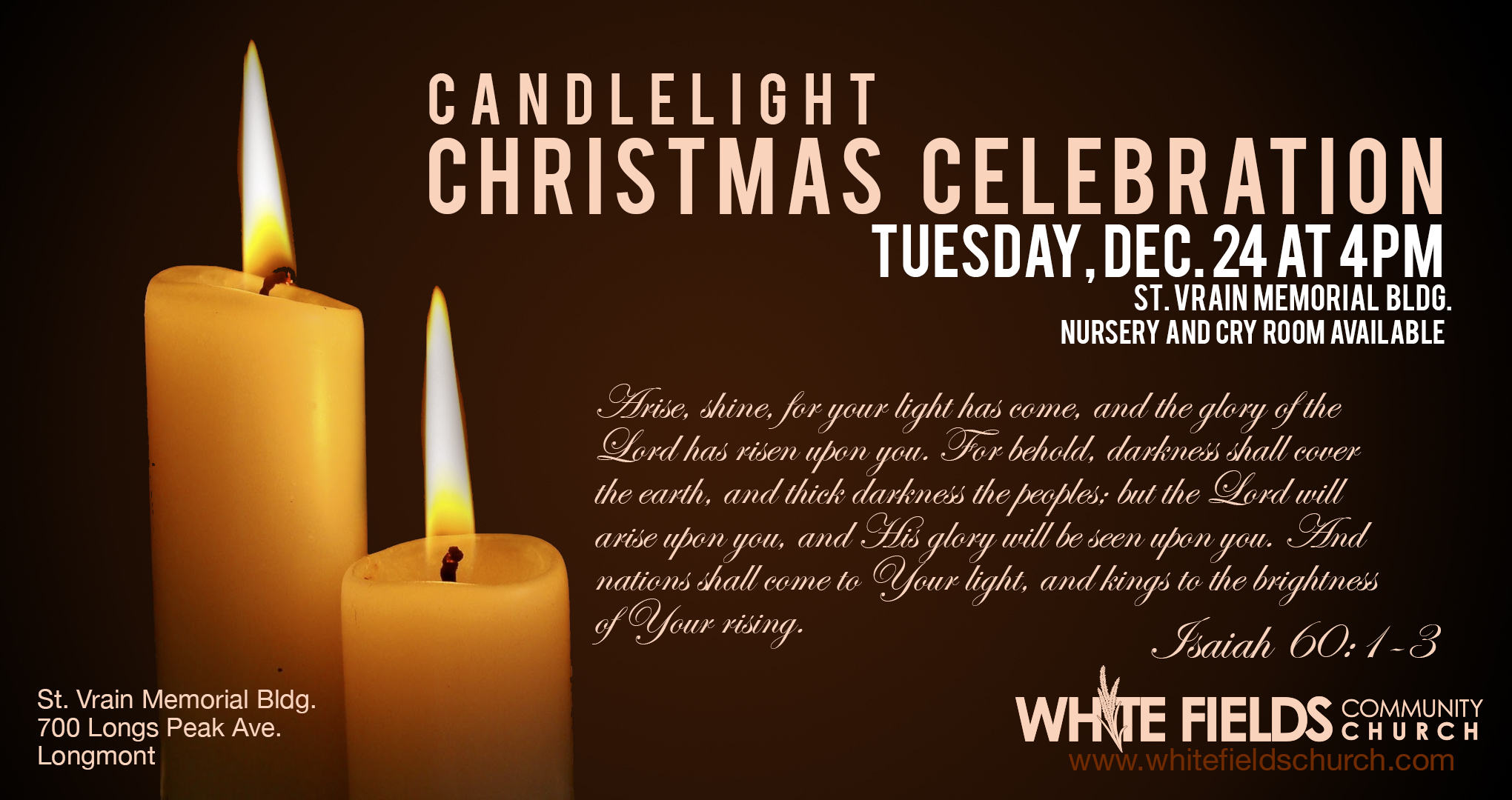
If you live near Longmont, then I’d like to invite you to join us on Christmas Eve for our Candlelight Christmas Celebration.

We will have a special band leading us in Christmas carols and worship, as well as a children’s choir and “glad tidings of great joy for all people”.

Hope you will join us!

‘Tis the Season… – How to love people struggling with depression

I’ve heard that Colorado has one of the lowest rates of depression in the US, partly because of all the sunshine we get. Perhaps it also has to do with lack of oxygen at this elevation. However, I have interacted with a good number of people who struggle with depression here in Colorado – and if rates of depression here are lower than average, it’s hard to think how bad they must be in other places.

It’s Christmastime – a time when people who struggle with depression struggle even more than usual. Shorter days, pressure and expectations surrounding the holidays, bad memories, etc. help turn up the volume on depression.

I read this blog post last night titled: 6 ways to love a depressed person. I found some of it helpful. Check it out and feel free to share your thoughts in the comments:


1. Keep the pin in the shame grenade.

Depressed people feel tremendous amounts of shame. The voice they hear most often in their head is like the anti-Robin Williams in Good Will Hunting: “It’s your fault. It’s your fault. It’s your fault.” The problem is not that they don’t know what they should do. The problem is finding the strength to do it. They’re carrying a heavy load. Don’t be the kind of friend who adds to it. Be the kind of friend who helps lighten it. Don’t patronize, empathize. In the words of Brene Brown, “Shame cannot survive empathy.” 

2. Don’t be simplistic.

Depression is like a bruise. Sometimes you know how it got there, and sometimes you genuinely don’t. What makes it hard is that it’s “like a bruise in your mind” (Jeffrey Eugenides, Marriage Plot). Nothing is worse than treating it simplistically. It’s not always as simple as “Take medicine,” or “Go see a counselor,” or “Repent” (usually all three will be part of the healing process). To make one of those the “end all be all” is extremely unhelpful. Help them simplify things, yes. But don’t be simplistic. 

3. Take the physical as seriously as the spiritual.

Don’t give a depressed friend a book. Give them a steak instead. Preferably an expensive one. And pair it with a loaded baked potato, a bottle of merlot, and if you want to get really spiritual, a whole pan of Sister Schubert rolls. That’s what God did for Elijah when he was depressed to the point of wanting life to be over. He didn’t give him a lecture, or even a devotional. He gave him a meal and then let him sleep (1 Kings 19:4-7). He didn’t Jesus juke him. He took the physical as seriously as the spiritual. Because sometimes the most spiritual thing you can do is take a nap (or a walk, or a meal). 

4. Embrace awkward silence.

If depressed people could take a book title for a life motto it would be More Baths, Less Talking (Nick Hornby). If they’re really depressed, the last thing they want to do is talk about why they’re really depressed. Don’t take this as a sign that they don’t want you around. They desperately do. They just want you to embrace the awkward silence with them. It shows them that sometimes it’s ok to sit in silence because life is hard and we don’t have all the answers. 

5. Help them take themselves less seriously.

One of the best things you can do for a depressed person is to help them take themselves less seriously. Sometimes when Martin Luther would get depressed to the point of spending entire days in bed, his wife Katharine would dress herself in all black and put on a veil. And when he asked her whose funeral she was going to she would say, “God’s, because the way you’re acting so hopeless he must be dead.” She had a great sense of humor. Humor is actually a vital part of dealing with depression, because if you listen closely enough to laughter you can hear the echoes of hope. Which is why an incredibly wise pastor once told a struggling friend the most important thing he could do for his depression was to watch an episode of Seinfeld with friends every night before bed. “Angels can fly because they take themselves lightly” (GK Chesterton). 

6. Give them grace by giving them space.

Depressed people need the space to be alone, yet the security that you’re not going anywhere. Don’t get all up in their grill. Be content to hang out on their back porch while they’re inside on the couch watching their seventh episode of New Girl in a row. They need the space of you leaving them alone, with the grace of knowing you’ll never leave them. It’s the Lord saying he won’t “break the bruised reed, or quench the smoking flax” (Isaiah 42:3) Even though our depression is hard, he’ll be gentle. Even though our depression may never go away, he promises he’s not going anywhere.

Project Greatest Gift – A Longmont Initiative to Help Children in Foster Care

One of the great outreaches we do here at White Fields church in Longmont is a home-grown initiative called Project Greatest Gift, which is our ministry at Christmastime to children in foster care.

Project Greatest Gift has been a tradition at White Fields since the beginning of our church, but in the past it was limited in the number of families we were able bless. After looking at ways to broaden its impact on the community and considering alternative programs such as Operation Christmas Child, we decided to attempt to bless the “orphans” of Northern Colorado. Since no orphanages existed in this area, God led us to reach out to local foster families. A couple in the church was heavily involved in the foster system and they offered to make contacts within that system to find families in need. Beginning in 2009, as a result of God’s provision and their efforts, we were able to begin blessing the foster families in Weld and Adams counties through the generous gifts of the congregation at White Fields.  Over the years, we have continued to see God’s great provision for us so we are able to continue to share His abundance with others.

In past years, our church family has provided gifts for around 40 to 60 kids. This year we have had a great outpouring of generosity, and people from our congregation have signed up to provide gifts for 90 children in Adams and Weld counties!

For those of you unfamiliar with the purpose of foster care, it is safe homes, loving caregivers and other family members who take in and provide for children whose living situation is unsafe.  Unfortunately, through no fault of their own, many children live in homes with parents addicted to drugs, who are neglectful or abusive, or who do not know how to care for children appropriately.  So foster homes are critical to meet the needs of these children while birth parents work to recover and learn to parent.  Sometimes, foster homes are also where children’s needs are met while they await a forever home through adoption.  Children in foster care experience grief and loss.  Even when their living situation was unsafe, children mourn its loss, as that is all they had ever known.  Foster parents serve not only as loving caretakers, but often also as counselors as they help the children in their care through this grief and loss.  We are so thankful that we can in some way bless these foster families too by helping provide gifts at Christmastime.

In addition to the blessing of Christmas gifts, please pray for these children that they would soon have a forever family, and more importantly, that they would come to know Jesus Christ as their savior, and God as their Heavenly Daddy.