
In response to my last post: “Have Verses Been Removed from My Bible?,” a member of White Fields Church contacted me with some further insights and a chart.
I thought this might be of interest to my readers, so check it out and feel free to share thoughts in the comments.
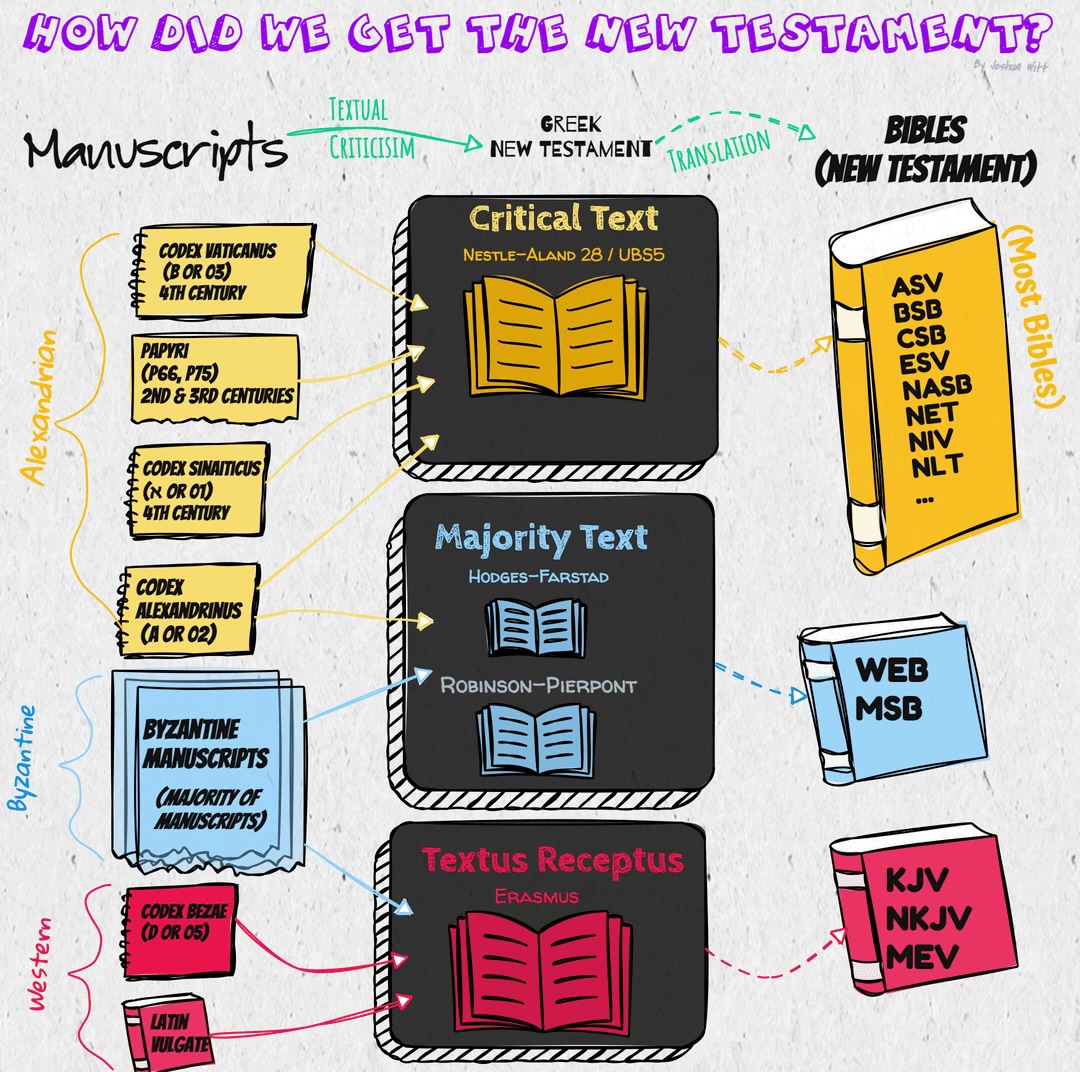
Many people may not realize that differences in verse inclusions across Bible translations often arise from the Greek New Testament edition chosen by the translators.
For instance, NIV translators didn’t “remove” verses present in the KJV; they were simply translating from different underlying manuscripts. These manuscripts have been compiled into two slightly different Greek New Testament editions.
Translation and textual criticism (determining which text is closest to the original) are related but distinct fields. Translation committees generally rely on the textual decisions made by textual critics who compile the Greek New Testaments used for translation.
Most Bible translations today are based on either the Textus Receptus (TR, or “Received Text”) or the Critical Text (CT, like the Nestle-Aland 28th Edition or United Bible Society 5th Edition). The KJV, NKJV, and MEV use the Textus Receptus, while the majority of other translations (such as the ESV, NIV, NASB, NLT, NET, and CSB) use the Critical Text.
Some translations, like the WEB and MSB, use a third option, the Majority Text (MT), which is less commonly known. Bible translations also vary in the number of textual footnotes they provide. For example, the NASB often includes fewer footnotes, while the NKJV has more than average, and the CSB, BSB, and WEB offer extensive notes (they’re the only translations I’ve seen with a note on the variant in Matthew 6:1).
A great resource for studying textual differences is the Text-Critical English New Testament: Byzantine Text Version, which shows the percentage of manuscripts supporting each reading. Sunday’s example was fascinating: most modern translations omit Matthew 17:21 (“But this kind does not go out except by prayer and fasting”) based on the Critical Text. However, a significant majority (87.7%) of Greek manuscripts do include this verse, whereas only a small fraction (0.6%) omit it.
While simply counting manuscripts isn’t necessarily the best way to determine authenticity, referring to 87.7% as merely “some” rather than “many” or “most” seems misleading.
It’s also unfortunate that the Majority Text and its close counterpart, the Byzantine Text, are so rarely discussed. God has blessed us with a rich manuscript tradition, and I think it’s important to consider the majority of these texts as part of faithfully stewarding this blessing.
Finally, I want to emphasize that I view all major modern evangelical translations as wonderful, reliable gifts from God. I use and recommend them all.
 Theology for the People
Nick,
Thanks for taking the time to give us the info and your thoughts! I’ve looked into it from time to time.
I suppose with the discovery of those Alexandrian manuscripts coming later, Bible translations, like the NASB and ESV, that came along after 1900 decided that it was best to use them because they were older combined with what I will say next:
The Textus Receptus that Erasmus gave us that the King James used generally has more Scripture text than the older Alexandrian manuscripts…there are more sentences/words than the Alexandrian (and in some cases vice versa, but that’s more seldom). We may then take the guess that over zealous scribes added to the King James manuscripts more of the time, making it likely that Greek Bible scholar Kenneth Wuest isn’t right when he says the King James is closest to the original writings (autographs). I find if the Textus Receptus manuscripts were more like the original, that its more unlikely that those who wrote the Alexandrian manuscripts would omit so much Scripture, Scripture that did not have doctrinal differences. A better guess seems to be scribes added text and given that the less worded Alexandrian manuscripts are older helps that case. Nonetheless, its likely that all 5,800 or so Greek New Testament manuscripts we have were inspired by Jesus (God) whether a scribe wrote it or an apostle wrote it.
Maybe you’ve already touched on this in previous communication. Feel free to correct or touch on what I said.
Blessings,
Ryan in Parker, Colorado
Yeah, I agree with that. Many variants in the Gospels are harmonizations, i.e. additions of details contained in other gospels – which would seem to point to later, well intentioned additions by scribes.
Thanks for your reply. Much appreciated.