
Book Review: Does the Bible Support Same-Sex Marriage?

A few weeks ago, I was sitting in the car with my kids on a family trip, and my teenage daughter asked me, “Dad, why is it wrong to be gay?”

I responded that, first we needed to discuss what she meant by “gay”; did she mean: “Is it a sin to feel attraction to people of the same sex?” or did she mean, “Is it a sin to perform sexual activities with people of the same sex?” – because those are two very different questions, which have two different responses from the Bible.

She clarified by saying, “Well, why is it wrong for two people of the same sex to be in love?”

I responded, “The Bible encourages people of the same sex to love each other. We are all called to love everyone God puts in our path, but that certainly doesn’t mean that we are to have sex with everyone God puts in our path.” “For example, the Bible says that David loved Jonathan more than he loved any woman. But that doesn’t mean that they performed sexual acts together; rather that they had a close and intimate friendship. In other words, when we reduce ‘love’ down to sex, we are cheapening it. Further, the Bible’s vision is for people of the same sex to have meaningful, loving friendships, but that’s different than having sex with someone.”

She clarified once again, “Why is it that people of the same sex can’t have romantic relationships?”

I responded, “What do you mean by romantic? Are you talking about an exclusive relationship which is characterized by touching of a sexual nature?”

At this point, she said, “Okay, I get it,” and we changed the subject.

I tell this story to illustrate why Preston Sprinkle’s latest book, Does the Bible Support Same-Sex Marriage?: 21 Conversations from a Historically Christian View, is so needed right now.

My daughter did not ask these questions from a heart of rebellion against God, but out of genuine curiosity and interest, and because she has sincere questions. Certainly the questions she asked were shaped by the cultural influences she faces at school and in the world in general. You can imagine people asking her these questions, and her wondering how to respond. As a father, I’m glad she asked me, and gave me the chance to help her understand.
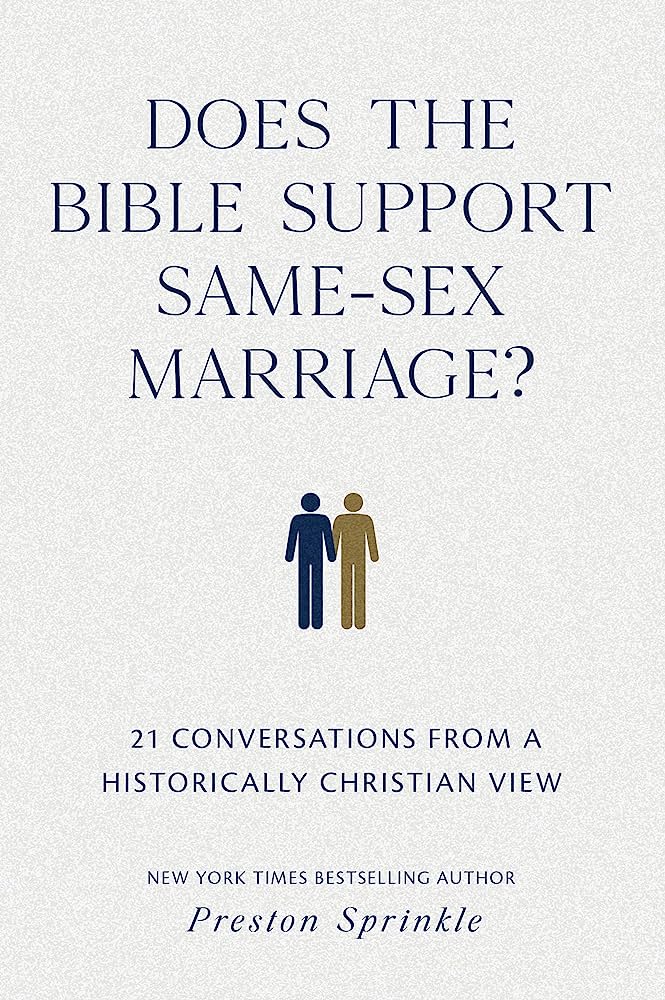
I received an advance copy of this book to read and review a few months ago. The book was released to the public on August 1, 2023 and is now available wherever books are sold.

The book begins with two chapters which give “Foundations,” or principles which need to be clarified up front. The first is about how to have a fruitful conversation about these topics which are highly charged when it comes to emotions and politics, in the world today. The second foundation is an explanation of the historically Christian view of marriage. This chapter is helpful, in that it looks at how Christians have viewed and understood marriage for the past 2000 years, and why. It looks at the Bible and the writings of church fathers, and more.

Then, the book goes into a response to 21 common questions or claims, which people use as justification for why same-sex marriage should be affirmed by Christians. Preston then responds to these in brief but content-rich chapters. He does so with tact and empathy, which I appreciated very much. He also shares data, statistics, history, facts, and quotes to support his responses.

Overall, the recurring theme of his answers is that sex difference is part of God’s design for marriage and that both same-sex sexual activity as well as all sex outside of marriage is considered “sexual immorality” (porneia in Greek) in the Bible.

For me, the most helpful chapters were Conversations 12-14, which addresses the claims that:

  • Jesus’ Sabbath Hermeneutic Informs How We Should Interpret Same-Sex Prohibitions
  • God’s Acceptance of Gentiles Mirrors How We Should Accept LGB People
  • The Trajectory of Women and Slavery Justifies Same-Sex Prohibitions

There are other chapters which are more “ground-level,” which address questions and claims which may be more common, such as:

  • Love is Love
  • Some People are Born Gay, So It Must Be Okay
  • Paul Was Not Talking about Consensual Same-Sex Relationships
  • The Word Homosexual Was Added to the Bible in 1946

In each chapter, Preston begins by giving a summary of the claim or viewpoint of those who argue for that particular position, then he follows it by sharing a few points of agreement, and finally gives a response.

In the end, Preston’s answer to the question posed in the title of the book is: No, the Bible does not support same-sex marriage. Yet he gives this answer in a thoughtful and helpful manner, which shows respect for his readers and those whose claims he seeks to refute. Finally, he urges the church to truly live out a biblical vision of being a community where the same-sex attracted can find acceptance, love, and care, so that they have a loving community to support them in faithfully following Jesus, including God’s instructions about sexual ethics.

I recommend this book as a helpful resource on this very relevant issue. It would be better if more Christians were well equipped to answer the questions people are asking about same-sex issues, with love and truth.

The Gospel Comes With a House Key: Hospitality & the Gospel

person handing keys

Home as a Hospital & Incubator

As a member of the lesbian community in Syracuse, New York, Rosaria Butterfield learned what it meant to use her home as a hospital and an incubator, which reflected her values to others. Members of the lesbian community in Syracuse made sure that everyone in their community had keys to each others houses; they looked out for one another and cared for each other. They viewed their homes as oases in a harsh world, and yet they sought to win over their neighbors by being the best neighbors on the block.

These lessons—learned far outside the walls of the church—are instructive for Christians, she says.

It was through the hospitality of a Christian couple in her neighborhood, that Rosaria changed her mind about Christianity. At the time, she was a celebrated professor at Syracuse University. Raised in an atheist home, Rosaria had always assumed Christians to be hateful, judgmental people, who considered people like her enemies. In fact, her interest in spending time with Christians came as a result of her intent to write a book about how Christianity fuels toxic masculinity. As a result, she sought out a Christian couple in her neighborhood, but her interactions with them surprised her and challenged her preconceived notions about Christians, so much so that she began to consider what they had to say about Jesus and the Bible. Ultimately, she embraced the gospel and forsook her lesbian lifestyle. She is now married to a pastor and they have adopted several children. They seek to use their home as a hospital and an incubator for the goal of making disciples of Jesus.

Ground Zero of the Christian Life

In her book, The Gospel Comes with a House KeyRosaria Butterfield describes what she calls “radically ordinary hospitality”, which she argues is “ground zero of the Christian life.”

Rosaria makes a convincing argument for this, pointing to passages like Matthew 25:35–36, in which Jesus talks about hospitality as the litmus test for real faith on judgment day. She also points out Mark 10:28–31, in which Jesus talks about how those who receive the gospel may very well lose a lot in the process of conversion, in order to gain the promises of God’s Kingdom, but that along with eternal life they can also expect to receive a new community. Inclusion in this new community, characterized by radical ordinary hospitality, is what Rosaria equates with receiving a “house key” when one receives the gospel.

Because Christian conversion always comes in exchange for the life you once loved, not in addition to it, people have much to lose in coming to Christ—and some people have more to lose than others.

A Resource for Evangelism

Hospitality, Rosaria explains, is an often under-utilized resource for evangelism as well. Those who live out radically ordinary hospitality, she says, see their homes not as theirs at all but as God’s gift to use for the furtherance of his kingdom.

The purpose of radically ordinary hospitality is to take the hand of a stranger and put it in the hand of the Savior, to bridge hostile worlds, and to add to the family of God.

She goes on to tell stories of how she and her husband intentionally live below their means, so they will be available and able to use their means to help others on a whim, as needs arise.

God promises to put the lonely in families (Ps. 68:6), and he intends to use your house as living proof.

A Sign to the World

Rosaria describes “radically ordinary hospitality” as: “using your Christian home in a daily way that seeks to make strangers neighbors, and neighbors family of God. It brings glory to God, serves others, and lives out the gospel in word and deed.”

Radically ordinary hospitality shows this skeptical, post-Christian world what authentic Christianity looks like.

Love and/or Approval?

She points out how important it is to reflect Jesus in our relationships. Jesus wasn’t embarrassed to relate to people who were different than him. He understood the difference between love and approval.

She mentions that Christians often ask her, “How can I love my neighbor without misleading them into thinking I approve of what they do?” She advises that we first remember that no one approves of everything that others do. Parents, for example, love their children even at times when they hate the things their children are doing.

Rosaria responds to a question people sometimes ask: “If my neighbors who identify as _________ are in sin, then why are they the nicest people on the block?” To this she responds: “If our Christian worldview cannot account for that, it can survive only in the echo chamber of imaginary theology.” To answer this question, we must understand a few very basic theological principles: 1) all people are recipients of “common grace” to varying degrees, and 2) our problem as human beings is not a lack of “niceness” but a debt of sin before a just and holy God. To put it in simple terms: “Nice people” need Jesus just as much as “not nice people”, because only through Jesus can anyone be redeemed.

Conclusion

Rosaria encourages Christians to be courageously loving rather than fearfully cautious. I was challenged, encouraged, and inspired by The Gospel Comes with a House Key, and I recommend you check it out.